SEO textbooks are the slow food of the search industry. Blog posts and quick guides give you a sugar rush a tactic that worked yesterday, a hack to try right now. Textbooks give you the actual mechanics of search. The distinction matters because while tactical SEO advice expires fast, the foundational stuff how people look for information, how search engines retrieve it, how content strategy actually functions evolves slowly. A solid SEO textbook published in 2024 will probably still be 70-80% relevant in 2026. A tactics-focused blog post from the same period? Likely useless within months.
Why I still reach for SEO textbooks in 2026
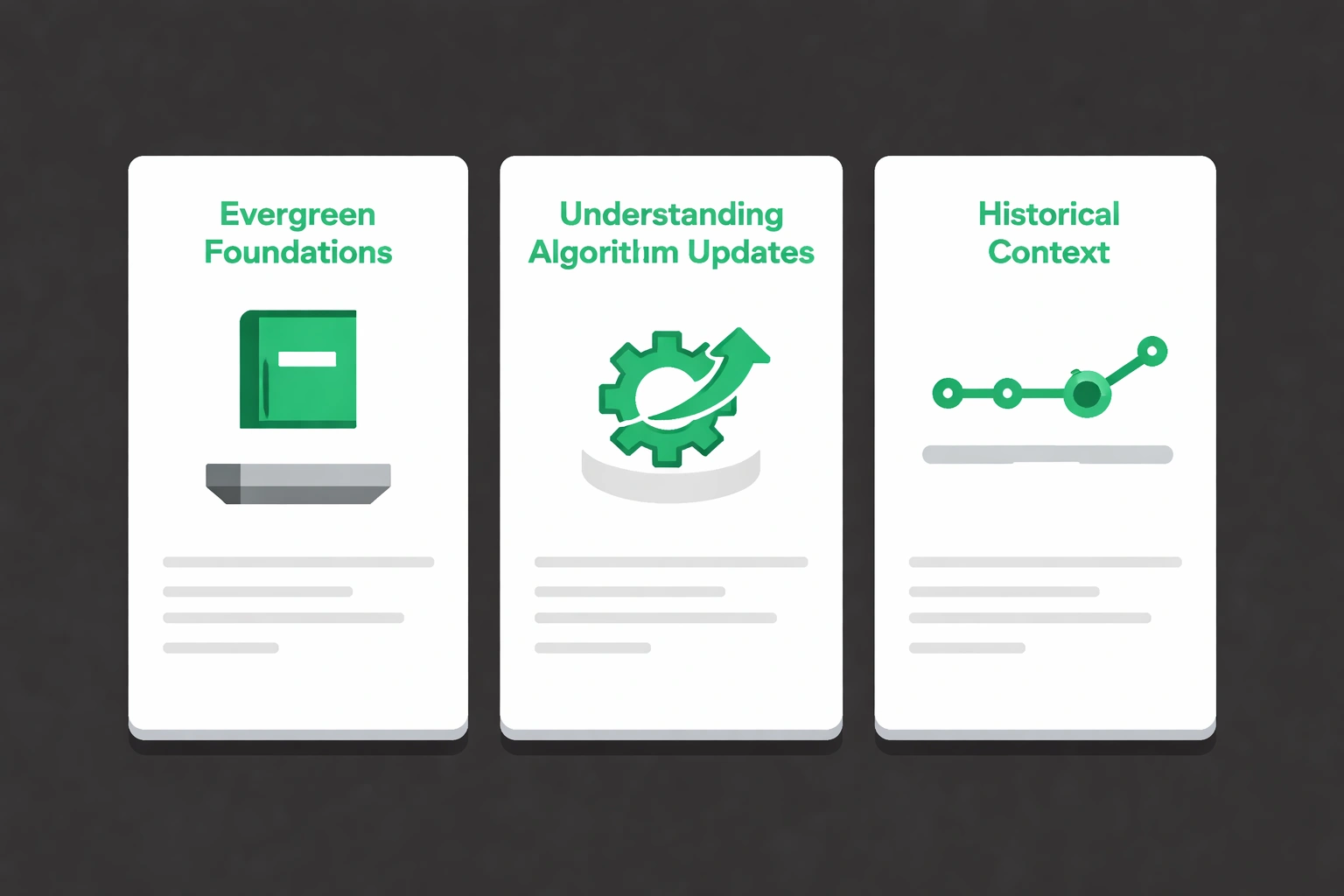
It feels counterintuitive to read a static book in an industry that panics every time Google sneezes. But textbooks ground you in the stuff that doesn't change. Information architecture, semantic relevance, user intent modeling these frameworks outlast specific ranking factors. When Google pushes a core update or ChatGPT changes how it cites sources, textbook knowledge helps you figure out why the shift happened and what to actually do about it, rather than just refreshing Twitter for hot takes.
The best books also give you a sense of SEO history. Understanding why keyword stuffing worked in 2005, why exact-match domains ruled 2010, and why mobile-first indexing hit in 2018 gives you pattern recognition. You start seeing the arc of search evolution instead of just isolated, stressful snapshots.
There's also something to be said for linear learning. Blog posts scatter knowledge across disconnected topics. A textbook walks you from crawling fundamentals through technical implementation to strategic planning in a logical sequence. If you're onboarding new SEO specialists, this structured approach gets them competent much faster than throwing a curated reading list at them and hoping for the best.
What actually belongs in an SEO textbook
Every good textbook starts with the plumbing: how crawlers discover content, how indexing systems categorize it, and how ranking algorithms evaluate relevance. Understanding these mechanisms makes you way better at troubleshooting indexing issues or optimizing content for AI search engines when the usual tricks don't work.
Keyword research methodologies should get serious page count. Not just "here are some tools," but frameworks for understanding search intent, query categorization, and semantic relationships. Good textbooks explain how to map keywords to buyer journeys, segment by commercial value, and find content gaps. That theoretical grounding makes you effective regardless of what tool you're using whether it's LeafPad's keyword research features or a messy manual spreadsheet.
On-page optimization is another big one. Semantic HTML structure, content hierarchy, internal linking, metadata. The best textbooks don't just tell you to do these things; they explain why they matter from both a user experience and an algorithmic perspective. They also connect on-page work to broader SEO automation strategies so you can scale optimization across hundreds of pages without losing your mind.
Technical SEO chapters age incredibly well because core web technologies change much slower than ranking factors. A 2023 textbook's guidance on robots.txt or structured data markup is still accurate in 2026. This stability makes textbooks a reliable crutch for technical SEO implementation.
Link building and authority development should get dedicated space, too. Quality textbooks separate manipulative spam from sustainable relationship-building. They explain PageRank theory, topical authority modeling, and domain trust signals. This helps you evaluate link opportunities and understand how automatic internal linking systems supplement external authority building.
And of course, analytics and measurement. Defining success metrics, interpreting data, connecting SEO activity to actual business outcomes. Attribution modeling, conversion tracking, reporting frameworks. If you can't measure it, you're just guessing.
Textbooks vs. the SEO blogosphere
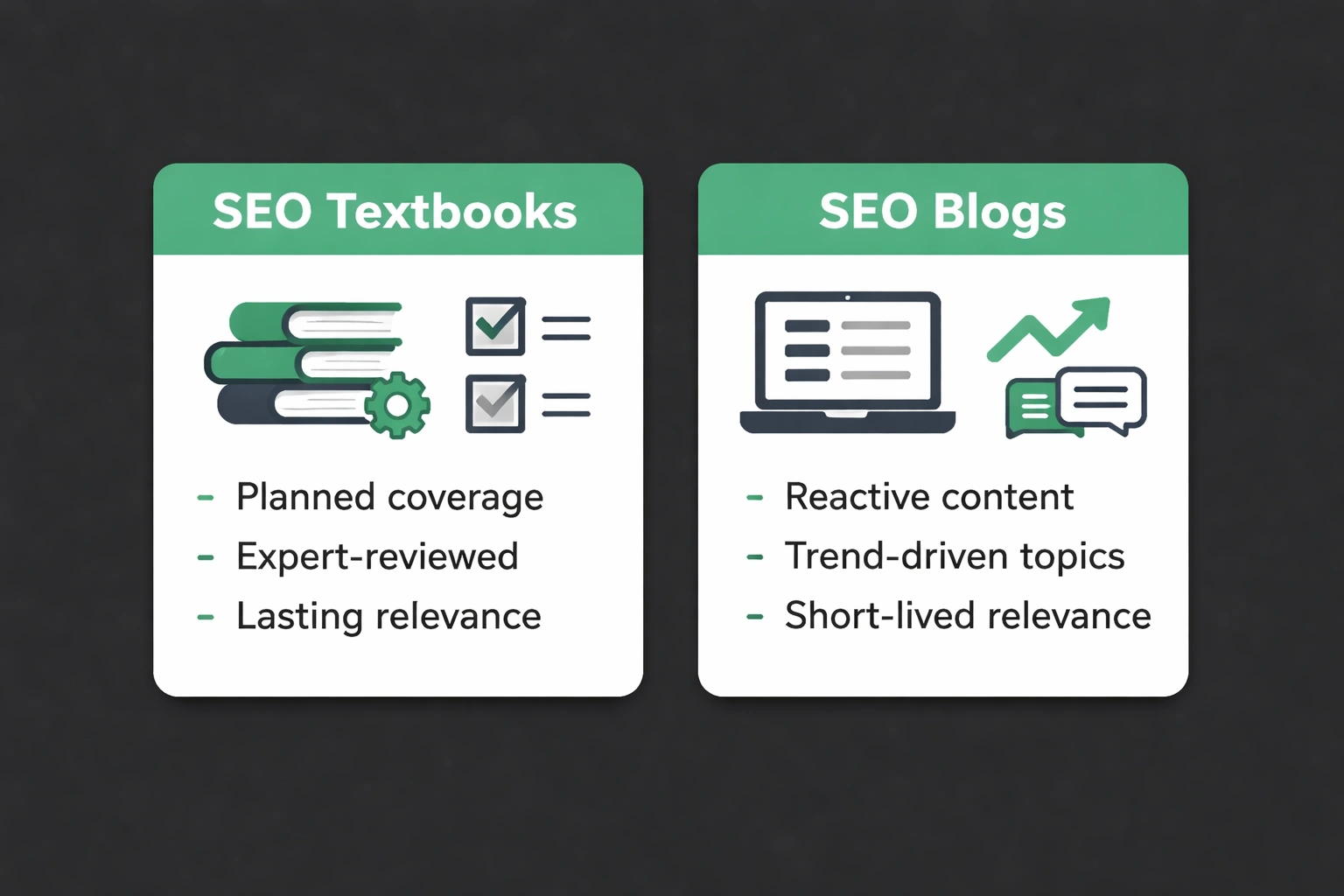
Blog archives are inherently reactive. Even comprehensive SEO blogs like LeafPad's cover topics based on what's trending or what questions people are asking right now. Textbooks plan coverage from the start, so no foundational topic gets skipped just because it wasn't trendy that month.
The editorial process is different, too. Publishers invest in technical reviewers and fact-checkers who validate every claim. When you reference textbook guidance for content optimization strategies, you're citing something that's been kicked around by experts, not just an individual's hot take published under a daily quota.
Textbooks also maintain consistent terminology. Blog archives written by multiple authors over several years often use conflicting definitions. A single-author textbook stays conceptually coherent. You don't waste mental energy trying to reconcile three different explanations of the same concept.
There's also the permanence factor. Authors know their work will sit on shelves for years, so they verify sources and hedge speculative statements appropriately. Blog posts under daily content quotas sometimes sacrifice accuracy for speed. That matters when you're building foundational knowledge.
The books I actually recommend
"The Art of SEO" by Enge, Spencer, and Stricchiola. Still the most comprehensive reference in the field. Now in its fourth edition, it covers everything from technical fundamentals to strategic planning across 900+ pages. It's a doorstopper. I keep it on my desk more than I read it cover-to-cover, using it as a reference manual when I run into unfamiliar edge cases.
"SEO 2024" by Adam Clarke. Clarke takes a more tactical approach but keeps the theoretical grounding. He updates this title annually, balancing timeless principles with current best practices. The 2024 edition remains relevant in 2026 and includes case studies showing how programmatic SEO strategies scale organic visibility for growing companies.
"SEO Fitness Workbook" by Jason McDonald. This is for practitioners who learn by doing. Rather than pure theory, McDonald provides worksheets and implementation checklists. It forces you to apply concepts immediately, which is useful if reading about SEO makes your eyes glaze over.
"Technical SEO: The Coding & Infrastructure Guide" by Dan Taylor. For technical specialists who aren't afraid of code. Taylor assumes programming literacy and dives deep into rendering optimization, structured data implementation, and crawl budget management. It pairs well with platforms like LeafPad that automate technical SEO elements while still explaining what's happening under the hood.
"Everybody Writes" by Ann Handley. Not strictly an SEO textbook, but it belongs on every content marketer's shelf. Handley teaches clear writing principles that improve user engagement the ultimate ranking signal. Her frameworks help you create content that satisfies both AI search requirements and human readers.
How to actually use these books
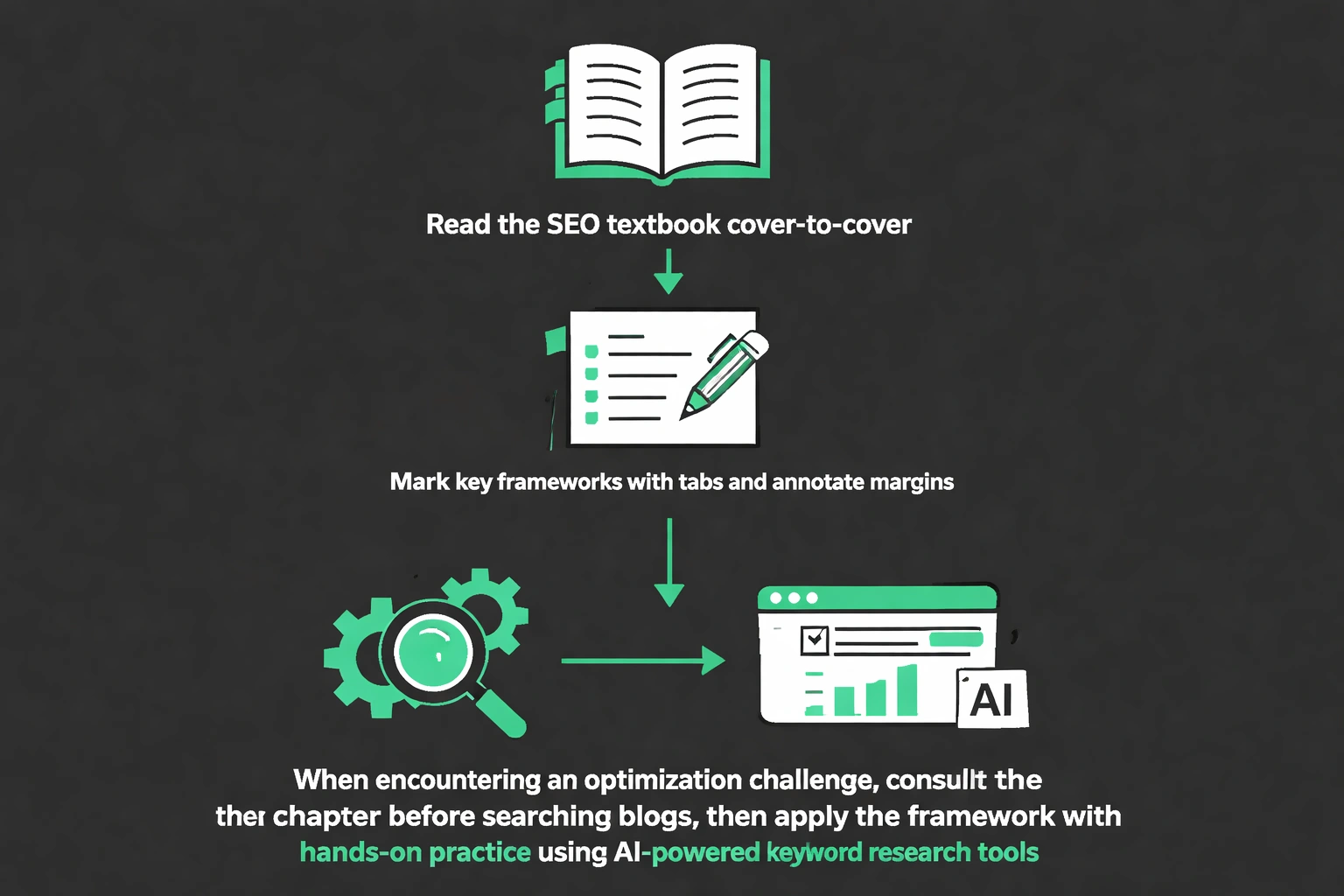
Treat textbooks as reference materials, not novels. Once you've done your initial cover-to-cover read, mark key frameworks with tabs. Annotate the margins with notes connecting concepts to your specific projects. When you hit an unfamiliar optimization challenge, consult the relevant chapter before searching for blog posts. It builds systematic thinking instead of reactive panic.
Combine reading with hands-on practice. After reading about keyword research methodology, immediately apply those frameworks using LeafPad's AI-powered keyword research features. After studying internal linking strategy, audit your site's link topology using automated analysis tools. This application loop converts abstract knowledge into practical skill.
Form study groups if you can. Discussing concepts with peers reveals blind spots. Online communities and local SEO meetups often organize textbook study groups, and you'll internalize concepts much more effectively than reading alone at 2 AM.
Revisit foundational chapters annually. SEO principles don't change, but your understanding deepens with experience. A passage about search intent that seemed obvious as a beginner will hit very differently after you've executed 50 content campaigns.
Mixing textbook knowledge with modern SEO automation
Knowing the theory makes you a better automation strategist. When you understand why internal linking matters from textbook study, you can better evaluate whether LeafPad's automatic internal linking system is actually implementing best practices or just making a mess. Foundational knowledge helps you ask better questions during tool selection.
Understanding search engine theory also helps you predict which automation approaches will survive. If you know how semantic search works, you recognize that AI content automation must focus on topical relevance rather than keyword density. This prevents wasted effort on outdated tactics.
Textbooks help you spot gaps in your automated workflows, too. If your textbook emphasizes passage-level optimization but your current tools don't address it, you know where to invest next. That strategic awareness comes from comprehensive education, not tactical tool knowledge. It positions you to adopt emerging capabilities like AI citation tracking before competitors even realize they need it.
The best practitioners I know combine textbook principles with modern automation. They use tools like LeafPad to publish content faster while ensuring the output aligns with foundational SEO principles. They automate the repetitive stuff but apply human judgment to strategic decisions.
Building your SEO library
Start with one comprehensive textbook covering all major SEO domains. Read it cover-to-cover before adding specialized texts. This prevents knowledge gaps and helps you see how different SEO elements interact. "The Art of SEO" works well as this cornerstone.
Add specialized books as you develop expertise in specific areas. If you focus on local SEO, get books covering Google Business Profile optimization and local ranking factors. If you work with massive e-commerce sites, add books addressing category page optimization and product feed management.
Include one book annually that challenges your assumptions. If you've focused purely on technical SEO, read a content marketing text. If you've avoided technical topics, study a coding-focused SEO book. This prevents you from getting too comfortable.
Maintain digital access to key textbooks, even if you prefer physical reading. When working remotely, digital versions let you reference specific frameworks quickly. Platforms like O'Reilly Learning provide institutional access to hundreds of technical books, including SEO titles, which is often cheaper than buying them all outright.
Complement textbooks with curated blog subscriptions for tactical updates. Follow authoritative sources like LeafPad's blog for current SEO trends and automation strategies. You'll understand both why strategies work and what's working right now.
What's next for SEO education
Interactive learning platforms are starting to combine textbook structure with hands-on practice environments. These let students execute SEO tasks in sandboxed environments, seeing immediate results without risking production sites. They're great for practical skill development, but they haven't replaced comprehensive textbooks for teaching foundational theory yet.
Video courses and certification programs supplement textbook learning well. Visual learners often grasp technical concepts faster through screencasts showing implementation details. However, video lacks the random-access benefits of textbooks. You can't easily scan a video for specific information the way you flip through a book's index.
AI-powered learning assistants may eventually personalize SEO education pathways. Imagine an AI that identifies your knowledge gaps through assessment, then curates reading from textbooks, blogs, and case studies addressing those specific needs. The technology isn't mature in 2026, but early experiments look promising.
Despite technological advances, traditional textbooks retain unique advantages: no login required, no subscription expiration, no platform dependencies. The physical textbook on your desk works regardless of internet connectivity or corporate access policies. Until that changes, textbooks aren't going anywhere.
If you're serious about SEO, build a reference library. Read the theory, then use modern tools like LeafPad's automated content publishing platform and current blog content covering 2026 SEO strategies to put it into practice. The theory makes the tools make sense.
Published with LeafPad