AI citation tracking measures how often large language models reference your content. In 2026, this is the only way to truly know your brand's visibility in search. Traditional SEO metrics have gone blind.
Here is the hard truth: if ChatGPT or Perplexity doesn't reference you, you are losing traffic to competitors who made themselves machine-readable. This guide covers how to track when your content appears across these platforms, and why ignoring this data is a strategic miss.
What Is AI Citation Tracking?
AI citation tracking is simply monitoring when your content shows up as a source in an LLM's response. It’s different from backlink analysis. A backlink is a vote from a human webmaster; an AI citation is a machine selecting you as the best answer.
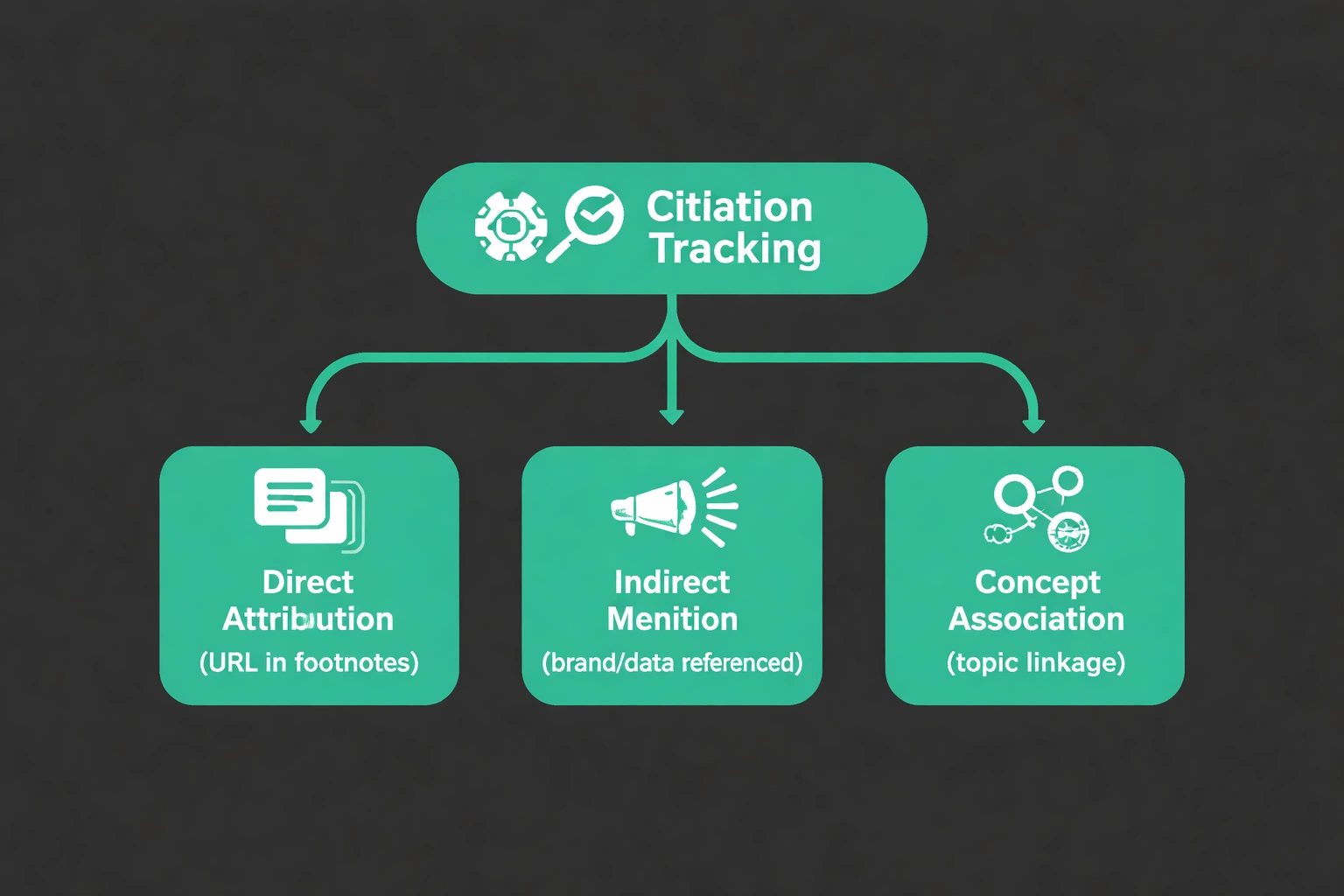
Modern tracking identifies three specific events:
Direct attribution: Your URL is in the footnotes.
Indirect mention: Your brand or data is referenced, but there's no link.
Concept association: The LLM connects your brand with specific topics, even if it doesn't explicitly cite you.
Tools like the AI Citations dashboard centralize this monitoring. You can't rely on Google Analytics for this because AI tools often synthesize data without sending any traffic. You need specific infrastructure to see the whole picture.
I view citation volume as a leading indicator. If AI systems start citing you, organic traffic usually follows. It’s not a vanity metric; it’s a preview of future rankings.
Why Traditional SEO Metrics Are Blind
Search Console tells you who clicked from Google. GA4 tells you where they came from. Neither tells you when ChatGPT cites your article to 50,000 users who never actually click a link.
This creates a massive measurement gap. Your best content might look like a flop in your dashboard because it was "stolen" by an AI overview, even though it reached more people than ever.
Citation tracking fills this gap by monitoring:
Mention frequency: How often do you appear?
Attribution quality: Are they linking to you, or just paraphrasing your work?
Topic association: Which queries trigger your citations?
Competitive displacement: Did you push a competitor out of the citation list?
A blog post with low search traffic but high AI citations is often more valuable than a high-traffic page the LLMs ignore. It’s building authority in the layer that sits between the user and the web.
The Infrastructure You Actually Need
You don't need a massive tech stack, but you do need four things working together.
Content fingerprinting. This creates unique IDs for your articles and key arguments. LLMs love to paraphrase. Fingerprinting helps you attribute a derivative output back to your original source using semantic matching, not just exact phrases.
Platform monitoring agents. These are scripts that query ChatGPT, Perplexity, and Claude daily with relevant prompts. You need to simulate real user questions to see if your brand pops up.
Attribution verification. AI detection is noisy. You need a system that confirms a mention is actually you and not a coincidence. We use timestamp correlation and manual spot-checks.
Performance dashboards. You need a view that shows trends, not just counts. The automatic SEO workflows help close the loop here.
Start With Manual Spot-Checking
Don't over-engineer this at the start. You can establish a baseline in about 20 minutes a week with zero tools.
Pick your 10 most important topics. Write 3-5 questions a user would ask about each. Go to ChatGPT, Perplexity, and Claude. Ask the questions.
Record the results in a spreadsheet. Note if you were cited, how you were cited (link or mention), and who else showed up. Do this for four weeks. You will see patterns emerge specifically, which formats the AI prefers.
I saw a SaaS company realize their "vs" pages were never cited, despite ranking well in search. It forced a hard pivot in strategy that wouldn't have happened if they only looked at GA4.
Once you scale past 20 topics, move to a tool. LeafPad's AI Citations dashboard runs these queries automatically and alerts you to shifts.
Advanced Attribution: Catching the Paraphrasers
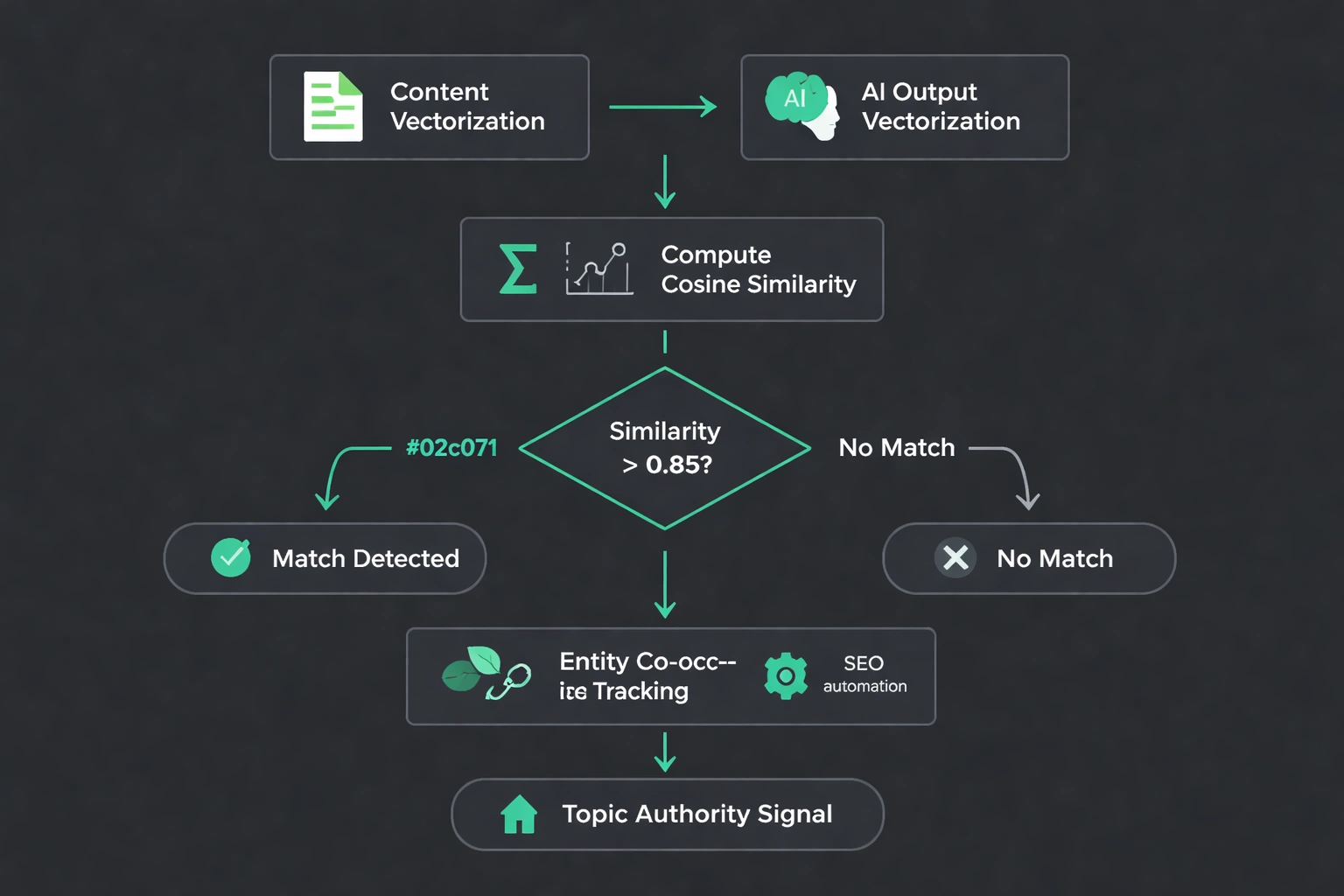
LLMs rarely copy-paste. They paraphrase. Semantic fingerprinting is how you catch them.
You vectorize your content (turn it into numbers) and store it. Then, you vectorize AI outputs. If the "distance" between your content and the AI output is small (a cosine similarity > 0.85), you have a match.
We also track entity co-occurrence. If "LeafPad" and "SEO automation" keep appearing together in responses, we are building topic authority even without a direct link. It’s a signal that usually precedes explicit citations.
The AI search visibility guide goes deeper into the math here.
Dashboards That Actually Work
A good dashboard answers five questions:
Where are we being cited?
Is volume going up or down?
Which topics are driving this?
Are we beating our competitors?
What do we write next?
Focus on citation velocity the rate of change. Plot this against when you publish. If you see a spike three days after a new post, you know that format works.
I also recommend a competitive view. If a competitor’s citation share ticks up, go read their last three articles. They likely found a new angle or format you should steal.
Integrate this with your content calendar tools so the data actually drives the schedule.
How to Write for Citations
There is no magic formula, but cited content generally shares four traits: clarity, authority, recency, and structure.
Clarity. The first 40-80 words of any section need to be a standalone answer. LLMs often just grab that chunk. Make it count. The blog architecture guide has good examples of this structure.
Authority. Credentials matter. Named experts beat "team" posts. Primary research beats aggregated stats. If you have original data, flaunt it.
Recency. LLMs seem biased toward newer content, often more so than traditional SEO. If your page is two years old, refresh it. Content refresh automation handles this if you have a large site.
Structure. Use schema markup, clear headings, and data tables. Make it easy for a machine to parse. The blog post templates for AI search are built for this.
Platform Quirks
They all behave differently.
ChatGPT: Check both standard and "research" modes. Research mode cites more often but has fewer users. Use follow-up prompts to see if your content sticks.
Perplexity: Being #1 in the citation list matters. Track your position, not just presence.
Claude: It often needs to be prompted to cite ("What sources did you use?"). It won't offer them up freely.
Vertical AI Tools: If you're in legal or medical, track the niche bots. Citation rates are way higher there (60%+) than in general tools (5-10%).
The AI search SEO guide breaks down platform-specific tactics.
Does This Actually Make Money?
Citation volume is a vanity metric until you tie it to revenue.
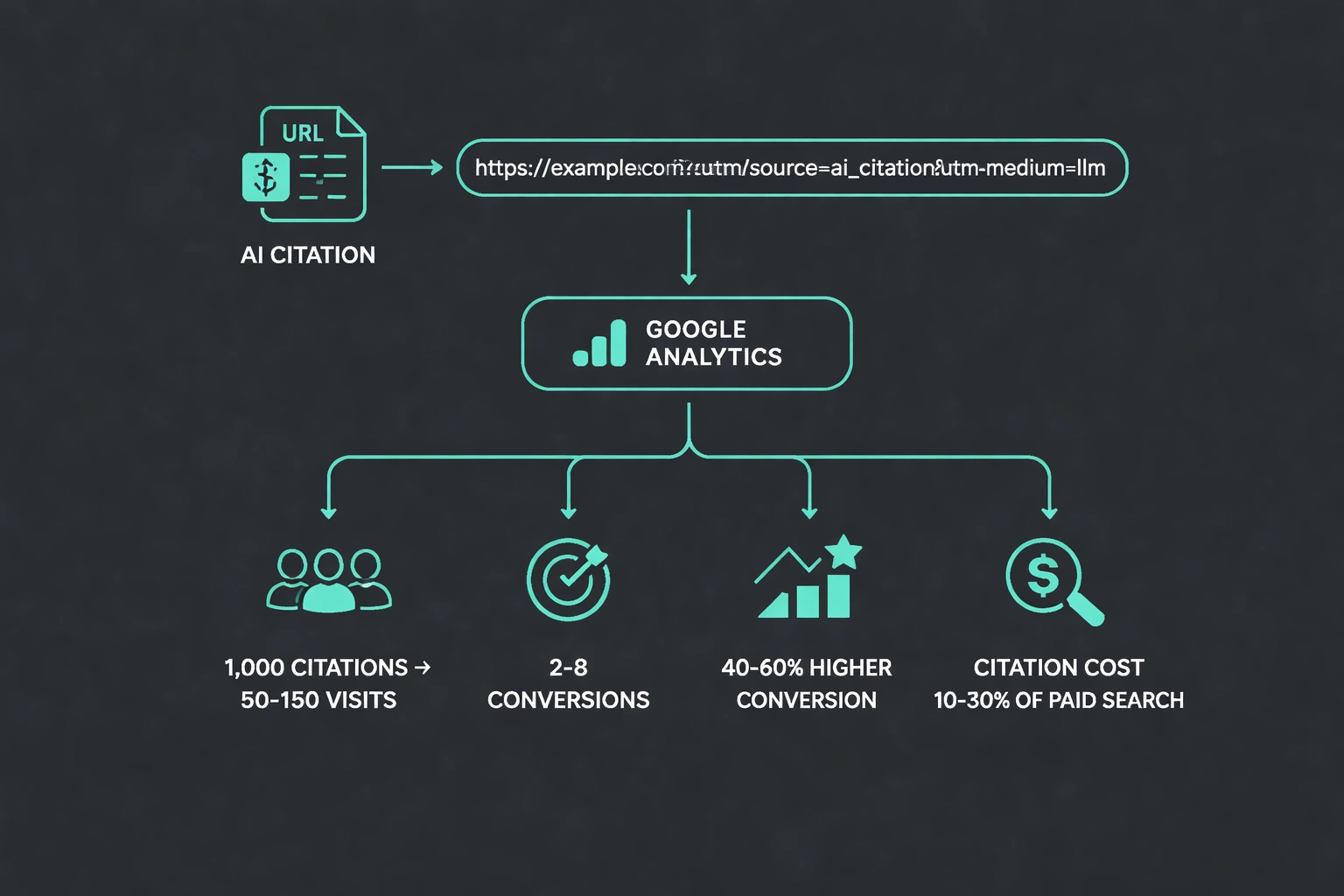
The best way is UTMs. Tag your URLs for AI specifically: utm_source=ai_citation&utm_medium=llm. When those tags show up in GA4 conversion paths, you have real ROI data.
We typically see 1,000 citations drive about 50-150 visits and 2-8 conversions. But the brand lift is the hidden variable. Users who see you in an AI answer convert 40-60% better when they eventually hit your site.
Compare your cost-per-citation to your cost-per-click. Citations are usually 10-30% of the cost of paid search.
For the C-suite, calculate "AI impression share" the % of relevant queries where you appear. Track that against your SEO rankings.
Mistakes I See Constantly
Farming citations. Don't write for the bot. If the content is garbage, the AI will eventually devalue you. Write for humans first.
Ignoring indirect mentions. If you only track links, you miss 60-80% of your impact. You need semantic tracking.
Vanity metrics. 1,000 citations from a general chatbot are worthless if you sell enterprise software. Track intent.
Ignoring competitors. If you grow 10% but the market grows 50%, you are losing. Always benchmark.
Staying manual. Once you have the baseline, automate. The automated SEO guide is essential here.
Closing the Loop
This data has to change what you do, not just what you see.
Connect tracking to your content calendar. If "AI keyword research" is getting citations, write "AI keyword clustering" next.
Run a gap analysis. Where are competitors getting cited that you aren't? That's your next post.
If a high-performing piece drops off, update it immediately. Often, just refreshing the date and examples restores citation flow.
If you're on LeafPad, the system feeds citation history back into the AI writer, so the next post is already optimized for what worked before.
What Comes Next
We are moving toward paragraph-level attribution. You'll know exactly which claim the AI lifted.
Cross-platform citation graphs are coming. You'll be able to trace how a claim moves from ChatGPT to Perplexity to a niche bot.
Real-time alerts are becoming standard. If a competitor steals your citation spot, you should know within the hour, not at the end of the month.
And yes, citation marketplaces might happen paying to be the source, essentially paid search 2.0.
Start tracking this month. Go manual for 60 days, then automate. The compound interest on AI visibility is real, and the earlier you start, the harder it is for competitors to dislodge you.
Published with LeafPad