
SEO automation isn't a buzzword. By April 2026, it's just the standard way companies scale organic traffic. If you're still manually tweaking meta descriptions at 11 PM, you've already lost.
The numbers are rough. Teams using automation publish 5-10x more optimized content. They grab long-tail keywords competitors miss. They build authority while their marketers focus on strategy instead of drudgery.
But founders often get this wrong. They think automation means "set it and forget it" or that AI ranks sites overnight. It doesn't work that way.
What SEO Automation Actually Means in 2026
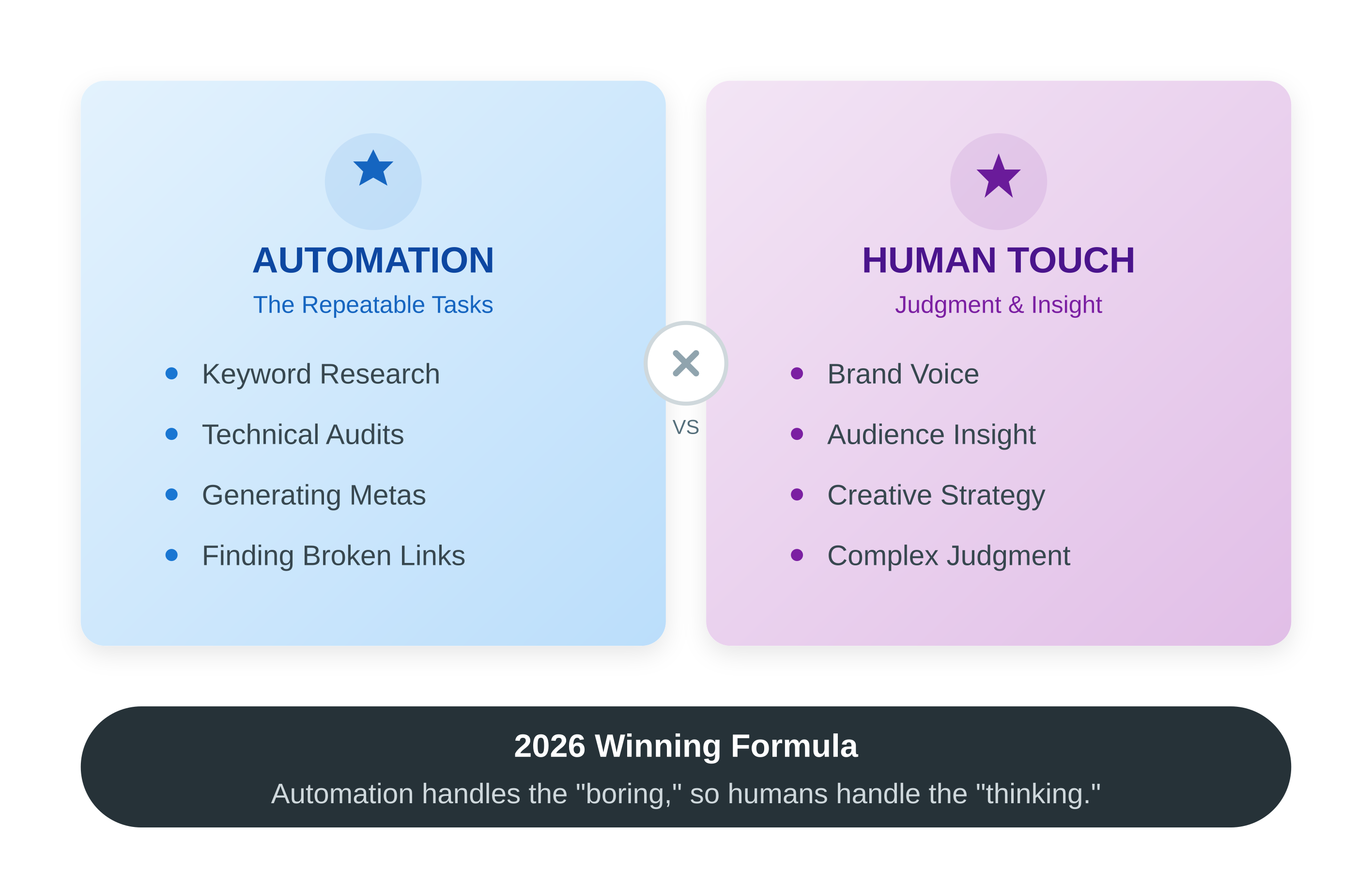
It's using software to handle repeatable tasks that used to eat human hours. Keyword research. Content optimization. Technical audits. Link building.
The keyword is "repeatable." Automation works for tasks with clear rules. Monitoring rankings. Generating meta descriptions. Finding broken links. Analyzing competitor keywords.
What it doesn't replace is judgment. Brand voice. The creative insights from actually understanding your audience. The winning companies in 2026 use automation to handle the boring stuff so people can do the thinking.
Manual SEO is washing dishes by hand after every meal. Automation is a dishwasher. The dishes get clean either way, but one approach lets you plan next week's menu while it runs.
What Actually Works
Knowing what to automate matters more than automating everything.
Content Generation and Optimization
Modern platforms draft content based on target keywords, check readability, suggest heading fixes, and find internal link opportunities.
The good ones don't just write generic text. They analyze top-ranking pages, find content gaps, and structure articles to match search intent. Some give you real-time SEO scoring as you write.
For teams publishing often, this means posts get drafted, optimized, and scheduled without manual keyword stuffing or hours spent spying on competitors.
Technical SEO Monitoring
Broken links. Slow pages. Duplicate content. Indexing errors. These kill rankings before content quality even enters the chat. Automation watches for these issues and fixes them or alerts you.
The best technical SEO tools in 2026 handle real-time indexing status, Core Web Vitals monitoring, structured data validation, and automatic sitemap submission. Some notice when a page drops from Google's index and resubmit it.
Keyword Research and Tracking
Stop building keyword lists in spreadsheets. Automated systems analyze trends, identify clusters, track ranking changes, and predict which keywords deserve attention.
The real shift is automated intent classification. Systems analyze whether a keyword is informational, commercial, or transactional and suggest content types. You stop chasing volume and start targeting keywords that convert.
Programmatic SEO
This is where scaling happens. Programmatic SEO creates hundreds or thousands of pages targeting long-tail variations. Location pages. Product variations. Category combinations.
A business might generate optimized pages for "SEO services in [City]" across hundreds of cities. Or "Best [Product] for [Use Case]" across dozens of combinations. Each page uses a template but includes unique, localized content.
Done right, this captures long-tail traffic you can't target manually. The catch: each page needs genuine value, not thin variations that annoy users.
Link Building and Outreach
Fully automated link building gets into gray-hat territory fast. But automation helps with legitimate outreach. Finding relevant sites. Personalizing emails at scale. Tracking responses. Managing relationships.
Some tools find broken links on authoritative sites and suggest your content as a replacement. Others track brand mentions without links and send polite requests for attribution.
Why Manual SEO Can't Compete
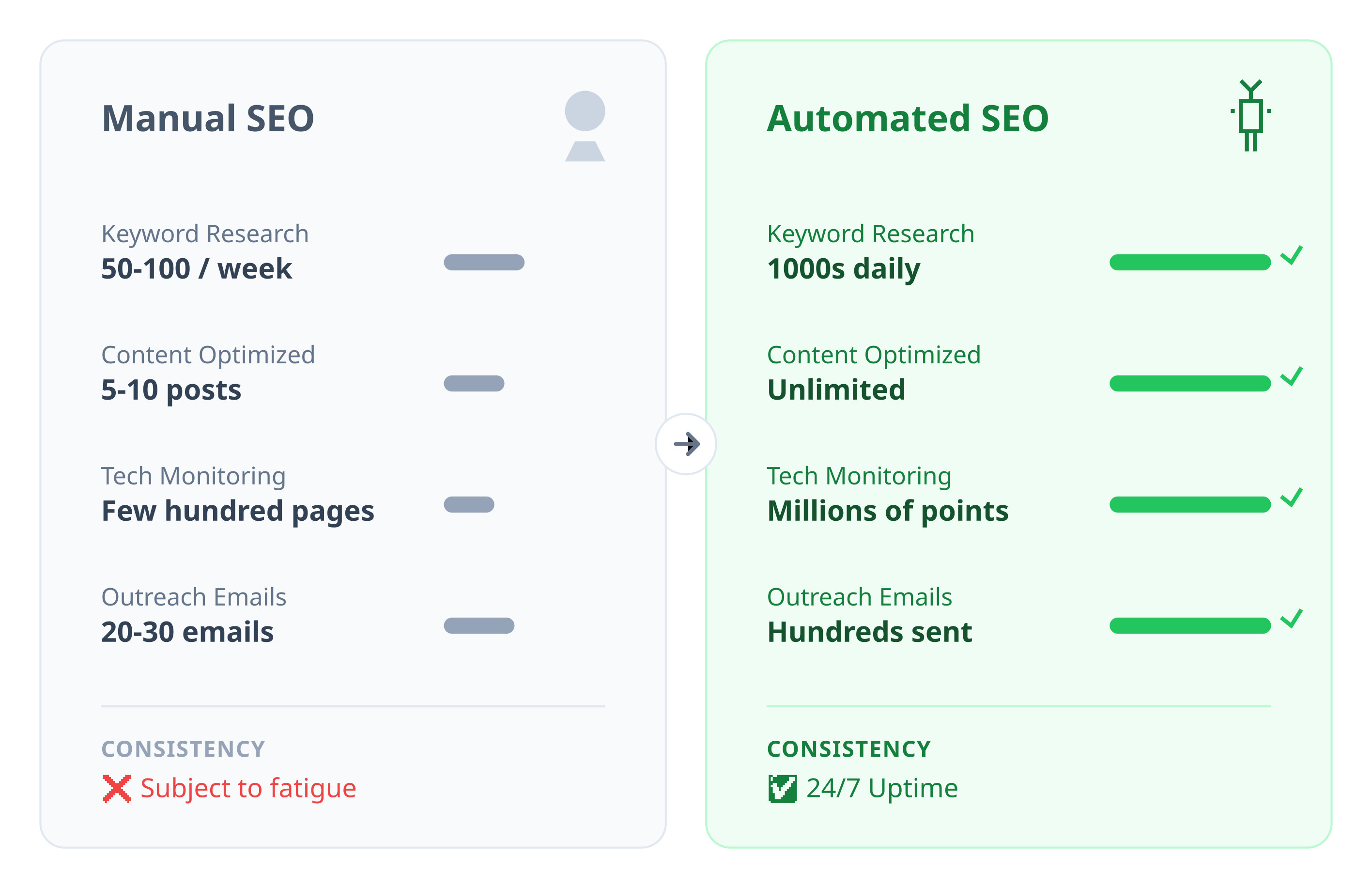
Look at the math. A skilled SEO person might:
Research 50-100 keywords per week
Optimize 5-10 posts thoroughly
Monitor technical issues across a few hundred pages
Track a couple hundred keyword rankings
Send 20-30 outreach emails
An automated system:
Analyzes thousands of keywords daily
Generates optimization recommendations for unlimited content
Monitors millions of data points across your site
Tracks unlimited keywords across all locations
Personalizes and sends hundreds of outreach emails
Quantity isn't the only difference. Consistency matters too. Humans get tired. They have off days. They can't watch rankings 24/7. Automation runs the same way on page one or page ten thousand.
This doesn't make SEO professionals obsolete. It shifts their role toward strategy, creative direction, and interpreting data. Much more valuable than manually updating meta tags.
The Real Cost of Not Automating
Teams that resist automation pay in other ways.
Opportunity cost. While your people spend hours on repetitive tasks, competitors capture keywords and build content libraries that widen the gap daily.
Inconsistency. Manual processes create uneven quality. Some pages get full optimization. Others slip through with basic treatment.
Burnout. Good SEO people don't want to do robot work forever. They leave for roles where they can think strategically. You lose institutional knowledge.
Scaling walls. Want to expand into new markets? Manual SEO makes that exponentially harder. Automation scales linearly. Ten times the content doesn't require ten times the team.
Slow reactions. Algorithm updates hit. Competitors move. Manual processes mean slow responses. Automation spots issues in hours, not weeks.
Building Your Stack
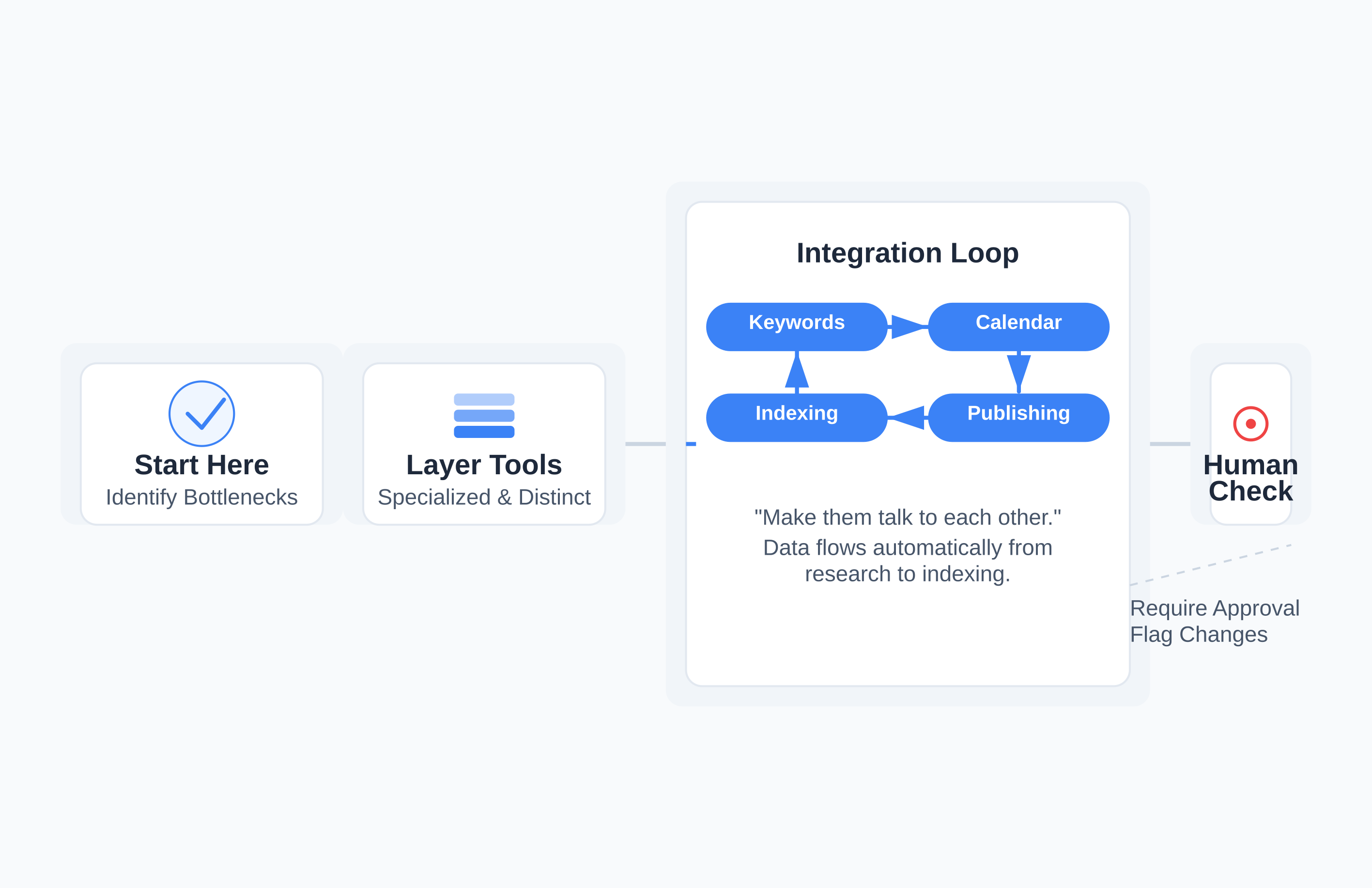
Not all automation helps. Build thoughtfully.
Start with bottlenecks. What tasks eat the most time for the least strategic value? Automate those first.
Layer tools strategically. Most companies use specialized tools for different jobs. Keyword research here. Content optimization there. Technical monitoring somewhere else.
Make them talk to each other. The power comes from integration. Keyword research should feed your content calendar. Your calendar should feed your publishing system. Publishing should trigger indexing requests.
Keep humans involved. Require approval for major changes. Flag unusual patterns. You want augmented intelligence, not blind automation.
Choose platforms that scale. Pick tools that handle 10x or 100x your current size. Migrating later costs time and momentum.
Platforms like LeafPad take an integrated approach to content automation for SEO. They handle drafting, optimization, and publishing without requiring multiple disconnected tools duct-taped together.
Mistakes That Waste Time
Good tools don't prevent bad decisions.
Over-automating content. Raw AI content lacks depth. Use it for structure and drafts. Add human insight.
Quantity over quality. Programmatic SEO can create thousands of pages. If they're thin or duplicative, they hurt more than help. Every page needs genuine value.
Set and forget. Automation needs tuning. Algorithms change. Competitors shift. Business priorities evolve. Check your rules quarterly.
Skipping tests. Don't launch 500 location pages at once. Test 10. See if they perform. Then scale. Automated mistakes scale fast.
Ignoring brand voice. Creative storytelling and strategic positioning need human judgment. Automation executes. Humans direct.
How Strategy Shifts
Remove manual execution time constraints and your approach changes.
Long-tail focus. Instead of chasing only high-volume head terms, you systematically capture thousands of long-tail variations. They add up.
Publishing velocity. Frequency becomes an advantage. Search engines like sites that publish fresh, valuable content consistently. Automation makes that sustainable.
Fast experiments. Test different structures. Optimize for different intents. Iterate on data. Automation handles the implementation grunt work.
Proactive monitoring. Spot trends and opportunities before competitors. Don't just react to problems.
Better decisions. Automation collects and analyzes data. You make strategic calls based on comprehensive insights, not limited samples.
Teams using full SEO automation systems pivot strategies in days rather than months. They test new markets without hiring. They maintain quality while scaling.
Where We Are Now
By April 2026, successful content-driven businesses have one thing in common. They stopped asking whether to automate and started building it into operations.
The winners aren't always the ones with bigger budgets or larger teams. They're the ones using automation to execute better, faster, and more consistently.
If you're looking at how automation changes content and SEO operations, LeafPad's approach shows what happens when you build it into the foundation rather than adding it later. The difference isn't more hours or more people. It's better systems.
Published with LeafPad