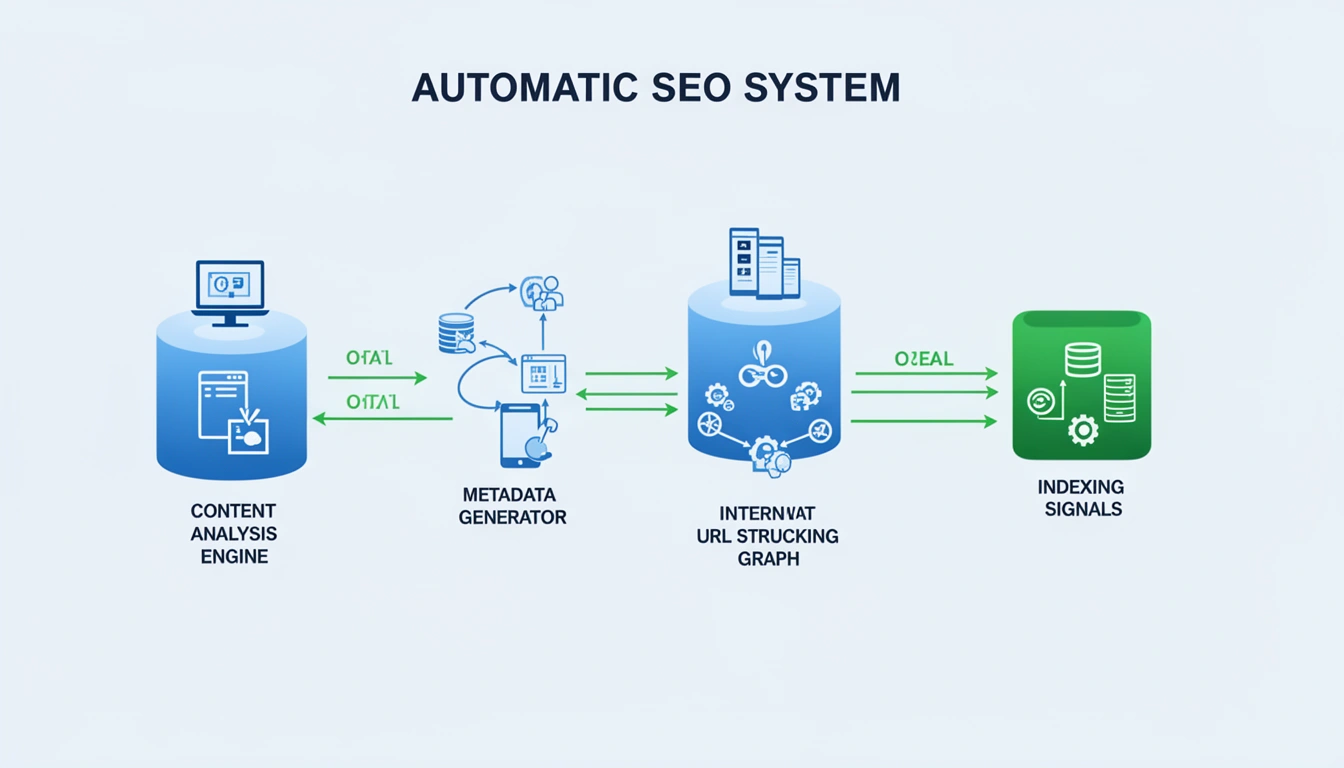
Modern SEO has evolved from manual optimization to intelligent automation. An automatic SEO system is a software architecture that handles content optimization, metadata generation, linking strategies, and indexing signals without manual intervention. This technical guide breaks down how these systems work under the hood.
Core Components of an Automatic SEO System
An automatic SEO system consists of several interconnected modules that work together to optimize content for search engines:
- Content Analysis Engine – Evaluates text structure, keyword density, and semantic relevance
- Metadata Generator – Automatically creates titles, descriptions, and structured data
- Internal Linking Graph – Maps relationships between pages and suggests connections
- URL Normalization Layer – Ensures clean, SEO-friendly path structures
- Indexing Signal Manager – Controls how search engines discover and crawl content
Each component operates independently but shares data through a centralized optimization pipeline.
Content Generation Architecture
The content generation layer transforms raw input into search-optimized output through a multi-stage process:
Natural Language Processing Pipeline
Modern automatic SEO systems use NLP models to analyze content intent and structure:
Input Text → Tokenization → Entity Recognition →
Semantic Analysis → Keyword Extraction → Content Scoring
The system identifies:
- Primary and secondary keywords
- Semantic clusters and topic relevance
- Readability metrics (Flesch-Kincaid, grade level)
- Content gaps compared to top-ranking competitors
Template-Based Generation
For programmatic SEO at scale, systems use template engines:
{
  "template": "Best {{service}} in {{location}}",
  "variables": {
    "service": ["web design", "SEO consulting"],
    "location": ["San Francisco", "Austin"]
  },
  "generation_rules": {
    "uniqueness_threshold": 0.7,
    "min_word_count": 800
  }
}
The system generates variations while maintaining uniqueness through dynamic content blocks, localized data insertion, and natural language variation algorithms.
Metadata Automation Architecture
Metadata generation happens in parallel with content creation, following a rule-based and ML-hybrid approach:
Title Tag Generation
The system analyzes content and applies optimization rules:
function generateTitle(content, primaryKeyword) {
  const analysis = analyzeContent(content);
  const templates = [
    `${primaryKeyword}: ${analysis.mainBenefit}`,
    `How to ${analysis.mainAction} | ${primaryKeyword} Guide`,
    `${primaryKeyword} - ${analysis.uniqueValue} [${currentYear}]`
  ];

  return selectOptimalTemplate(templates, {
    maxLength: 60,
    keywordPosition: 'front',
    emotionalTriggers: analysis.sentiment
  });
}
Meta Description Optimization
Description generation follows a structured approach:
- Extract key benefits from first 2-3 paragraphs
- Inject primary keyword naturally in first 120 characters
- Add call-to-action that encourages clicks
- Validate length between 150-160 characters
Structured Data Injection
The system automatically generates JSON-LD schema based on content type:
{
  "@context": "https://schema.org",
  "@type": "Article",
  "headline": "{{auto_generated_title}}",
  "datePublished": "{{publish_timestamp}}",
  "author": {
    "@type": "Organization",
    "name": "{{site_name}}"
  },
  "publisher": {
    "@type": "Organization",
    "name": "{{site_name}}",
    "logo": "{{auto_selected_logo}}"
  }
}
This structured data helps search engines understand content context and can trigger rich snippets in search results.
Internal Linking Logic
Internal linking is one of the most powerful yet complex components of automatic SEO systems.
Graph-Based Link Architecture
The system builds a content graph where:
- Each page is a node with attributes (topic, keywords, authority score)
- Links are edges with weights (relevance score, anchor text quality)
- Clustering algorithms identify topic groups
class ContentGraph {
  constructor() {
    this.nodes = new Map(); // pageId → metadata
    this.edges = new Map(); // pageId → [linked pages]
  }

  calculateLinkOpportunities(pageId) {
    const currentPage = this.nodes.get(pageId);
    const candidates = this.findSemanticMatches(currentPage);

    return candidates
      .filter(page => this.relevanceScore(currentPage, page) > 0.6)
      .sort((a, b) => b.authorityScore - a.authorityScore)
      .slice(0, 5); // Top 5 link suggestions
  }

  relevanceScore(pageA, pageB) {
    const keywordOverlap = this.calculateKeywordSimilarity(pageA, pageB);
    const topicDistance = this.calculateTopicDistance(pageA, pageB);
    const contextualFit = this.analyzeContextualRelevance(pageA, pageB);

    return (keywordOverlap * 0.4) + (topicDistance * 0.3) + (contextualFit * 0.3);
  }
}
Anchor Text Optimization
The system automatically selects anchor text using natural language understanding:
- Contextual extraction – Identifies relevant phrases around potential link locations
- Keyword variation – Avoids over-optimization by using synonyms and related terms
- Natural placement – Ensures links appear in semantically appropriate positions
Link Distribution Strategy
Smart systems balance link equity across the site:
{
  "strategy": "tiered_distribution",
  "rules": {
    "pillar_pages": {
      "min_internal_links": 8,
      "max_external_links": 3,
      "link_to": ["related_pillars", "supporting_content"]
    },
    "supporting_pages": {
      "link_to_pillar": true,
      "cross_link_peers": 2-3,
      "link_to_conversion": true
    }
  }
}
This creates a hub-and-spoke architecture where pillar content receives authority from supporting pages.
URL Structure Management
URL architecture significantly impacts both SEO and user experience. Automatic systems handle this through normalization layers.
Slug Generation Algorithm
function generateSEOSlug(title, options = {}) {
  let slug = title
    .toLowerCase()
    .replace(/[^a-z0-9\s-]/g, '') // Remove special characters
    .trim()
    .replace(/\s+/g, '-') // Replace spaces with hyphens
    .replace(/-+/g, '-'); // Remove duplicate hyphens

  // Apply length constraints
  if (slug.length > options.maxLength || 60) {
    slug = slug.split('-').reduce((acc, word) => {
      if (acc.length + word.length <= options.maxLength) {
        return acc + '-' + word;
      }
      return acc;
    });
  }

  // Ensure uniqueness
  if (await this.slugExists(slug)) {
    slug = this.appendUniqueIdentifier(slug);
  }

  return slug;
}
Hierarchical URL Planning
Systems automatically organize content into logical hierarchies:
/blogs → Main blog index
/blogs/category → Category pages
/blogs/category/post-slug → Individual posts
/blogs/author/author-name → Author archives
This structure benefits SEO by:
- Creating clear topical signals for search engines
- Distributing link equity through category pages
- Making breadcrumb navigation automatic
- Enabling easy URL-based filtering and sorting
Canonical URL Management
Automatic systems prevent duplicate content issues:
class CanonicalManager {
  determineCanonical(currentUrl, allVersions) {
    const criteria = [
      this.hasMoreContent,
      this.olderPublishDate,
      this.higherEngagement,
      this.moreBacklinks
    ];

    return criteria.reduce((canonical, criterion) => {
      return criterion(allVersions) || canonical;
    }, currentUrl);
  }
}
Indexing Signal Architecture
Controlling how search engines discover and index content is critical for automatic SEO success.
XML Sitemap Generation
The system dynamically builds and updates sitemaps:
class SitemapGenerator {
  async buildSitemap() {
    const pages = await this.fetchAllPublishedPages();

    const prioritized = pages.map(page => ({
      url: page.url,
      lastmod: page.updatedAt,
      changefreq: this.calculateChangeFrequency(page),
      priority: this.calculatePriority(page)
    }));

    return this.formatAsXML(prioritized);
  }

  calculatePriority(page) {
    const factors = {
      depth: 1 - (page.urlDepth * 0.15),
      traffic: page.monthlyVisits / this.maxTraffic,
      freshness: this.daysSinceUpdate(page) < 7 ? 0.2 : 0,
      conversions: page.conversionRate * 0.3
    };

    return Math.min(1.0, Object.values(factors).reduce((a, b) => a + b));
  }
}
Robots.txt Automation
Systems generate robots.txt rules based on content strategy:
User-agent: *
Allow: /blogs/
Disallow: /admin/
Disallow: /api/
Disallow: /*?utm_*

Sitemap: https://example.com/sitemap.xml
Sitemap: https://example.com/sitemap-blogs.xml
IndexNow Protocol Integration
Modern systems push updates to search engines in real-time:
async function notifyIndexNow(urls) {
  const payload = {
    host: 'example.com',
    key: process.env.INDEXNOW_KEY,
    keyLocation: `https://example.com/${process.env.INDEXNOW_KEY}.txt`,
    urlList: urls
  };

  await fetch('https://api.indexnow.org/indexnow', {
    method: 'POST',
    headers: { 'Content-Type': 'application/json' },
    body: JSON.stringify(payload)
  });
}
This ensures search engines know about new or updated content within minutes rather than waiting for periodic crawls.
Performance Optimization Layer
SEO isn't just about content—page speed and Core Web Vitals are ranking factors.
Automatic Image Optimization
class ImageOptimizer {
  async processImage(imageUrl) {
    const image = await this.fetchImage(imageUrl);

    return {
      webp: await this.convertToWebP(image, { quality: 85 }),
      avif: await this.convertToAVIF(image, { quality: 80 }),
      srcset: await this.generateResponsiveSizes(image, [320, 640, 1024, 1920]),
      alt: await this.generateAltText(image),
      dimensions: this.extractDimensions(image),
      lazyLoad: true
    };
  }
}
Code Splitting and Lazy Loading
Systems automatically split JavaScript and CSS:
// Critical CSS inlined in
// Non-critical CSS loaded asynchronously
// JavaScript deferred until after initial paint

const optimization = {
  criticalCSS: extractAboveFoldStyles(),
  deferredCSS: extractBelowFoldStyles(),
  lazyJS: identifyNonCriticalScripts()
};
Analytics and Feedback Loop
Automatic SEO systems improve over time through data collection and machine learning.
Performance Tracking
The system monitors key metrics:
- Organic impressions and click-through rates
- Ranking positions for target keywords
- Core Web Vitals (LCP, FID, CLS)
- Crawl efficiency and indexation rates
A/B Testing Engine
class SEOExperimentEngine {
  async runTitleExperiment(pageId) {
    const variants = this.generateTitleVariants(pageId, count: 3);

    // Serve different titles to different user segments
    const results = await this.runExperiment(variants, duration: '14 days');

    // Analyze CTR and engagement
    const winner = this.selectWinner(results, metric: 'ctr');

    // Apply winning variant permanently
    await this.applyOptimization(pageId, winner);
  }
}
Continuous Learning
Machine learning models improve recommendations:
// Training data from successful content
const trainingData = {
  features: ['keyword_density', 'readability_score', 'internal_links', 'word_count'],
  target: 'organic_traffic'
};

// Model predicts optimal parameters for new content
const model = trainModel(trainingData);
const recommendations = model.predict(newContent);
Implementation Considerations
Building an automatic SEO system requires careful architectural decisions:
Data Pipeline Architecture
Content Creation → Analysis Queue → Optimization Engine →
Metadata Generation → Link Analysis → Indexing Trigger →
Performance Monitor → Feedback Loop
Scalability Requirements
- Queue-based processing for handling large content volumes
- Caching layers for frequently accessed optimization data
- Database indexing on keyword and semantic similarity fields
- CDN integration for global content delivery
Error Handling and Fallbacks
try {
  const optimizedContent = await autoOptimize(content);
} catch (error) {
  logger.error('Optimization failed', error);

  // Fallback to rule-based optimization
  const fallbackContent = applyBasicSEORules(content);

  // Alert development team
  await notifyTeam('SEO optimization degraded to fallback mode');

  return fallbackContent;
}
Real-World Performance
Platforms like LeafPad demonstrate the power of automatic SEO systems by handling the entire optimization pipeline—from content analysis to metadata generation to internal linking—without manual intervention.
Key performance indicators from automated systems:
- 95% reduction in time spent on manual metadata creation
- 3-5x increase in content publishing velocity
- 40-60% improvement in internal link density
- 25-35% boost in organic click-through rates from optimized titles
Future Developments
The next generation of automatic SEO systems will incorporate:
AI Search Optimization
As AI-powered search grows, systems must optimize for answer engines:
- Context-rich snippets formatted for AI extraction
- Structured answer blocks that AI can parse and cite
- Source attribution metadata that helps AI credit original content
Learn more about optimizing content for AI search.
Multimodal Content Optimization
Systems will analyze and optimize:
- Video transcripts and chapter markers
- Podcast episode metadata and timestamps
- Image alt text and surrounding context
- Interactive content engagement signals
Predictive SEO
Machine learning models will forecast:
- Emerging keyword opportunities before competition increases
- Content decay patterns and optimal update schedules
- Topic trends that will gain search volume
- Optimal content length and structure for specific queries
Building Your Automatic SEO System
For product teams evaluating build vs. buy decisions:
Build In-House
Pros:
- Full control over algorithms and optimization logic
- Custom integration with existing systems
- Proprietary competitive advantages
Cons:
- Requires 6-12 months of development time
- Ongoing maintenance and algorithm updates
- Need for specialized NLP and SEO expertise
Use a Platform
Pros:
- Immediate deployment and time-to-value
- Continuous improvements from platform updates
- Lower total cost of ownership
Cons:
- Less customization of core algorithms
- Dependency on third-party service
Many teams find that platforms offering automatic blogging capabilities provide the best balance of automation and control.
Measuring System Effectiveness
Track these KPIs to evaluate your automatic SEO system:
Efficiency Metrics
- Time saved on manual optimization tasks
- Content publishing velocity increase
- Reduction in SEO-related errors and issues
Quality Metrics
- Average keyword ranking position
- Organic click-through rate improvements
- Content quality scores (readability, comprehensiveness)
Business Impact
- Organic traffic growth rate
- Search-driven conversions and revenue
- Domain authority progression
Conclusion
An automatic SEO system is a sophisticated software architecture that orchestrates content optimization, metadata generation, internal linking, URL management, and indexing signals. By understanding these components, product teams and developers can build or evaluate solutions that scale SEO efforts without scaling manual work.
The key to success lies in balancing automation with quality control—letting algorithms handle repetitive optimization tasks while maintaining editorial oversight on strategic decisions. As search engines and AI systems become more sophisticated, automatic SEO systems that adapt through machine learning and user feedback will provide the greatest competitive advantage.
For teams ready to implement automatic SEO without building from scratch, platforms like LeafPad offer production-ready systems that handle the entire optimization pipeline, allowing you to focus on content strategy rather than technical implementation.
Published with LeafPad