Internal linking that wires itself
Every new Leafpad post gets linked from the right pillar, the right cluster, and the right related articles the moment it publishes. Anchor text varies naturally. No spreadsheets, no broken links, no orphan pages.
Internal linking is the SEO that pays itself back
Internal links are the links from one of your pages to another of your pages. They tell Google which posts are most important, which topics you cover deeply, and where to send ranking power. They also help readers find the next thing to read.
Most teams know this and still skip it. Manual linking works for the first 30 posts. It breaks at 100. By 500 posts, no one remembers what links where.
30
posts
Manual linking is still manageable.
100
posts
Tracking is already breaking down.
500
posts
No one remembers what links where.
How it works
How automatic internal linking works in Leafpad
Every new post joins a cluster.
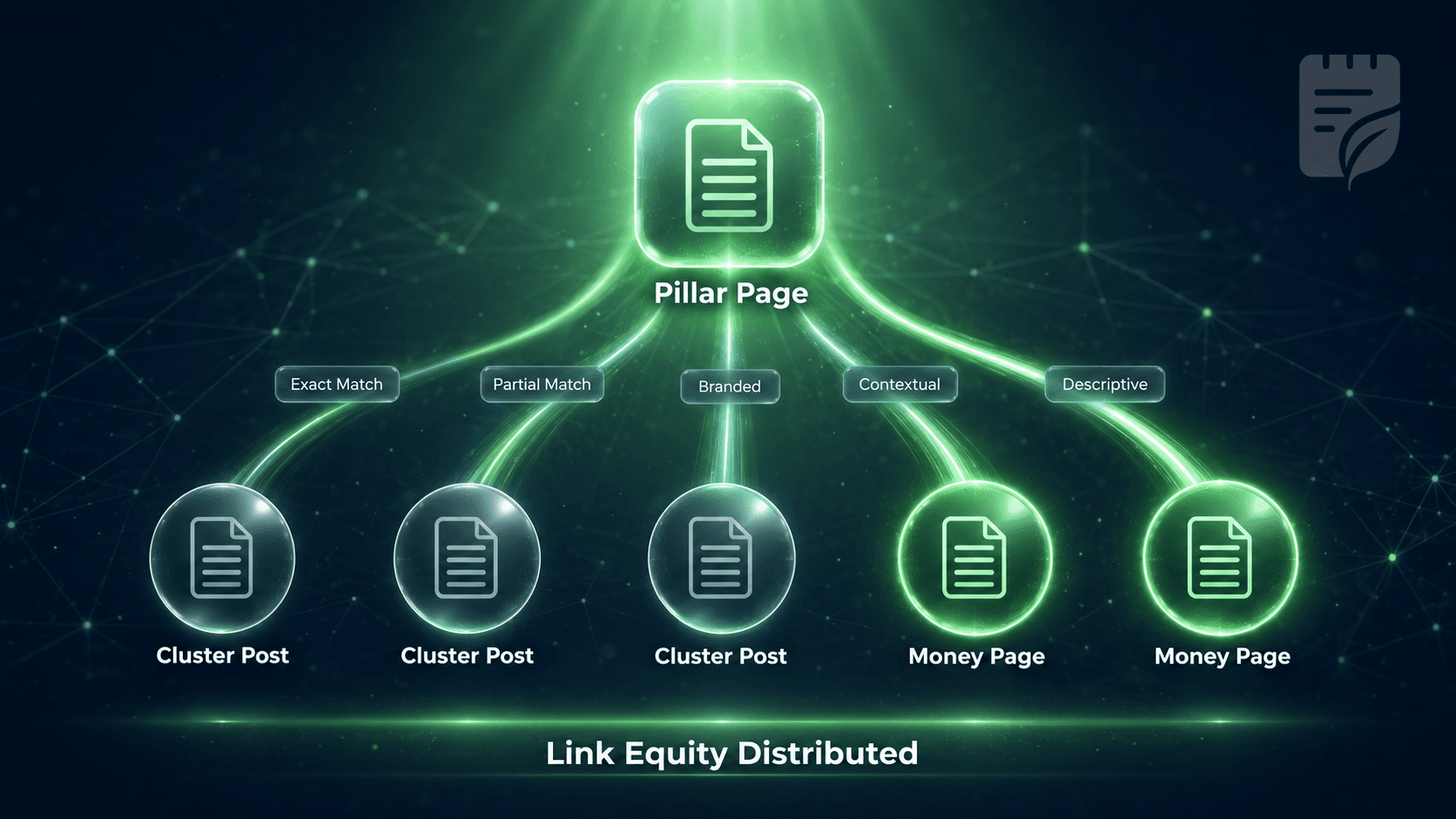
When Leafpad publishes a new article, it looks at your existing content, finds the related posts and the parent pillar (the big guide on that topic), and adds links in both directions. The new post gets discovered by Google faster. The pillar gets stronger.
Anchor text varies on purpose.
Linking 40 pages to one URL with the same anchor text looks spammy. Leafpad rotates anchor text naturally (exact match, partial match, branded, and contextual phrases) so links read like a real editor wrote them. Topical authority compounds.
Old posts get linked to new ones.
The hard part of manual linking is going back. Leafpad scans older posts when a new article goes live and adds inbound links from the most relevant places. No orphan pages, no buried content, no link equity stuck in dead ends.
No over-optimization.
Leafpad caps the number of links pointing to any one page from any other page and watches for unnatural patterns. The system is designed to look like a thoughtful editor at work, not a link factory.
AI search
Why this matters more in 2026
Pages with strong internal linking get crawled and indexed faster, and rank for more long-tail queries because the cluster structure signals topical depth. Linkbot's 2025 publisher case study found that 47 previously unindexed pages moved from unindexed to indexed within 14 days after targeted internal linking.
AI engines use the same depth signal. Domain authority accounts for roughly 15 percent of Perplexity's reranker weighting, per the 2025 reverse-engineering analysis by Metehan Yesilyurt of Perplexity's L3 reranker (cited in Stackmatix, 2026), alongside content relevance (~30%), visual placement (~20%), content freshness (~15%), source diversity (~10%), and structured data (~10%). ChatGPT, Claude, and Gemini all pull more from sources that cover a topic comprehensively. A clean cluster shows them you are the source, not a one-off article.
What you do not have to do
Decide which anchor text to use
Open old posts to add inbound links
Audit the site for orphan pages
Worry about link cannibalization
Keep a spreadsheet of which post points to which
FAQ
Common questions
How many internal links does Leafpad add per post?
Usually 3 to 8 contextual internal links per post, scaled to post length. Each link points to a relevant pillar, cluster post, or related article. The system never stuffs links for the sake of count.
Does Leafpad ever break existing internal links?
No. If you rename or unpublish a post, Leafpad updates the inbound links automatically and removes any broken references. You never have a 404 hanging in the body of an old article.
Can I lock certain pages as link targets I want to push?
Yes. Mark any page as a priority target and Leafpad will prioritize linking to it from new and refreshed posts, while keeping anchor text varied and link density natural.
Does the system add external links too?
Yes, sparingly. Leafpad links to authoritative external sources (research papers, named publications, primary data) when a stat or quote calls for it. External citations to credible sources actually increase your odds of being cited by AI engines.
How is this different from a WordPress internal linking plugin?
Most plugins match keywords to URLs and add the link. Leafpad understands topical structure (pillar, cluster, related, comparison) and links by intent, not just keyword match. It also works across WordPress, Shopify, Ghost, Webflow, Framer, Lovable, and Bolt without changing setup.
Wire your blog