Automated Keyword Research: How It Works, From Seed to Published Post
Keyword research is finding the searches your readers type, how many people type them and how hard each is to rank for, so you know which pages to write. Automated keyword research hands those steps to software: it pulls the data, keeps the keywords your site can actually win and turns them into a content plan. Leafpad does it with real search volume and keyword difficulty from Ahrefs, then writes and publishes the posts.
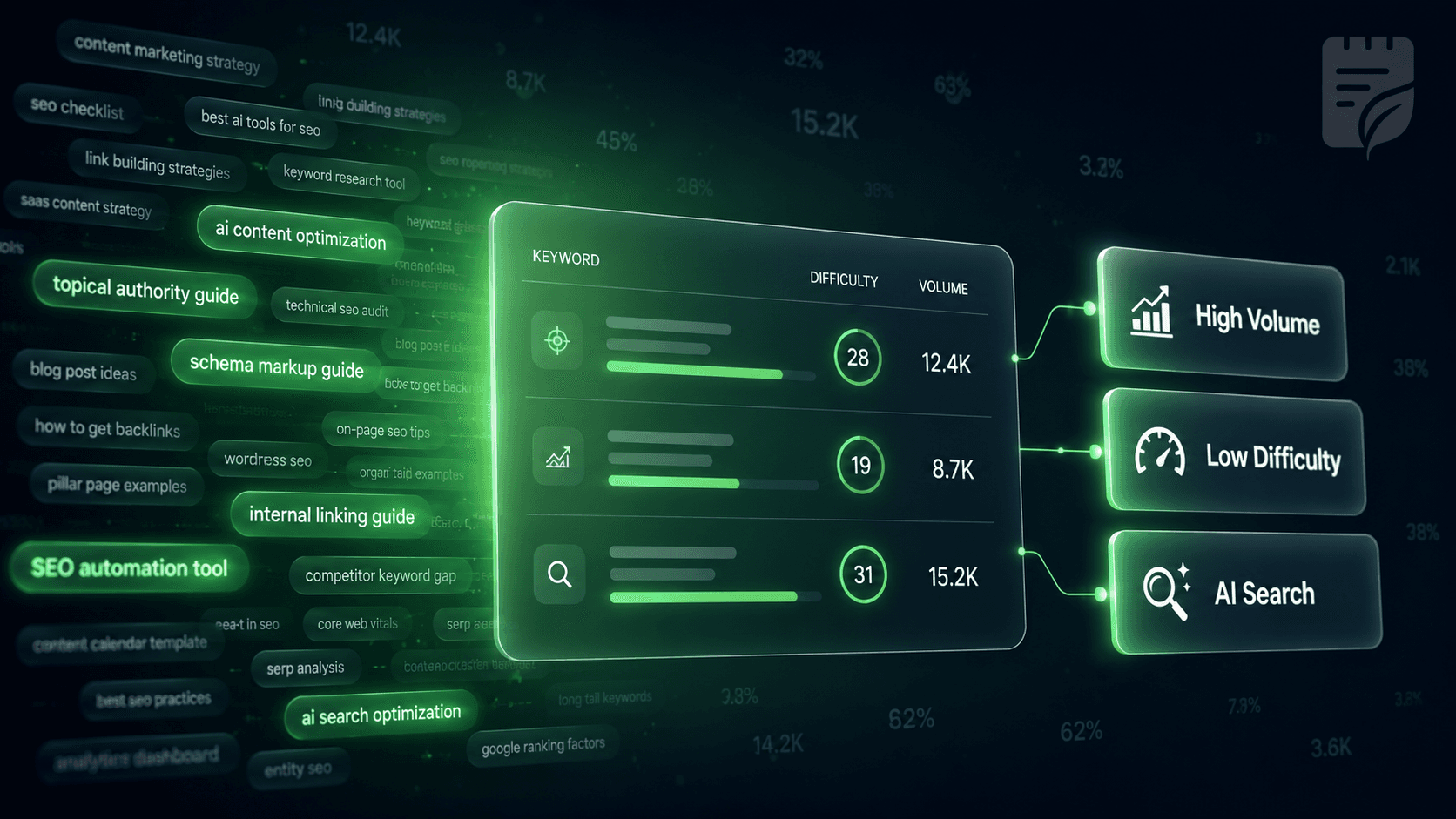
Step by step
How Leafpad automates keyword research, step by step
- 1
It starts from your site. Leafpad surfaces topics for your niche, and you can paste your own keyword list to add to them.
- 2
It pulls real data. Every keyword gets its monthly search volume, keyword difficulty, search intent and the pages ranking now, from Ahrefs.
- 3
It keeps what you can win. Difficulty is scored against your domain's authority, so a new site gets low-competition, high-intent topics first and the plan reaches for bigger keywords as your authority grows.
- 4
It finds the gaps. Topics your top two competitors rank for and you don't go into the plan.
- 5
It builds the plan. Topics are grouped into a pillar and its cluster posts, and queries that trigger AI Overviews are flagged.
- 6
You approve. Each topic comes with a one-line reason it was picked, and you can swap any of them before writing starts.
- 7
It writes and publishes. Approved topics flow into your content calendar, and the keyword data updates monthly so the plan stays current.
What stays yours: which topics to approve, how often to publish, and whether each post goes live on approval or automatically. To run each step by hand, see how to do keyword research.
Your options
Three ways to automate keyword research
| Route | How it works | Examples | What you still do |
|---|---|---|---|
| A workflow builder with a keyword API | A no-code workflow calls a keyword data API, then sorts and stores the results | Make's tutorial with the DataForSEO API; n8n workflows shared on Reddit | Build and maintain the workflow, pay for the API, and decide what to write |
| An AI assistant with an MCP server | An assistant like Claude or ChatGPT calls a keyword database through its MCP server and works on the results in the chat | Ahrefs' MCP server, which works with ChatGPT and Claude; DataForSEO's MCP server | Ask for each step, check the output, and move the plan into your CMS |
| A platform with it built in | Research runs as part of writing and publishing | Leafpad | Approve topics and posts |
Whichever route you take, let AI expand seed lists and sort intent, but take volumes and difficulty from a keyword database. A number an AI model writes on its own is a guess, which is why Leafpad uses Ahrefs data and no AI-generated volumes.
Most AI writers guess. Leafpad uses real data.
ChatGPT does not know how many people search for your topic each month. It does not know which keywords your competitors already own. It does not know which queries are worth your time.
Leafpad pulls its keyword data from Ahrefs. Every topic in your content plan comes back with the same data a human SEO would pull: monthly search volume, keyword difficulty, search intent, and the pages currently ranking. You see the math before a single word gets written.
Real search volume
Monthly search volume from Ahrefs, not estimated guesses.
Keyword difficulty
Scored against your domain's actual authority, not an abstract number.
Search intent
Informational, commercial, or transactional so you write the right page.
Live SERP data
See which pages currently rank before you decide to compete.
Day one
What you get on day one
A scored topic list.
Every keyword your site has a realistic shot at, ranked by traffic potential and ranking difficulty.
Search intent labels.
Each topic tagged as informational (people learning), commercial (people comparing), or transactional (people buying), so the right page goes in front of the right reader.
Competitor gaps.
Topics your top two competitors rank for and you do not.
A pillar-and-cluster map.
One big guide on your core topic, plus the supporting posts that link back to it. Topical authority means Google seeing your site as a real expert on a topic, not just one post about it.
How it works
How Leafpad's keyword research is different
Ranking difficulty that matches your actual site.
A keyword with difficulty 40 means nothing without context. Leafpad scores difficulty against your domain's real authority. A keyword that is a stretch for a brand-new domain may be a layup for a site with three years of content.
AI search intent, not just Google.
Leafpad also flags which queries are pulling AI Overviews and which AI engines (ChatGPT, Perplexity, Claude, Gemini) already cite your category. We pick topics with double upside: rank on Google and get cited in AI answers.
You approve the plan, then it runs itself.
Once you sign off, every topic flows straight into your content calendar. You never see another spreadsheet. The keyword data updates monthly so the plan stays current.
No SEO degree required
Built for founders, not SEO agencies
You should not need to know what keyword difficulty 27 means to run a blog. Leafpad picks the topics, explains in one line why each one was chosen, and lets you swap any topic you do not love. No certification required.
Keyword data from Ahrefs, not AI guesses
Difficulty scored against your real domain authority
One-line explanation for every topic picked
Swap any topic before writing starts
Plan updates monthly as search trends shift
Publishing
From keyword research to publishing
In Leafpad, keyword research isn't a spreadsheet you hand to a writer. Approved keywords flow into your content calendar; Leafpad writes each post, generates its images, links it to related posts and publishes it on your schedule to WordPress, Shopify, Ghost, Webflow, Framer, Lovable or Bolt. The same keyword data drives content refresh: the searches a published post already appears for decide what its refresh updates.
FAQ
Common questions
Does Leafpad use real Ahrefs data or fake AI-generated numbers?
Real Ahrefs data. Every keyword in your plan comes back with the same search volume, keyword difficulty, and SERP details you would see if you paid for Ahrefs directly. AI-generated keyword numbers are unreliable, so we do not use them.
How does keyword research connect to the rest of Leafpad?
The approved keywords flow straight into your content calendar. From there Leafpad writes the post, generates the images, links it to related content, and publishes it on your schedule. The same keyword data also powers the refresh layer. Keyword research is one step in what an SEO agent automates, from research to refresh.
Will Leafpad just chase high-volume keywords I cannot rank for?
No. Leafpad scores difficulty against your domain. Brand-new sites get low-competition, high-intent topics first. As your authority grows, the plan reaches for bigger keywords. You always see why each topic was picked.
Does it cover AI search keywords too?
Yes. Every plan flags queries that trigger AI Overviews, plus the conversational questions people ask ChatGPT and Perplexity. You build for both Google and AI engines at once, and AI citation tracking shows which AI answers cite your pages.
Can I bring my own keyword list?
Yes. Paste in your list and Leafpad enriches it with the same Ahrefs data, search intent, and ranking difficulty.
Keyword research
Keyword research questions
How do you automate keyword research?
Hand the data steps to software: pull volumes and difficulty from a keyword database, group the keywords into topics, score them against your site and turn them into briefs, and keep the choice of what to publish for yourself. Leafpad runs those steps and asks you to approve the plan; how to do keyword research walks through doing them by hand.
Which AI is best for keyword research?
Any capable AI assistant can expand a seed list and label intent, but none knows search volumes on its own. Connect it to a keyword database, like Ahrefs' or DataForSEO's MCP servers, or use a platform that pulls the data for it.
What is the best tool for keyword research?
The one that fits what happens after the research. A keyword database like Ahrefs or Semrush suits a person who plans and writes; Google Keyword Planner gives free data from Google's ads tool; a platform like Leafpad turns the research into published posts.