SEO Automation: What It Is, What to Automate, and How to Do It Safely
Written by Sameeh, Founder of Leafpad
SEO automation is the use of software to handle search engine optimization work that teams normally do by hand: keyword research, content planning, writing, publishing, internal linking, and refreshing older posts. The goal is consistent organic growth without daily manual effort, across both Google rankings and AI engines like ChatGPT and Perplexity.
The timing matters. AI Overviews now appear on roughly 48% of tracked Google queries (BrightEdge, February 2026), and organic click-through rates on informational queries fall by as much as 61% when they appear (Seer Interactive). Winning organic visibility now means publishing consistently for two surfaces at once: classic search rankings and AI citations. Consistency is exactly what manual SEO struggles to deliver, and exactly what automation is built for.
Explore the SEO automation series
This guide covers the full picture. For a deeper look at any single piece, these five guides go further:
- Automated keyword research how one seed keyword turns into a 30-day content calendar
- Manual vs automated SEO an honest comparison, including what Google actually penalizes
- Automated blog publishing the pipeline stage that ships posts straight to your CMS
- Shopify SEO automation why blog content, not product pages, drives store traffic
- WordPress SEO automation full pipeline vs single-post plugins, explained
What is SEO automation?
SEO automation means software runs the repeatable parts of your SEO workflow end to end. A true automation platform researches keywords, builds a content calendar, writes and publishes posts, adds internal links, and refreshes content as it ages. This is different from an AI writing tool, which drafts one article at a time and leaves research, publishing, and maintenance to you.
Automated SEO software sits on a spectrum. At one end are point tools: a rank tracker here, a title generator there, a plugin that drafts a post inside your CMS editor. At the other end are full-pipeline platforms that take a seed topic and return a live, internally linked, maintained post with no manual steps in between.
The category has also outgrown Google. Blog content is now the raw material AI engines use to recommend products. When ChatGPT or Perplexity suggests a tool, that recommendation is pulled from published content. Automating your content pipeline is how you show up in both places without hiring a content team.
What SEO tasks can you automate?
Six SEO tasks automate reliably in 2026: keyword research, content calendar planning, content writing, publishing, internal linking, and content refreshes. Together they cover the entire pipeline from a seed topic to a live, maintained post. Tasks that depend on original data, relationships, or judgment, like digital PR and strategy, still need a human.
Keyword research
Software expands a seed topic into hundreds of candidate keywords, pulls volume and difficulty data, classifies search intent, clusters related queries, and assigns each cluster a spot on the calendar. What takes a marketer a full day per topic runs in minutes. This is exactly what Leafpad's keyword research engine does before any post is written. See the full breakdown of automated keyword research, including a worked example that turns one seed keyword into a 30-day calendar.
Content calendar planning
Instead of a spreadsheet you abandon by week three, automation builds a rolling 30-day content calendar from the keyword clusters, paced to a cadence your domain can actually support. Publishing volume that matches domain age and authority is a safety feature, not a limitation. More on that below.
Content writing
Modern pipelines do far more than generate text. They analyze the ranking pages for a query, identify gaps, and draft content that includes verifiable statistics, named quotes, and cited sources. That structure is not cosmetic. Princeton and Georgia Tech researchers found that adding citations, quotations, and statistics each drives a 30 to 40% visibility uplift in generative engines (Aggarwal et al., KDD '24).
Publishing
Automated publishing, or auto-publish, pushes finished posts to your CMS on schedule, with images, meta tags, and structured data attached, then notifies search engines the page exists. This matters more than it sounds: ChatGPT's search runs on Bing's index, where 87% of its citations match Bing's top results (Seer Interactive). Faster indexing means faster AI visibility. The full pipeline is covered in automated blog publishing.
Internal linking
This is the most neglected task in SEO and one of the easiest to automate. A study of 23 million internal links found that 53% of URLs on most sites have three or fewer internal links pointing at them, while pages with at least one exact-match anchor earn roughly five times more search traffic (Cyrus Shepard, Zyppy). Automatic internal linking adds contextual links with varied anchors on every publish, including links back from older posts.
Content refreshes
Rankings decay. Statistics go stale. Content refresh automation detects declining pages, updates their data and internal links, and resets their freshness signals. Refreshed content also gets cited more by AI engines, which weight freshness heavily, and AI citation tracking shows you exactly where those citations land.
What SEO automation cannot do
Automation cannot replace original research, first-hand experience, brand voice judgment, or relationship-driven link earning. Software can structure and scale content, but the insights that make a page genuinely worth citing still come from people. The best results come from automating the pipeline and reserving human time for expertise, data, and review.
Be specific about what stays manual: proprietary data and surveys that earn links, founder stories and opinions, product positioning decisions, podcast appearances and community presence that build brand demand. Rand Fishkin, co-founder of SparkToro, put the priority plainly after analyzing Google's leaked ranking documentation: “Build a notable, popular, well-recognized brand in your space, outside of Google search.” Automation does not do that for you. It frees the hours so you can.
Is automated SEO safe? What Google actually penalizes
Automated SEO is safe when quality, topical focus, and publishing pace are controlled. Google's scaled content abuse policy (March 2024) targets pages created “primarily for benefiting the website owner and not helping users”, regardless of whether humans or AI produced them. The production method is not the violation. Low effort at high volume is.
Google's January 2025 quality rater guidelines make the same point from the other side: raters assign the lowest quality rating to scaled, low-effort content whether a person or a model wrote it. Well-researched, well-structured automated content is judged on the same terms as anything else.
For readers who follow the technical side, Google's leaked ranking documentation names the attributes that matter here. contentEffort estimates how much work a page reflects. siteFocusScore and siteRadius measure whether a site stays on topic. These are sitewide scores, which means one burst of thin, off-topic posts can drag down every page on the domain.
Three safeguards separate automation from spam:
- Quality gates. Every draft is scored before publishing and regenerated when it falls short. Nothing ships on volume alone.
- Topical focus. Content stays inside a small set of pillars relevant to your business instead of chasing every keyword with volume.
- Paced cadence. A six-month-old domain should not publish 60 posts a month. Volume should ramp with domain age and authority, because engagement signals need time to accumulate.
For a complete, honest breakdown of where each approach wins, read our manual vs automated SEO comparison.
How to choose SEO automation tools
The best SEO automation tools cover the whole pipeline, not one step of it. Evaluate five things: whether keyword research and planning are included, whether publishing integrates directly with your CMS, whether a quality gate reviews every draft, whether the tool refreshes older content, and whether it paces volume to your domain rather than selling raw post counts.
A quick way to sort the market:
| Question to ask | Point tool | Full-pipeline platform |
|---|---|---|
| Who does keyword research? | You | The platform |
| Who plans the calendar? | You | The platform |
| Who publishes? | You, per post | Automatic, on schedule |
| Who maintains old posts? | Nobody, usually | Automatic refresh |
| Who adds internal links? | You | Automatic, on every publish |
Where you publish also narrows the choice. Store owners should look at Shopify SEO automation specifically, since product pages alone rarely rank and blog content drives store discovery. Publishers on WordPress should compare plugins against platforms in our guide to WordPress SEO automation. If you are weighing specific products, you can compare Leafpad against the tools you already know, including Jasper, Scalenut, Copy.ai, Outrank, and Blogify.
Manual vs automated SEO: which wins?
Manual SEO wins on brand voice nuance, original research, and editorial judgment. Automated SEO wins on consistency, refresh discipline, and internal linking at scale. Most teams should not choose one. Automate the pipeline, then spend the saved hours on the parts only humans can do.
The honest failure mode of manual SEO is not quality. It is abandonment. A founder writes three posts, the product demands attention, and the blog dies. The honest failure mode of automation is publishing generic volume with no quality control. The comparison deserves a full page, and it has one: manual vs automated SEO.
How Leafpad automates the entire SEO pipeline
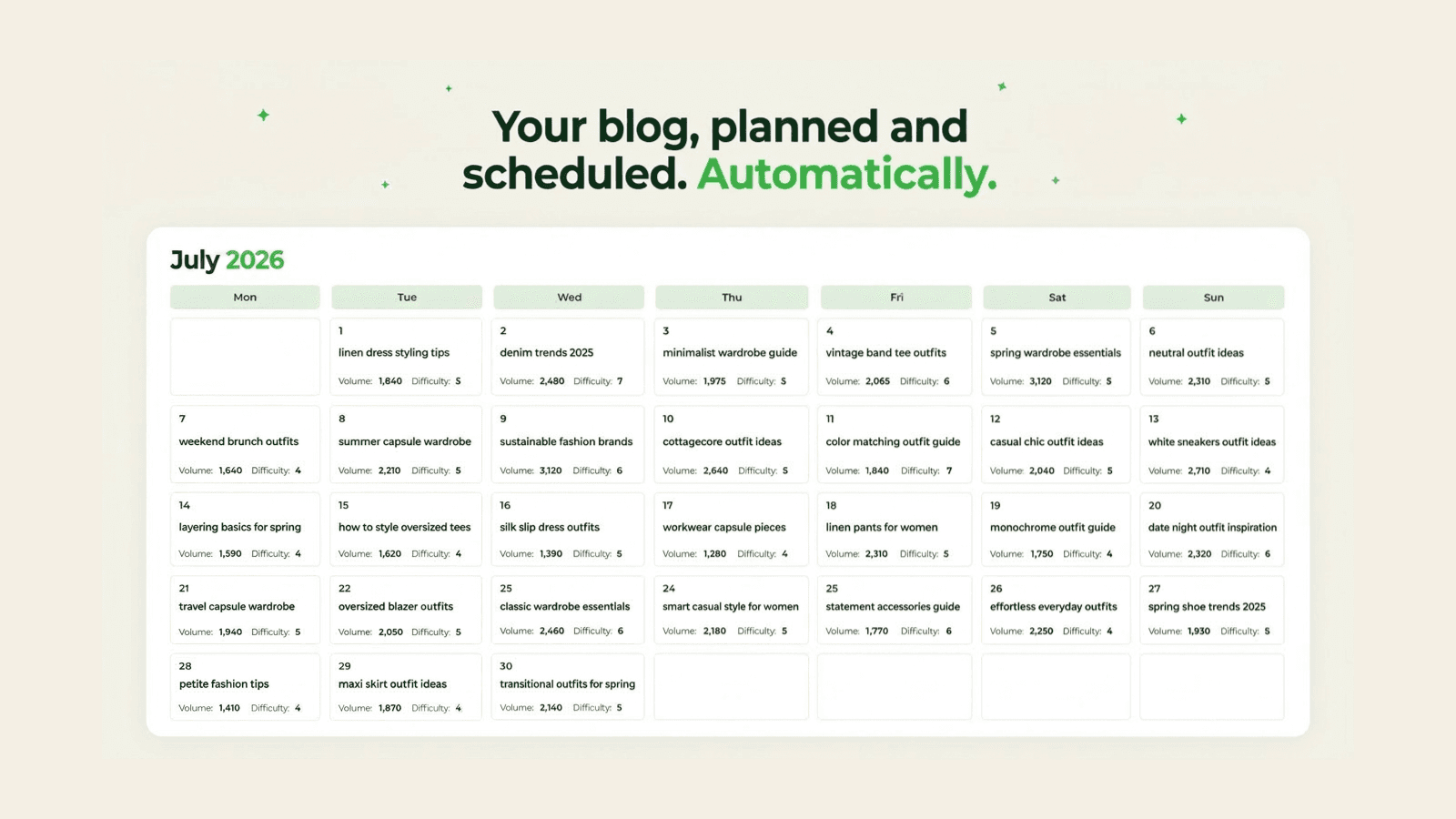
Leafpad runs the full pipeline: keyword research, a 30-day content calendar, writing with statistics and citations built in, banner images, internal linking, publishing, and automatic refreshes of aging posts. Every post is optimized for Google rankings and AI citations at the same time. Leafpad's own site earned 50,000+ Google impressions in 28 days and 600+ ChatGPT citations in a single week running on this system.
Across customer accounts, the platform has driven 300,000+ impressions and 10,500+ clicks over 250+ published blogs. It publishes to WordPress, Shopify, Webflow, Ghost, and Framer, works with projects built on Lovable, Bolt, and Replit, and includes an MCP server for publishing directly from Claude, ChatGPT, or Cursor. See every supported integration for the full list.
You can judge the quality before paying anything. Sign up, connect your site, and Leafpad analyzes your pages, proposes a topic calendar, and writes your first post free. No card required. Plans and details are on the Leafpad pricing page.
FAQ
Frequently asked questions
Does Google penalize automated or AI-generated content?
No. Google penalizes low-effort content produced at scale primarily to manipulate rankings, whether humans or AI wrote it. Its March 2024 scaled content abuse policy and January 2025 rater guidelines both judge content on quality and usefulness, not production method. Automated content with real research, citations, and topical focus is treated like any other content.
What SEO tasks can be fully automated?
Keyword research, content calendar planning, content writing, publishing, internal linking, and content refreshes can all run end to end without manual steps. Strategy, original research, digital PR, and brand building still need people. The practical split: automate the pipeline, keep the judgment.
Is SEO automation worth it for a small or new website?
Yes, with one caution: pace matters more than volume. A new domain publishing four to eight quality posts a month will outperform one blasting 60, because Google's sitewide quality signals need engagement to accumulate. Good automation platforms ramp volume as your domain earns it.
What is the difference between SEO automation and an AI writing tool?
An AI writing tool drafts one article at a time inside an editor. You still research keywords, plan topics, publish, add links, and maintain the content. SEO automation runs that entire pipeline: research in, live and maintained posts out. The writing step is one of six, not the whole product.
Can automated content get cited by ChatGPT and Perplexity?
Yes. AI engines cite content that is fresh, well-structured, and dense with verifiable statistics and named sources. Those are exactly the properties a good automation pipeline enforces on every post. Leafpad's own automated blog earns 600+ ChatGPT citations a week.
Written by Sameeh, Founder of Leafpad. Sameeh builds Leafpad, an SEO and GEO automation platform, and has spent the last year publishing daily through the same pipeline described on this page, earning 50,000+ monthly Google impressions and hundreds of weekly AI citations for Leafpad's own site.