Automated Blog Publishing: How It Works and What It Isn't
Written by Sameeh, Founder of Leafpad
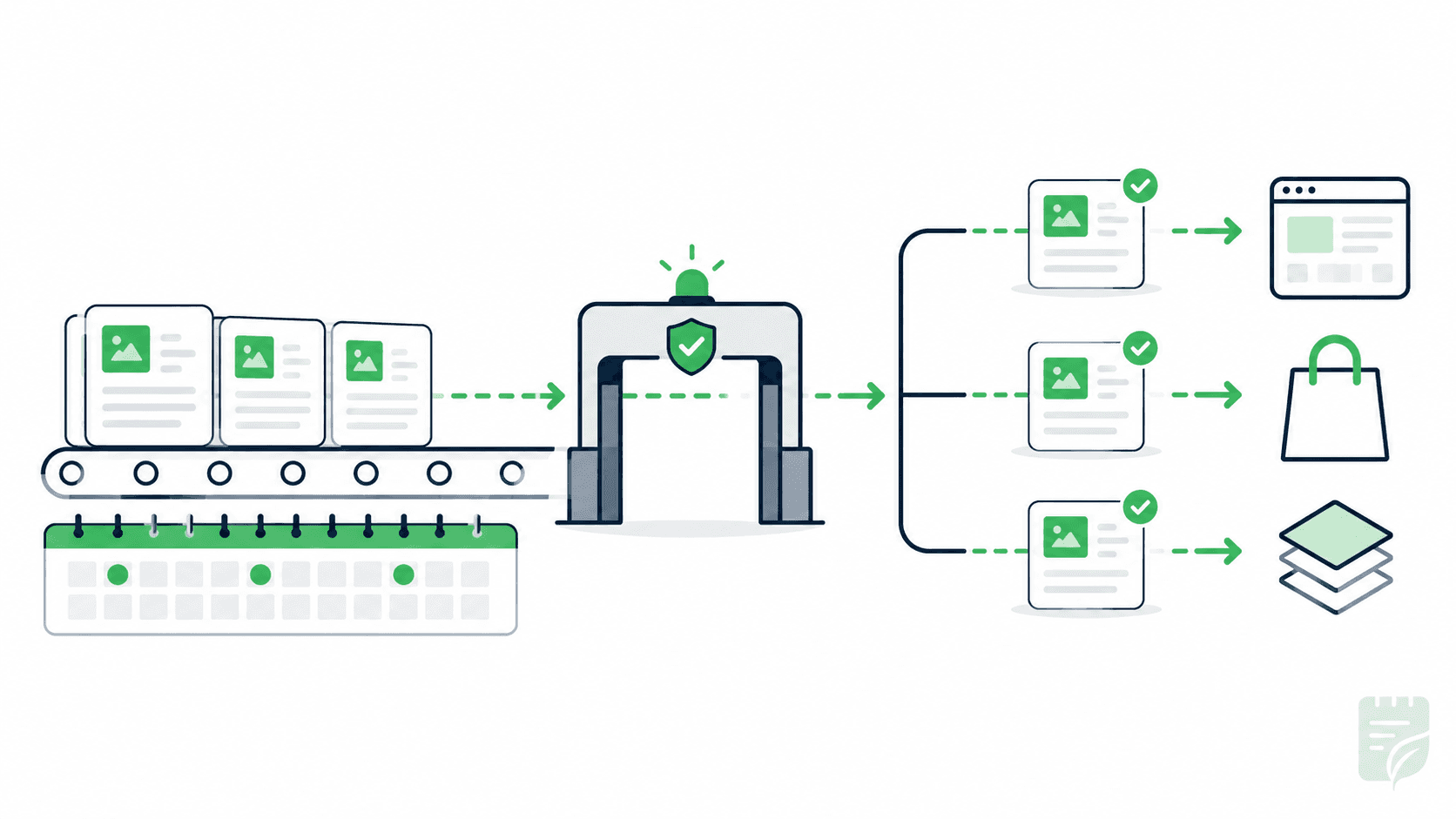
Automated blog publishing takes finished posts from a content calendar and ships them straight to your CMS on schedule, with images, meta tags, internal links, and structured data already attached. It is the step between “content is written” and “content is live”, and it is where most manual SEO programs quietly break down, not because the writing stops but because publishing consistently is tedious enough that it stops happening.
The stakes for getting this stage right have gone up. ChatGPT's browsing runs on Bing's index, and 87% of its citations match Bing's top results (Seer Interactive). That means how fast and how cleanly a post gets published, indexed, and picked up by Bing now affects AI visibility, not just Google rankings. A post sitting in a drafts folder helps nobody.
How automated blog publishing works
Automated blog publishing runs four steps for every post: formatting, asset attachment, scheduled delivery, and indexing signals. Each step mirrors what a human publisher does manually, just without the excuse to skip one when the week gets busy.
- Formatting. The draft is converted into the CMS's native format, headings, tables, and links intact, ready to render without manual cleanup.
- Asset attachment. Hero images, meta title, meta description, slug, and schema markup (Article, FAQPage, Person where relevant) are attached automatically.
- Scheduled delivery. The post publishes at a set time via the CMS's API, with days varied across the week rather than dumped in bursts, since burst publishing looks synthetic to both Google and readers.
- Indexing signals. The published URL is submitted to IndexNow, notifying Bing, Yandex, and other supporting engines that new content exists, so it gets crawled faster instead of waiting for the next natural crawl cycle.
This is the stage that follows automated keyword research and calendar planning. Research decides what to write, the content calendar decides when, and publishing is where the post actually reaches readers and search engines.
Why cadence matters more than most publishers realize
Publishing volume should ramp with domain age and authority, because a burst of posts on a young or thin domain reads as scaled content abuse rather than a growing publication. This is not a theoretical caution. Google's leaked ranking documentation includes contentEffort, an estimate of how much genuine work a page reflects, and siteFocusScore, which measures whether a site stays on topic. Both are scored sitewide, so publishing fast without pacing does not just risk the new posts, it drags down pages that were already ranking.
The practical fix is a readiness-based cadence: new domains publish four to eight posts a month while engagement signals build, and volume increases only as the domain earns it through steady traffic and topical consistency. A site with 24 months of history and a Domain Rating above 50 can sustain 30 to 60 posts a month safely. A six-month-old domain publishing the same volume is choosing risk over growth. Automated publishing done well enforces this pacing by default instead of leaving it to whoever remembers to check.
Supported integrations
Automated blog publishing needs to write into wherever your site actually lives, not just generate content that sits in a dashboard. Leafpad publishes directly to WordPress, Shopify, Webflow, Ghost, and Framer, and works with projects built on Lovable, Bolt, and Replit through their APIs. An MCP server is also available, so posts can be published directly from Claude, ChatGPT, or Cursor without leaving those tools. See every supported integration for the full list and setup details.
Two platforms get dedicated treatment because their publishing paths differ enough to need it: store owners should read Shopify SEO automation for App Store install steps and blog-versus-product-page framing, and WordPress publishers should read WordPress SEO automation for the plugin-versus-platform distinction and connection setup.
Automated blog publishing vs autoblogging
Automated blog publishing is not autoblogging, even though the two terms get used interchangeably. Autoblogging tools of the 2010s scraped or spun existing content and published it at high volume with no quality review, which is exactly the pattern Google's scaled content abuse policy was written to catch. Automated blog publishing, done correctly, is the delivery mechanism for content that already passed research, drafting, and quality gates. The term carries baggage it does not deserve when the pipeline behind it is sound.
The distinction is not cosmetic. A quality gate that scores every draft before it ships, automatic internal linking that connects new posts to relevant existing ones with varied anchors, and a cadence paced to domain readiness are what separate a legitimate publishing pipeline from the autoblogging pattern Google penalizes. Removing the review step is what turns automation into spam, not the automation itself.
What Leafpad's publishing pipeline does
Leafpad publishes finished posts directly to your connected platform on a schedule paced to your domain's readiness score, with images, metadata, schema, and internal links attached automatically, then submits the URL to IndexNow so search engines discover it fast. Nothing sits in a drafts folder waiting for someone to remember to hit publish.
You can see this working before committing to anything. Connect your site and Leafpad analyzes it, builds a calendar, and writes and publishes your first post free, no card required. Full plan details are on the Leafpad pricing page, and everything above is one stage of the full SEO automation pipeline Leafpad runs end to end.
FAQ
Frequently asked questions
What is automated blog publishing?
Automated blog publishing is software that takes a finished post and delivers it directly to your CMS on schedule, with images, meta tags, internal links, and structured data attached automatically. It is the delivery stage of a content pipeline, sitting after research and drafting and before a post reaches readers or search engines.
Is automated blog publishing the same as autoblogging?
No. Autoblogging historically meant scraping or spinning content and publishing it at high volume with no review, which is what Google's scaled content abuse policy targets. Automated blog publishing, run correctly, ships content that already passed research, drafting, and quality checks. The difference is the review step, not the automation.
How often should an automated blog publish?
Cadence should match domain age and authority rather than a fixed number. New domains under six months old are safest at four to eight posts a month while engagement builds. Established domains with 24 or more months of history and strong authority can sustain 30 to 60 posts a month. Publishing volume ahead of what a domain can support is the most common way automation causes real harm.
Can automated publishing work with my existing website platform?
Most likely, yes. Leafpad publishes directly to WordPress, Shopify, Webflow, Ghost, and Framer, and integrates with Lovable, Bolt, and Replit projects through their APIs, plus an MCP server for publishing from Claude, ChatGPT, or Cursor. Check the full integrations list for platform-specific setup details.
Written by Sameeh, Founder of Leafpad. Sameeh builds Leafpad, an SEO and GEO automation platform, and has spent the last year publishing daily through the same pipeline described on this page, earning 50,000+ monthly Google impressions and hundreds of weekly AI citations for Leafpad's own site.