Automated Keyword Research: From One Seed Keyword to a 30-Day Calendar
Written by Sameeh, Founder of Leafpad
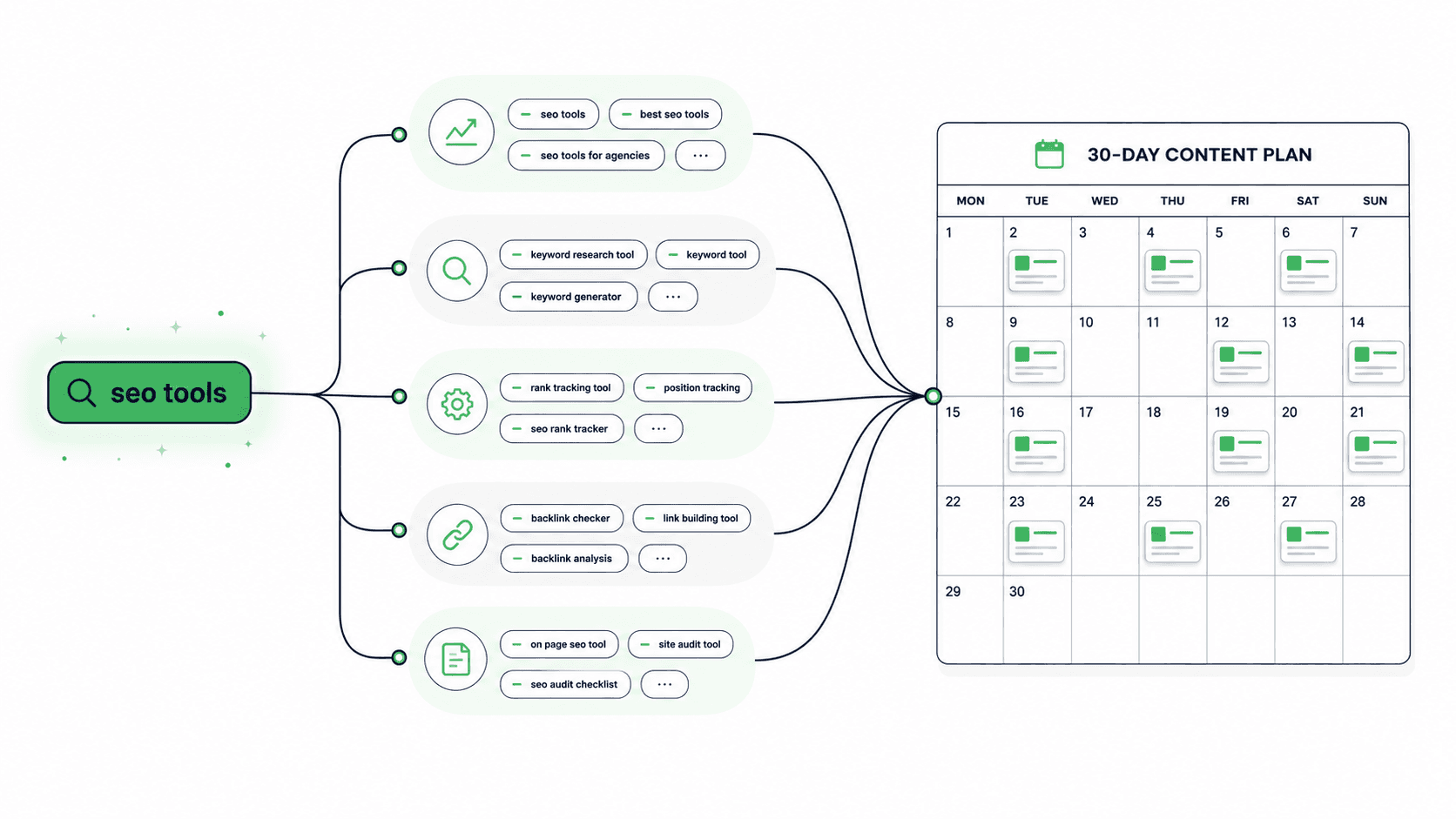
Automated keyword research uses software to expand a seed topic into hundreds of candidate keywords, pull search volume and difficulty data, classify intent, cluster related queries, and assign each cluster to a content calendar. What takes a marketer six to eight hours per topic runs in minutes, with no spreadsheet involved.
Getting the targets right matters more than it used to. 46% of ChatGPT prompts now trigger a live web search (Semrush, 80 million queries analyzed), only 38% of AI Overview citations come from Google's top 10 results (Ahrefs, February 2026), and Google-referred traffic is down roughly 33% year over year (Press Gazette). The queries worth targeting are shifting toward longer, conversational, question-shaped searches, and manual research workflows were never built to keep up with that volume.
How automated keyword research works
Automated keyword research runs five steps in sequence: seed expansion, volume and difficulty pulls, intent classification, clustering, and calendar assignment. Each step used to be a separate manual task with its own tool and its own spreadsheet tab. Automation chains them into one pipeline that starts with a topic and ends with scheduled content.
- Seed expansion. One seed topic is expanded into hundreds of related queries, questions, and long-tail variants using live search data.
- Volume and difficulty. Each candidate gets search volume and ranking difficulty attached, so low-volume dead ends and unwinnable head terms are filtered out early.
- Intent classification. Every query is tagged informational, commercial, or transactional. Intent decides content shape: a how-to guide, a comparison, or a product-adjacent page.
- Clustering. Queries that one page can satisfy are grouped together. This prevents the classic mistake of writing five thin posts that compete with each other for the same query.
- Calendar assignment. Clusters are ranked by opportunity and placed on a content calendar, paced to what the domain can support.
This is exactly the sequence Leafpad's keyword research engine runs before a single post is written.
Manual vs automated: the time math
A competent marketer needs six to eight hours to research one topic cluster manually. The same work runs in under ten minutes automated, and the output arrives already clustered, deduplicated, and scheduled. The quality difference is not in any single step. It is that automation never skips steps when the week gets busy.
| Step | Manual | Automated |
|---|---|---|
| Seed expansion | 1 to 2 hours | Seconds |
| Volume and difficulty pulls | 1 hour | Seconds |
| Intent classification | 1 to 2 hours | Minutes |
| Clustering and deduplication | 2 hours | Minutes |
| Calendar assignment | 1 hour | Instant |
| Total per topic | 6 to 8 hours | Under 10 minutes |
Speed is only half the argument. The deeper comparison, including where manual research still wins, is covered in our manual vs automated SEO guide.
Worked example: one seed keyword to a 30-day calendar
Take a furniture store that sells office chairs. Feed the seed keyword “ergonomic office chair” into an automated pipeline and it returns clustered, intent-tagged topics with a publishing schedule attached. Here is a condensed version of what comes out.
Clusters identified:
| Cluster | Example target query | Intent |
|---|---|---|
| Buying guides | best ergonomic office chair for back pain | Commercial |
| Comparisons | mesh vs leather office chair | Commercial |
| How-to | how to adjust an ergonomic office chair properly | Informational |
| Problem queries | why does my office chair hurt my back | Informational |
| Budget | best ergonomic office chair under $300 | Transactional |
Sample first week of the calendar:
| Day | Scheduled post |
|---|---|
| Monday | Why does my office chair hurt my back? 7 fixes that work |
| Wednesday | Mesh vs leather office chairs: which lasts longer? |
| Friday | Best ergonomic office chairs for back pain, tested criteria |
Every post targets one cluster, so nothing competes with anything else, and the informational posts internally link toward the commercial ones. Leafpad generates this automatically when you connect your site: it analyzes your pages, builds the calendar, and writes your first post free so you can judge the quality before paying anything.
What automation gets wrong without guardrails
Raw keyword automation optimizes for search volume, not business value. Without guardrails it will happily schedule high-volume topics your buyers never search, duplicate topics you already rank for, and misread intent on ambiguous queries. The fix is not more manual work. It is automation with business context attached.
Mike King of iPullRank described the underlying problem with volume-chasing tools: “Google moved beyond the lexical model of search 10 years ago and all of our tools are still just counting the presence and distribution rates of words.” Good pipelines correct for this in three ways: scoring every candidate against your actual product pages, checking new topics against existing content before scheduling (which is also how content refresh decisions get made), and keeping all topics inside a small set of pillars so the site stays topically focused. That focus discipline is the core of SEO automation done safely.
Where the keywords go next
Research is step one of six. The clusters feed a calendar, the calendar feeds writing, and finished posts move into automated blog publishing with images, meta tags, and internal links attached. The whole chain is what makes the research worth automating: keywords in a spreadsheet earn nothing until they become live pages.
You can run the entire sequence on your own site today. Sign up, connect your site, and get your first post free, no card required. Plans are on the Leafpad pricing page.
FAQ
Frequently asked questions
How do I automate keyword research?
Use a tool that chains all five steps: seed expansion, volume and difficulty data, intent classification, clustering, and calendar assignment. Point tools automate one step and leave you to stitch the rest together in spreadsheets. Full-pipeline platforms like Leafpad take a seed topic in and return a scheduled content calendar out.
Can keyword research be fully automated?
The mechanical work can be, end to end. What should stay human is the business judgment layer: confirming the pillars match your positioning, and adding topics only you know matter, like queries your sales calls surface. A good pipeline handles everything else and asks for your review, not your labor.
How does automated keyword research work for blogging?
The pipeline expands your niche into clustered blog topics, tags each with intent, and schedules them at a sustainable cadence. Each cluster becomes one post, informational posts link toward commercial ones, and the calendar refills itself monthly. This is how a blog publishes consistently without anyone maintaining a topic spreadsheet.
Is automated keyword research accurate?
Volume and difficulty data are as accurate as the underlying search data, which is the same data manual researchers use. Where automation is measurably better is consistency: it never skips the clustering or deduplication steps that prevent posts from competing with each other, which is the most common manual research mistake.
Written by Sameeh, Founder of Leafpad. Sameeh builds Leafpad, an SEO and GEO automation platform, and has spent the last year publishing daily through the same pipeline described on this page, earning 50,000+ monthly Google impressions and hundreds of weekly AI citations for Leafpad's own site.