TL;DR
Google's official position is unambiguous: there is no separate "AI SEO." The "Optimizing for generative AI" guide explicitly says "optimizing for generative AI search is optimizing for the search experience, and thus still SEO," and it tells founders to ignore most "AEO/GEO hacks" (llms.txt, chunking content, rewriting for AI, inauthentic mentions, special schema for AI). Pages must simply meet the standard Search technical requirements, be indexable and eligible to be shown with a snippet, and follow Google's helpful-content, E-E-A-T, and spam guidance — the same playbook that has run since the 2022 Helpful Content System.
On AI-generated content, Google's "Guidance on using generative AI" + the March 2024 "scaled content abuse" spam policy together draw the line at intent and value, not authorship: AI-assisted content is fine if it meets Search Essentials, but "using generative AI tools or other similar tools to generate many pages without adding value for users" violates policy "no matter how it's created." The "Who, How, Why" framework expects disclosure of AI/automation when readers would reasonably ask "how was this created?".
The bonus AI-citation layer (ChatGPT, Perplexity, AI Overviews) is mostly downstream of doing the SEO/E-E-A-T fundamentals well. The Princeton GEO paper (Aggarwal et al., KDD '24) — the only peer-reviewed evidence base — confirms keyword stuffing hurts visibility in generative engines while adding citations, statistics, and quotations from credible sources lifts visibility by up to ~40% in aggregate. As of mid-2026, AI Overviews appear in ~18% of Google searches (Pew, March 2025 data) and demonstrably cut external clicks by 30–50% on triggered queries, so the strategic prize is to be cited and to write content deep enough that AI summaries cannot substitute for the click.
This isn't a leaked algorithm document. It's a design blueprint for publishers panicking about collapsing click-through rates.
The core message: traditional SEO (keywords, backlinks) is necessary but insufficient. You now need machine readability at the meaning level.
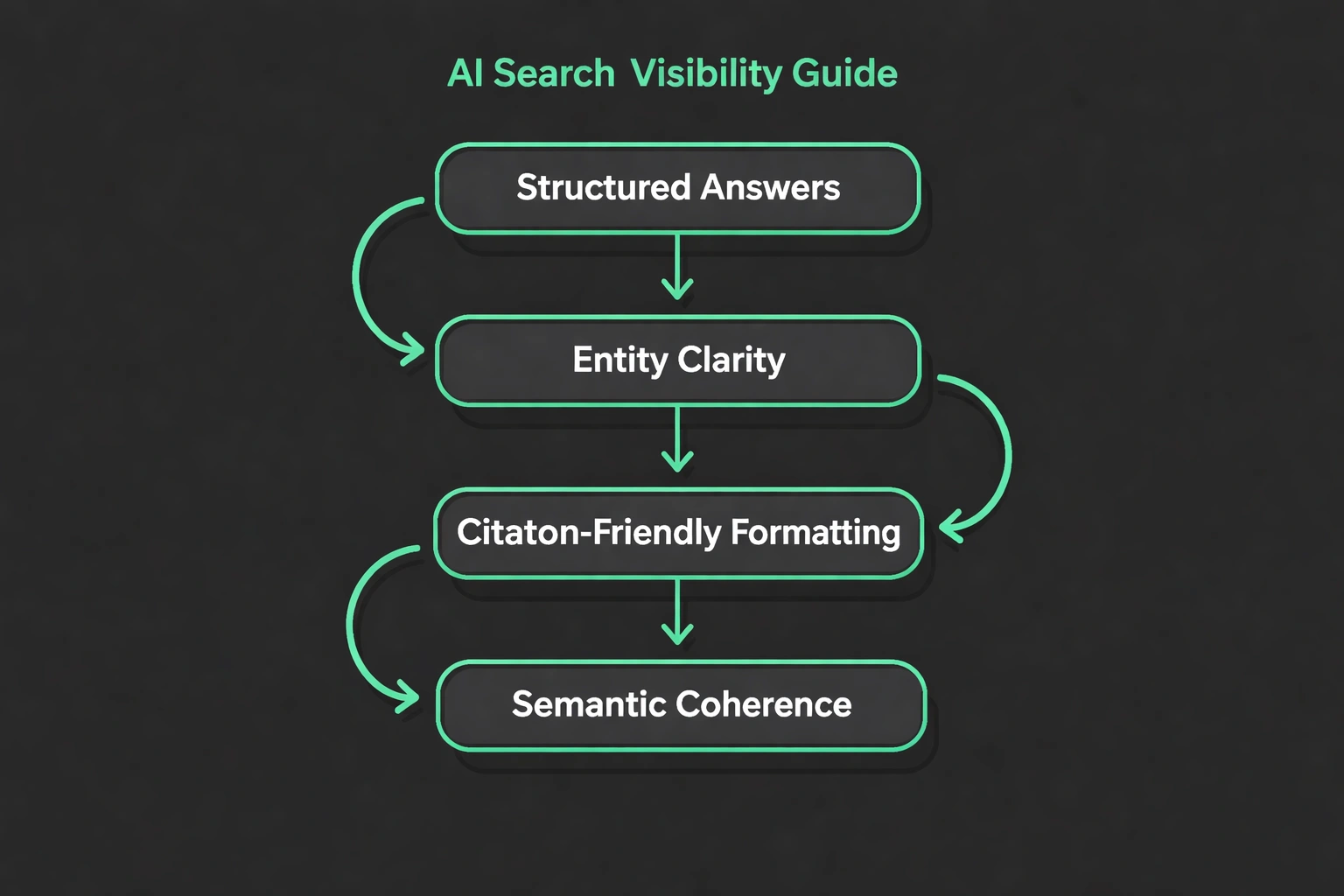
The guide focuses on four things: structured answers, entity clarity, citation-friendly formatting, and semantic coherence. It tells you to write for the questions people ask chatbots, not just the keywords they type into a search bar.
Key Findings
Both Google documents are part of the "SEO fundamentals → Generative AI fundamentals" subtree of Search Central. They sit alongside (and explicitly point back to) the SEO Starter Guide, "Creating helpful, reliable, people-first content," Search Essentials, the spam policies, and the structured data docs. Last-updated stamps at the time of capture: AI optimization guide — 2026‑05‑15 UTC; Using generative AI content — 2025‑12‑10 UTC; Helpful content — 2025‑12‑10 UTC; Spam policies — 2026‑05‑15 UTC.
Google explicitly names two technical mechanisms behind AI Overviews and AI Mode: (a) Retrieval-augmented generation (RAG) — "also known as grounding" — which uses core Search ranking to pull pages from the index, and (b) Query fan-out — concurrent related sub-queries (the same technique powering AI Mode). This is the most authoritative explanation Google has given of how its AI features choose sources.
Eligibility rule (memorise this for the guide): "To be eligible to be shown in generative AI features on Google Search, a page must be indexed and eligible to be shown in Google Search with a snippet, fulfilling the Search technical requirements." Practically: don't use
nosnippet, don'tnoindexvaluable pages, allow Googlebot to crawl, render JS-rendered content server-side or properly, and meet Core Web Vitals/page-experience basics.Google's five-item "mythbust" list is the single most important corrective for founders being sold "GEO": (a) you do not need llms.txt or special AI markup; (b) you do not need to "chunk" content into tiny pieces; (c) you do not need to rewrite for AI; (d) seeking "inauthentic mentions" is unhelpful; (e) structured data is not required for AI features (though it's still good SEO for rich results).
The AI-content guidance is short by design — it's a policy doc, not a how-to. The headline rule: AI-assisted content must meet Search Essentials and the spam policies, particularly the scaled content abuse policy (March 2024). Google explicitly defers to the "How" question in the Who/How/Why framework and the Search Quality Rater Guidelines sections 4.6.5 (scaled content) and 4.6.6 (little-to-no-effort/originality/value).
Scaled content abuse (March 5, 2024 spam update) — verbatim: "Scaled content abuse is when many pages are generated for the primary purpose of manipulating Search rankings and not helping users… This abusive practice is typically focused on creating large amounts of unoriginal content that provides little to no value to users, no matter how it's created." That last clause ("no matter how it's created") is the most-quoted line in the SEO industry because it closed the human-vs-AI loophole that had existed before.
Site reputation abuse (often called "parasite SEO") is a separate spam category founders should know about — third-party content piggybacking on a host's ranking signals. Editorial syndication, native advertising shared "directly to readers," forums, user-generated content, columns, opinion pieces, affiliate links, coupons from merchants, and wire/press release services are explicitly NOT site reputation abuse. Site reputation abuse enforcement was delayed from the main March 5, 2024 rollout to May 5, 2024.
2025–2026 measurement reality: AI Overviews and AI Mode clicks/impressions are folded into the standard Search Console performance report under the "Web" search type — there is no separate AI Overviews filter as of May 2026. Google's own "AI features and your website" doc confirms: "Just like the rest of the search results page, sites appearing in AI features (such as AI Overviews and AI Mode) are included in the overall search traffic in Search Console." Founders should expect impressions to rise while CTR falls on informational queries that trigger AI Overviews. (Caveat: Google disclosed a GSC logging bug overstating impressions from May 13, 2025 onward; clicks unaffected.)
AI Mode timeline (so the guide can stay current): experimental Labs launch March 2025 → expanded to all US users May 20, 2025 at I/O → India June 2025 → UK July 2025 → 200+ countries / 40+ languages by October 7, 2025 → agentic actions (OpenTable, Resy, Ticketmaster, etc.) and personalization rolled into Labs late 2025. AI Overviews have surpassed 1.5 billion monthly users (Google, May 2025).
Empirical impact of AI Overviews on clicks (this is the hook your readers will want): Pew Research Center (data collected March 2025, published July 22, 2025) — 18% of Google searches in the study produced an AI Overview; users clicked an organic link 8% of the time when an AI Overview was present vs. 15% without (a ~47% relative drop); only 1% clicked a link inside the AI Overview itself; 26% of sessions with an AI Overview ended on the SERP vs. 16% without. Saharsh Agarwal (Indian School of Business) and Ananya Sen (Carnegie Mellon), in "Google AI Overviews and Publisher Traffic: Evidence from a Field Experiment" (SSRN, Jan–Feb 2026 working paper; 1,065 US adults recruited via Prolific, Chrome extension), confirmed the causal effect: "average outbound organic clicks fell from 0.61 to 0.38 per search. That works out to a 38% drop" when AI Overviews were shown. Pew sample: 900 US adults / 68,879 searches.
Details — Point-by-Point Structured Breakdown
A. Page 1 — "Optimizing your website for generative AI features on Google Search"
URL: developers.google.com/search/docs/fundamentals/ai-optimization-guide · Last updated 2026‑05‑15 UTC
Intro framing (verbatim):
"User preferences are rapidly evolving and people are increasingly gravitating to generative AI experiences… This guide is for website owners looking for official best practices from Google Search on how to succeed in generative AI features in Google Search (such as AI Overviews and AI Mode)."
Section A1 — "Is SEO still relevant for generative AI search?" Google's one-word answer: "yes!" The argument: AI features are "rooted in our core Search ranking and quality systems." Two named techniques:
RAG / grounding — "improve the quality, accuracy, and freshness of AI responses by relying on our core Search ranking systems to retrieve relevant, up-to-date web pages from our Search index… showing prominent, clickable links to relevant web pages."
Query fan-out — concurrent related sub-queries; example given is "how to fix a lawn that's full of weeds" → "best herbicides for lawns" / "remove weeds without chemicals" / "how to prevent weeds in lawn."
AEO/GEO callout: "From Google Search's perspective, optimizing for generative AI search is optimizing for the search experience, and thus still SEO."
Section A2 — "Apply foundational SEO best practices to generative AI search" has two sub-sections. The first is content; the second is technical.
A2.1 "Create valuable, non-commodity content for your audience" — five bullets, each with a "do this" recommendation:
Provide a unique point of view. Example contrast Google itself draws: a "first-hand review… based on personal experience" vs. "a summary of existing content [that] simply restates information already available elsewhere." Google says: "Don't just recycle what others on the internet have already said, or could easily be produced by a generative AI model."
Create non-commodity content. Verbatim contrast: commodity = "7 Tips for First-Time Homebuyers"; non-commodity = "Why We Waived the Inspection & Saved Money: A Look Inside the Sewer Line." The non-commodity example "provides unique expert or experienced takes that go beyond common knowledge."
Organize content for readers — paragraphs, sections, "headings that provide a clear structure to navigate content."
Add high-quality images and video — Google notes its AI features bring in images/video; references the existing Image SEO and Video SEO docs as sufficient.
Focus on user wants, avoid overdoing it — explicit warning: creating separate pages for every fan-out query variation "primarily to manipulate rankings or generative AI responses in Google Search violates Google's scaled content abuse spam policy."
If using AI tools to assist: must meet Search Essentials and spam policies; cross-links to the AI-content guidance doc.
The "satisfaction test" Google gives as the simplifying question (worth quoting directly in the guide):
"Is this content that my visitors would find satisfying?"
A2.2 "Build and maintain a clear technical structure" — six bullets:
Meet the Search technical requirements — eligibility rule (page must be indexed and eligible to be shown with a snippet). Important caveat verbatim: "Just because a page meets all requirements, best practices, and complies with the policies, doesn't mean that Google will crawl, index, or serve its content. Indexing and serving aren't guaranteed."
Follow crawling best practices — content must be crawlable; pointer to crawl budget guide for large/frequently-updated sites.
Semantic HTML — "focus on human readability and don't worry about perfect code"; the web isn't valid HTML and Google can parse it, but semantic HTML helps screen readers and agentic browsers.
JavaScript SEO — Google can process JS as long as it isn't blocked; pointer to JS SEO basics.
Good page experience — displays well across devices, reduced latency, main content distinguishable from chrome.
Reduce duplicate content — pointer to SEO Starter Guide section on duplicates.
Verify in Search Console for diagnostics.
A2.3 "Optimize your local business and ecommerce details" — Merchant Center feeds and Google Business Profile help products/services appear in AI responses and other Google Search results. Mentions Business Agent (conversational experience for brands).
Section A3 — "Mythbusting generative AI search: what you don't need to do" (the most quotable single section for the guide). Five items:
LLMs.txt and other "special" markup — "You don't need to create new machine readable files, AI text files, markup, or Markdown to appear in generative AI search."
"Chunking" content — "There's no requirement to break your content into tiny pieces for AI to better understand it… There's no ideal page length."
Rewriting content just for AI systems — "You don't have to worry that you don't have enough 'long-tail' keywords or haven't captured every variation of how someone might seek content like yours."
Seeking inauthentic "mentions" — "Seeking inauthentic 'mentions' across the web isn't as helpful as it might seem."
Overfocusing on structured data — "Structured data isn't required for generative AI search, and there's no special schema.org markup you need to add. However, it's a good idea to continue using it as part of your overall SEO strategy."
Section A4 — "Explore agentic experiences" — defines AI agents (browser agents, etc.), points to web.dev's agent-friendly site UX guide and the emerging Universal Commerce Protocol (ucp.dev). Tone is "if relevant to your business and you have extra time" — secondary.
Section A5 — "Next steps: what to focus on" — recap in four bullets: apply SEO best practices; create non-commodity helpful content; prioritize SEO over "AEO/GEO hacks"; explore agentic experiences.
Section A6 — "Stay informed and ask questions" — links to Search Central blog, LinkedIn, X, Help Forum, YouTube channel.
B. Page 2 — "Google Search's guidance on using generative AI content on your website"
URL: developers.google.com/search/docs/fundamentals/using-gen-ai-content · Last updated 2025‑12‑10 UTC
Much shorter doc (essentially policy + three subsections).
Intro (verbatim, ≤25 words):
"Using generative AI tools or other similar tools to generate many pages without adding value for users may violate Google's spam policy on scaled content abuse."
Followed by the bolded rule:
"If you're using generative AI content on your website, make sure your work meets the standards of the Search Essentials and our spam policies."
Reference to the Search Quality Rater Guidelines — explicitly cites section 4.6.5 (scaled content abuse) and section 4.6.6 (main content created with little to no effort, little to no originality, and little to no added value). Critical caveat Google itself adds: "These guidelines are not a guide to ranking first in Google… their ratings don't directly influence ranking" — raters are calibration, not algorithm.
Subsection B1 — "Focus on accuracy, quality, and relevance" — applies "especially when automatically generating the content." Specifically calls out metadata that may appear in Search results:
<title>elements (link to title-link doc)meta description elements (link to snippet doc)
structured data (link to structured data intro)
alt text for images (link to Google tech writing accessibility doc)
For structured data: must comply with general guidelines, feature-specific policies, and be validated.
Subsection B2 — "Give users context" — points back to the "How the content was created" section in the Helpful Content doc (this is the AI/automation disclosure guidance). Specifics:
Consider adding background on how automation was used.
Add image metadata for AI-generated images.
For ecommerce / Merchant Center: AI-generated images must contain IPTC
DigitalSourceType=TrainedAlgorithmicMediametadata; AI-generated product titles/descriptions must be specified separately and labeled as AI-generated.Links to "FAQs in our blog post on AI-generated content" (the February 2023 Google Search Blog post that introduced the "Who, How, Why" framework).
That's the entire doc. It is intentionally short because the substantive guidance lives in (a) Helpful Content doc, (b) Spam Policies, and (c) the February 2023 blog post.
C. Supporting Google docs the AI-content guidance points to (essential context for the guide)
C1. "Creating helpful, reliable, people-first content" (last updated 2025‑12‑10 UTC)
The self-assessment is the most actionable single Google document. Structure:
C1.1 Content and quality questions (12 questions) — does it provide original information/reporting/research/analysis? substantial/comprehensive description? insightful analysis beyond the obvious? avoid copying? descriptive non-clickbaity title? bookmarkable? magazine-quality? substantial value vs. other SERP pages? spelling/style? produced well, not sloppy? not mass-produced across creators or networks?
C1.2 Expertise questions (4) — clear sourcing/expertise/about page/author info? would research yield a trusted/authoritative impression? written or reviewed by an expert or knowledgeable enthusiast? any easily-verified factual errors?
C1.3 People-first content (yes list) — existing intended audience? first-hand expertise & depth? primary purpose/focus? readers leave having learned enough? satisfying experience?
C1.4 Avoid search-engine-first content (warning list) — primarily for SE traffic? lots of content on many topics hoping some perform? extensive automation? mainly summarizing? trending-only? readers needing to search again? writing to a target word count? entering niches without expertise? answering unanswerable questions? changing dates to fake freshness? mass adding/removing content for "freshness"? Google explicitly debunks: "No, we don't" (word count) and "No, it won't" (freshness churn).
C1.5 E-E-A-T (Experience, Expertise, Authoritativeness, Trustworthiness) + YMYL — verbatim: "Of these aspects, trust is most important." YMYL = "Your Money or Your Life" — topics affecting health, financial stability, safety, welfare. Google: "E-E-A-T itself isn't a specific ranking factor" but its signals are used. Raters use it for calibration only.
C1.6 "Who, How, and Why" framework — the core mental model Google now wants creators to use:
Who — "Is it self-evident to your visitors who authored your content?" Bylines + author pages explicitly encouraged.
How — disclosures for automation/AI when readers would reasonably ask "How was this created?" Three sub-questions: is the use of automation self-evident? are you providing background on how AI was used? are you explaining why automation was useful?
Why — the most important. The right answer is "creating content primarily to help people." Wrong answer = "primarily making content to attract search engine visits." If you use AI "to produce content for the primary purpose of manipulating search rankings, that's a violation of our spam policies."
C2. Spam Policies (last updated 2026‑05‑15 UTC) — the categories founders need to recognize
Twelve categories. The two that matter most for AI/content strategy:
Scaled content abuse (added March 5, 2024; Google Search Central blog post by Elizabeth Tucker, "What web creators should know about our March 2024 core update and new spam policies"). Definition (verbatim):
"Scaled content abuse is when many pages are generated for the primary purpose of manipulating search rankings and not helping users."
Crucial qualifier: "This abusive practice is typically focused on creating large amounts of unoriginal content that provides little to no value to users, no matter how it's created." Google's companion April 26, 2024 update note quantified the impact: "As of April 19, we've completed the rollout of these changes. You'll now see 45% less low-quality, unoriginal content in search results."
Five example tactics listed in the policy:
AI tools used to generate many pages without adding value.
Scraping feeds/search results/other content (incl. synonymizing, translating, obfuscation).
Stitching/combining content from different web pages without adding value.
Multiple sites to hide the scaled nature.
Pages where content makes little sense to a reader but contains search keywords.
Site reputation abuse ("parasite SEO"). Definition: "third-party content is published on a host site mainly because of that host's already-established ranking signals." Enforcement was delayed to May 5, 2024. Examples include sponsored payday-loan reviews on an education site, "best casinos" on a medical site, fortune-teller pages on a movie-review site, etc. Explicit NOT-violations: wire/press releases, news syndication, UGC/forums/comments, columns/opinion pieces, editorial advertorials/native ads where the purpose is to share content directly with readers, affiliate links (properly qualified), embedded ad units, and coupons sourced directly from merchants.
Other categories worth a one-liner mention in the guide: cloaking, doorway abuse, expired domain abuse, hacked content, hidden text/links, keyword stuffing, link spam (incl. paid links without rel="sponsored"/nofollow"), machine-generated traffic, malicious practices, misleading functionality, scraping, sneaky redirects, thin affiliation, user-generated spam.
Bonus / Secondary Layer (clearly secondary in the guide)
D1. Princeton GEO study (Aggarwal et al., KDD 2024) — the only peer-reviewed evidence base
Citation: Aggarwal, P., Murahari, V., Rajpurohit, T., Kalyan, A., Narasimhan, K., & Deshpande, A. (2024). GEO: Generative Engine Optimization. In KDD 2024 — Proceedings of the 30th ACM SIGKDD Conference on Knowledge Discovery and Data Mining, pp. 5–16. ACM. DOI 10.1145/3637528.3671900. arXiv 2311.09735 (v3, June 28, 2024).
Headline finding (verbatim from the abstract): "Through rigorous evaluation, we demonstrate that GEO can boost visibility by up to 40% in generative engine responses." And: "…including citations, quotations from relevant sources, and statistics can significantly boost source visibility…"
Body-of-paper specifics (these are the ones to use in the guide; the abstract gives only the aggregate "up to 40%"):
Tested 10,000 queries (the GEO-bench benchmark) across multiple generative engines.
Section 4 (verbatim): "our top-performing methods, Cite Sources, Quotation Addition, and Statistics Addition, achieved a relative improvement of 30-40% on the Position-Adjusted Word Count metric and 15-30% on the Subjective Impression metric."
Table 1 absolute lifts vs. baseline of 19.3: Quotation Addition = 27.2 (~41% lift), Statistics Addition = 25.2 (~31% lift), Cite Sources = 24.6 (~27% lift).
Keyword Stuffing performed worse than baseline — confirms it transfers as a negative from SEO to GEO.
Perplexity.ai real-world test (Section 6, Table 5): Statistics Addition showed up to 37% improvement on Subjective Impression; Quotation Addition showed 22% improvement on Position-Adjusted Word Count.
Effects depend on query domain; methods combine well (Fluency Optimization + Statistics Addition is the strongest combination).
Honest framing for the guide: these are academic findings against a benchmark (GEO-bench) and tested primarily on Perplexity.ai-class engines, not Google AI Overviews specifically. Treat as "supporting evidence that adding citations, statistics, and quotations is a good idea — which Google's own helpful-content guidance also rewards as 'original information, reporting, research, or analysis'." Do not claim the abstract specifies the per-method percentages — it doesn't; the abstract gives only "up to 40%" overall and the per-method numbers come from the body and tables.
D2. Industry consensus on AI citation (clearly third-party)
On source selection (industry observation, not Google guidance):
Aleyda Solis (Orainti, June 16, 2025 checklist) — eight-point framework: chunk-level retrieval optimization, answer synthesis, citation worthiness, topical breadth/depth, multimodal support, authoritativeness/entity signals, personalization resilience, crawlability. Note: Aleyda is candid that Google says no special optimization is needed for AI Overviews beyond general guidelines.
iPullRank/Solis observation (with industry caveat — not Google-confirmed): "~52% of AI Overviews citations are not in the top 50 traditional results; ~29% link to Google properties; ~12% overlap between Google's traditional results and ChatGPT answer sources." Cite carefully as industry-observed, not official.
Pew (the official-quality citation source): AI Overviews most commonly cite Wikipedia, YouTube, and Reddit; .gov sites appear in 6% of AI Overview citations vs. 2% of standard results; 88% of AI Overviews cite three or more sources; median length 67 words (range 7–369).
On getting cited by ChatGPT, Perplexity, Claude — the broadly accepted, non-controversial moves:
Be crawlable by AI bots (GPTBot, OAI-SearchBot, ChatGPT-User, PerplexityBot, ClaudeBot, Claude-SearchBot, Google-Extended, CCBot). Cloudflare's May 2025 analysis ("From Googlebot to GPTBot: who's crawling your site in 2025") found: "The AI crawler landscape saw a significant shift…with GPTBot (from OpenAI) emerging as the dominant force, surging from 5% to 30% share" of AI-only crawler traffic (May 2024 → May 2025); GPTBot's share of all AI+search traffic rose from 2.2% to 7.7% over the same period. Cloudflare's August 2025 follow-up, "The crawl-to-click gap: Cloudflare data on AI bots, training, and referrals," reported: "Over the past 12 months, 80% of AI crawling was for training, compared with 18% for search and just 2% for user actions."
Write extractable, self-contained passages — clear definitions up front, single idea per section, descriptive H2/H3.
Include verifiable specifics — numbers, dates, named sources, quoted experts. (This is where Princeton GEO findings reinforce Google's own non-commodity guidance.)
Earn external corroboration — be mentioned/reviewed across the open web (G2, Trustpilot, Capterra for SaaS; Reddit and YouTube for B2B explainer content). Yext's Oct 9, 2025 press release on a study of ~1.6M queries per model across ChatGPT, Gemini, and Perplexity (July 1 – August 31, 2025) found that brand-controlled sources still drive ~86% of citations (websites 44% + listings 42%) and that "Reddit and similar platforms accounted for just 2% of citations once location context and query intent were applied." Reviews/social added another 8%. Reddit and YouTube dominate only in specific prompt categories (general explainers, community-driven questions), not in objective product/pricing/feature queries.
Maintain freshness — visible last-updated dates, quarterly review of priority pages. Perplexity especially weights recency.
D3. Liz Reid (Google VP, Search) public commentary 2025–2026 (semi-official)
AI Mode and AI Overviews have driven a 10%+ increase in usage of Google for the types of queries that show AI Overviews (Google I/O 2025 internal data, Sept 2024–April 2025).
AI Mode users in US + India = 100M+ MAU (Reid, Oct 2025).
Reid's "deep clicks vs. shallow clicks" framing: shallow lightly-rewritten content loses clicks; pages with unique perspective, expertise, depth gain "deep clicks." This is consistent with Google's own helpful-content doctrine.
Preferred Sources globally launched December 2025; users who pick a preferred source click that site ~2× more often on average (Google).
Multimodal LLMs now allow Google to evaluate audio (podcasts) and video content beyond metadata/transcripts.
D4. Topical authority / pillar-cluster architecture (industry-consensus, not Google guidance)
The pillar-and-spoke model is endorsed by Search Engine Land, Conductor, Siteimprove, MarketMuse, Backlinko, etc., as the canonical 2025–2026 architecture for B2B SaaS organic growth. Note: Google does not officially endorse the term "topic clusters" — but the underlying behavior (depth, internal linking, hierarchy, comprehensive coverage of an entity/topic) aligns with the Helpful Content questions on "substantial, complete, or comprehensive description."
Practical implementation: clean subfolders (e.g.,
/crm/,/crm/implementation/), bidirectional pillar↔cluster internal links, descriptive HTML anchor text (not JS-only links per Google's crawlable-links guidance), Article + BreadcrumbList schema validated via Rich Results Test.Industry-cited statistic: HireGrowth's 2025 analysis "Topic Clusters vs Keyword Targeting: Which Wins in 2025?" (hiregrowth.ai), which Search Engine Land's topic-cluster guide cites verbatim: "Content grouped into clusters drives about 30% more organic traffic and holds rankings 2.5x longer than standalone pieces." Treat as a third-party metric, not a Google number.
D5. Schema/structured data state-of-the-art for B2B SaaS in 2026
Article — still produces rich results; include
author(Person),datePublished,dateModified,headline,image.Organization — essential for entity recognition by AI; include
name,url,logo,sameAs(LinkedIn, Crunchbase, Wikipedia/Wikidata when applicable),founder,foundingDate.Person (author bios) —
name,jobTitle,worksFor,sameAs(LinkedIn, X, GitHub, ORCID where applicable),knowsAbout.BreadcrumbList — still produces rich results; reinforces hierarchy.
FAQPage — deprecated as a rich result on May 7, 2026. Google notice: "FAQ rich results are no longer appearing in Google Search. We will be dropping the FAQ search appearance, rich result report, and support in the Rich results test in June 2026… support for the FAQ rich result in the Search Console API will be removed in August 2026." The FAQPage schema type remains valid; markup is harmless and may help other engines parse Q&A, but it no longer earns a SERP feature. The guide should explicitly correct the still-common advice to "add FAQ schema everywhere."
HowTo — restricted in 2023 and effectively deprecated; not a viable rich-result play.
Software application — relevant for SaaS; can produce rich results with reviews, pricing.
D6. Google-Extended and AI training controls (clearly secondary)
Google introduced the
Google-Extendeduser-agent in robots.txt on September 28, 2023 (Danielle Romain, VP Trust at Google). It controls whether your content trains Bard/Gemini and Vertex AI generative APIs.Google's documentation states: "Google-Extended does not impact a site's inclusion or ranking in Google Search." It is decoupled from Googlebot.
Apple introduced an
Applebot-Extendedequivalent shortly after.For founders who want to be cited by AI but not used as training data: allow Googlebot + Google-Extended for search/citation; OpenAI splits into GPTBot (training), OAI-SearchBot (search results in ChatGPT), and ChatGPT-User (live user-initiated browsing) — block GPTBot if you want to block training but keep OAI-SearchBot to remain citable. Anthropic has ClaudeBot (training) vs. Claude-SearchBot.
Important caveat to flag: for a B2B SaaS pursuing AI visibility, blocking these bots usually reduces citations. Most operators should allow them.
D7. Measurement (2026 reality)
Search Console — AI Overviews and AI Mode clicks/impressions are counted in the standard Performance report under the "Web" search type. There is no AI Overviews segment filter as of May 2026. AI Mode methodology added to Search Console help on June 17, 2025: clicks count when the user clicks a link to an external page in AI Mode; standard impression rules apply. Be aware of a Google-disclosed GSC logging bug overstating impressions from May 13, 2025 onward (clicks unaffected; disclosed April 3, 2026 on Google's Data Anomalies page).
GA4 — create a custom channel grouping for AI/LLM referrals (
chatgpt.com,perplexity.ai,gemini.google.com,claude.ai, etc.).Manual citation tracking — weekly scripted or manual queries to ChatGPT/Perplexity/AI Mode for priority prompts; log whether you're cited, which URL, and competing domains. Tools: Profound, Amplitude AI Visibility, AI Rank, Otterly, Peec — all third-party, all with limited methodological transparency, treat outputs as directional.
Recommendations — How to structure the guide for founders/B2B SaaS operators
Lead with Google's own thesis, then give the operator's playbook. The single highest-value reader experience is to disabuse founders of the "AI SEO is different / you need llms.txt / you need to chunk for AI" narrative they're being sold by vendors, then hand them the genuine list of high-leverage actions.
Suggested chapter outline:
The thesis (1 page): Google says optimizing for AI search is SEO. Lead with the verbatim quote. Frame the rest of the guide as "everything you'd do for great SEO, with a few new emphases."
What's actually changed in 2025–2026: AI Overviews (1.5B+ MAU), AI Mode rollout timeline, Pew + Agarwal/Sen click-loss data. Set expectations: zero-click sessions up, informational queries hit hardest, transactional/branded queries less affected.
The technical baseline (Google checklist): indexable + eligible for snippet, crawlable, no broken JS rendering, page experience, no
nosnippetornoindexon valuable pages, verified in Search Console, sitemaps, canonical tags. Each becomes an "actionable" line for the reader's checklist.Non-commodity content (the content engine): the unique-POV test, the "Why We Waived the Inspection" example, the satisfaction test, first-hand expertise, structure with H2/H3s, images and video. Turn each into a "do this/avoid this" couplet.
Who/How/Why and E-E-A-T (the trust engine): author bylines + author pages +
sameAs, Organization schema, AI/automation disclosures, YMYL caution. Concrete templates for the author box and About page.AI-generated content — what's allowed and what isn't: the scaled-content-abuse line ("no matter how it's created"), the rater-guidelines sections 4.6.5 and 4.6.6, the IPTC metadata for AI images, the "if a reader would ask how this was made, disclose it" rule.
The five "you don't need to" myths: llms.txt, chunking, rewriting for AI, mention-buying, AI-specific schema. Quote Google verbatim.
Architecture: pillars, clusters, internal linking, schema — clearly labeled as industry consensus, with Google's "comprehensive description" and crawlable-links guidance as the underlying authority. Note FAQPage rich result is dead as of May 7, 2026.
Bonus: getting cited by ChatGPT, Perplexity, and AI Overviews — clearly secondary. Princeton GEO as the academic backstop; the three repeated wins (numbers/statistics, explicit citations, expert quotes); G2/Trustpilot/Reddit/YouTube presence; freshness signals; bot access (
Google-Extended, GPTBot/OAI-SearchBot, PerplexityBot, ClaudeBot).Measurement, not metrics theatre: GSC the right way (Web type, query-shape analysis, impressions vs. clicks divergence as an "AI Overview is taking your click" signal), GA4 AI-referral channel grouping, weekly manual citation log.
Voice and positioning suggestions: Take a position. The position is: "Stop buying GEO snake oil. Google has been remarkably clear that the playbook is unchanged. The discipline shift is that the bar for original, expert-led, non-commodity content has risen sharply because AI Overviews now eat the easy clicks." That's a stance founders will share. It also lets you cite Liz Reid's "deep clicks vs. shallow clicks" framing as Google's own corroboration.
Thresholds that would change the recommendations:
If Google ever officially publishes an AI Overviews segment filter in Search Console → re-prioritize a dedicated AI Overview tracking workflow in chapter 10.
If Google formally endorses llms.txt (it has explicitly rejected this in the AI optimization guide) → revise the mythbust chapter. As of May 2026 there is no such endorsement.
If a future spam policy update names a new abuse category specific to AI Mode prompt manipulation → add to chapter 6.
If Princeton or other peer-reviewed research replicates the GEO findings specifically against AI Overviews (vs. Perplexity) → upgrade the bonus chapter from "supporting evidence" to "primary evidence."
Caveats and Source-Quality Flags
Pew study (July 22, 2025) on AI Overviews and clicks is a 900-adult panel from KnowledgePanel Digital — a self-selecting, US-only, opt-in browsing-tracked sample. Google publicly disputed methodology. The directional finding (clicks fall when AI Overviews appear) is corroborated by Ahrefs (–34.5% CTR), Authoritas (up to –79% on top news), Search Engine Land/Kevin Indig (~–50% desktop), and the Agarwal/Sen ISB+CMU randomized field experiment (–38% causal). The 8% vs. 15% headline figure is best presented as "~47% relative drop, corroborated by multiple independent studies in 2025–2026."
The "52% of AI Overview citations are not in top 50" / "29% link to Google properties" / "12% overlap with ChatGPT sources" statistics are industry-observed (iPullRank, Aleyda Solis cite them). They are not Google-confirmed. Use with attribution and the word "approximately."
"800% / 357% / 25× AI referral traffic growth" figures floating in 2025–2026 SEO commentary come from Similarweb and Datos clickstream — third-party estimates with limited methodology disclosure; cite as "according to Similarweb/Semrush, with the usual caveats."
Princeton GEO uses GEO-bench and tests primarily on Perplexity-like engines. It is the best peer-reviewed evidence we have for generative-engine citation behavior, but Google's RAG implementation in AI Overviews is not directly tested. The "up to 40%" figure is the abstract's aggregate; per-method percentages come from the body/tables, not the abstract.
FAQ schema still appears in some AI-search practitioner advice as a way to make content easier for AI systems to parse. Google has not connected the May 2026 FAQ rich-result deprecation to AI Overviews, and there is no Google statement that FAQ schema influences AI citation. If the guide recommends keeping the markup, frame it as "harmless and may help other parsers" — not as an AI-citation tactic.
Liz Reid's "deep clicks vs. shallow clicks" is podcast/interview commentary (Bloomberg Odd Lots April 23, 2026; The Economic Times Morning Brief; IAB ALM 2026), not a Search Central document. Cite as Reid's framing, not Google policy.
"Topic clusters / pillar-and-spoke" is industry methodology that aligns with Google's helpful-content principles, but Google has never officially endorsed the term. Present as industry consensus.
The "Update" stamps on the two primary Google pages (2026‑05‑15 and 2025‑12‑10) indicate Google is actively maintaining this guidance. Re-check before publishing a major guide; the AI optimization guide in particular has been updated multiple times since its first publication.