Scaling organic growth with a lean team is a specific kind of nightmare. You know you need content, but you're already doing support, product, and fundraising. Hiring writers is expensive often $300k+ a year for a real team and doing it yourself never sticks. AI content automation is the only way I've seen small teams actually compete. It handles the grunt work research, drafting, scheduling leaving humans to do the part that actually matters: making sure it doesn't sound like a robot wrote it.
Most founders get the theory. The execution is the problem. You write a post, get busy, and suddenly the blog hasn't been touched in three months. Search engines notice that silence. They stop crawling. Meanwhile, competitors are pumping out content, building authority you can't catch up to later. Content velocity isn't just a buzzword; it's the reason you're invisible.
Why Lean Teams Struggle with Traditional Content Marketing
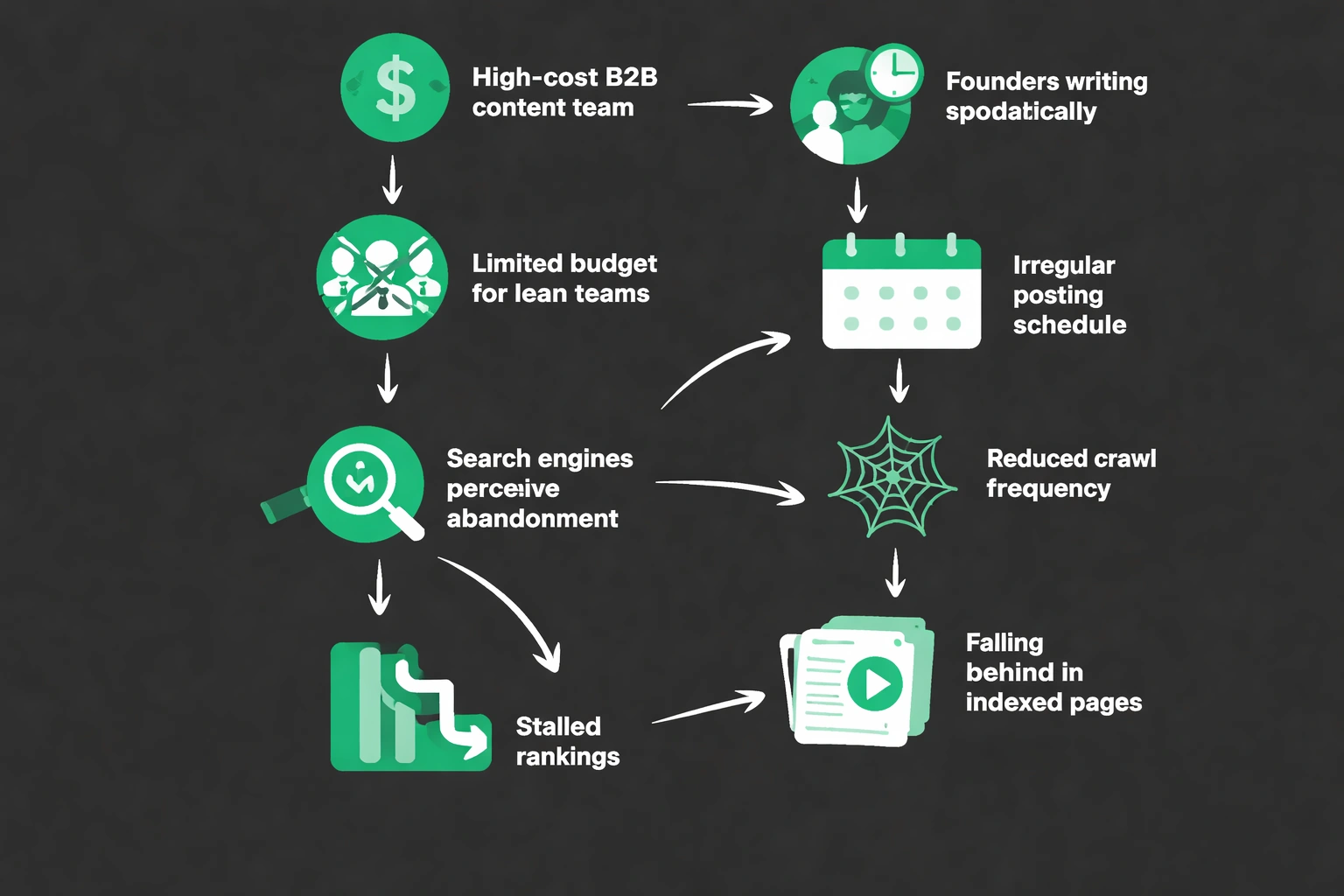
A decent B2B content team costs over $300,000 a year. Lean teams can't carry that overhead. So founders write when they can, usually at odd hours. The cadence drifts from weekly to "whenever we get a chance."
It’s a compounding problem. Search engines see irregular posting and assume the site is abandoned. Crawl frequency drops. Rankings stall. By the time you can afford a content lead, you're years behind in indexed pages.
The AI Content Automation Stack for Small Teams
You don't need a massive org chart. You need four specific parts to make this machine run without breaking.
First, research automation. Use tools that analyze SERPs and competitor gaps to spit out content briefs. This replaces hours of manual keyword work with a structured output you can scan in minutes.
Second, draft generation. This is where things get dicey. LLMs like GPT-4 can write solid drafts if you prompt them well. It’s not perfect expect to edit about 20-30% of it but it beats staring at a blank cursor.
Third, optimization tooling. Before anything goes live, run it through automated checks for readability and heading structure. It’s a basic quality gate to catch obvious errors.
Fourth, publishing infrastructure. Platforms like LeafPad handle the technical debris: canonical tags, sitemaps, structured data. Make sure content lives on your main domain under /blogs, not a subdomain that splits your authority.
Building Your Content Automation Workflow
Start with a map. Pick 10-15 core topics your product actually addresses. Use automated keyword research to fill in the gaps. You'll get a roadmap of 50-150 posts pretty quickly.
Don't wing the prompts. Build detailed briefs with word counts and target keywords. Include competitor URLs so the AI learns the structure without stealing the words. Set your temperature low (0.3-0.5) for factual content. Higher (0.7-0.8) if you're trying to say something new.
The human part is reviewing. Have one person review three drafts a day. Focus on accuracy. If you're making the same edits repeatedly, your prompt is the problem. Use content calendar automation to enforce a rhythm. Tuesday and Thursday is better than five posts one week and silence for a month.
Maintaining Quality While Scaling Volume
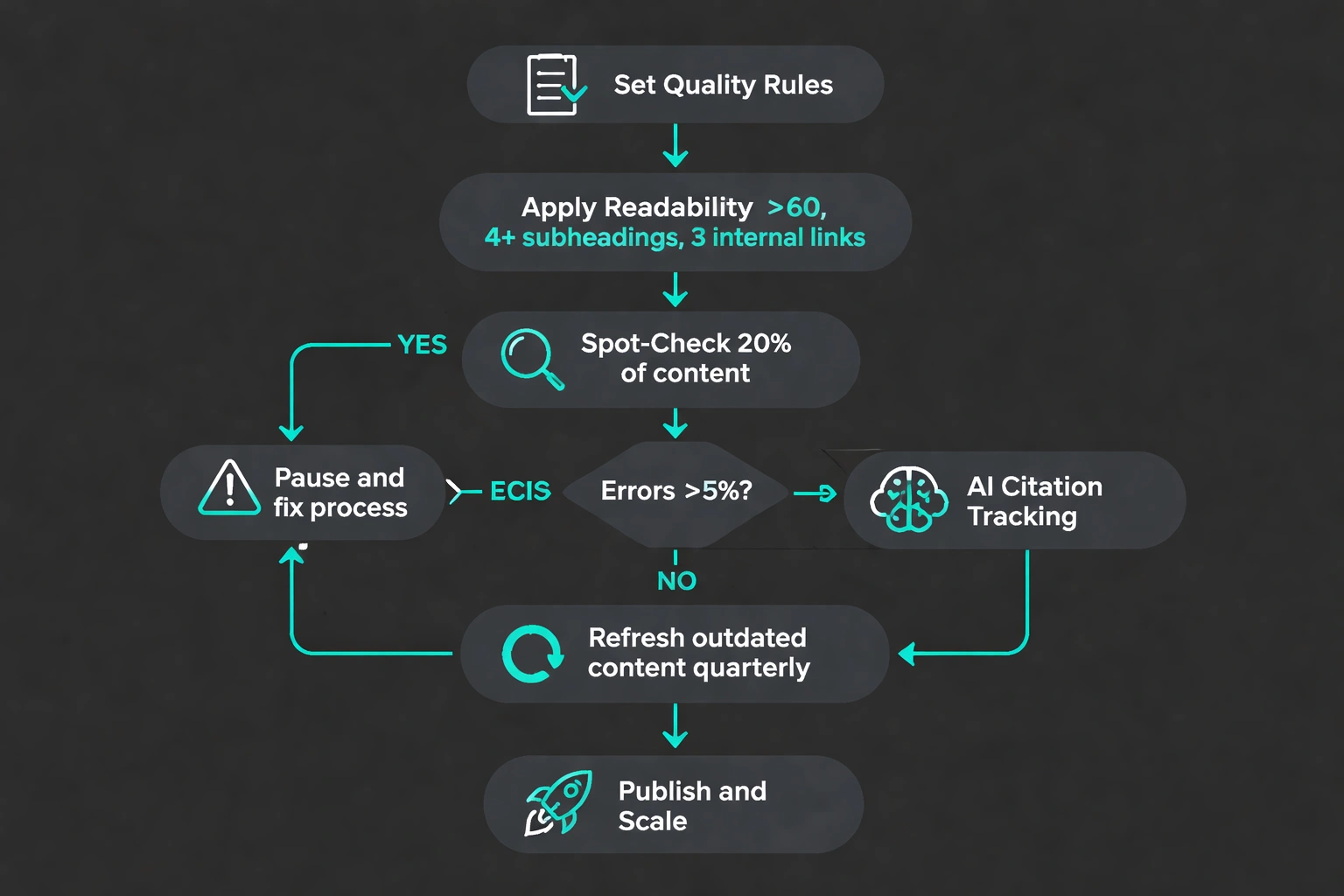
Quality is a system, not a vibe. Set hard rules: Flesch readability above 60, four subheadings minimum, and three internal links.
You don't have to read every word if you're scaling. Spot-check 20%. If you see factual errors in more than 5% of the sample, pause and fix the process.
Use AI citation tracking to see if ChatGPT or Claude is referencing your stuff. If they are, you have authority. Also, don't let old content rot. Run content refresh automation quarterly to update pages that are slipping.
Programmatic SEO for Geographic and Variant Coverage
Programmatic SEO is how you get hundreds of pages without writing them. You find a pattern where the intent is the same but the keywords change "Best [product] in [city]" is the classic example.
You build a template with variable slots. Use AI to write the unique intro and details. This lets you generate comparison pages against 40 competitors automatically, complete with screenshots and feature matrices.
But be careful. Google hates thin content. Manually review 10 samples before you bulk publish 500 pages. Watch Search Console for warnings.
Measuring Content Automation ROI
Ignore vanity metrics. Track four things: publishing velocity, indexed pages, organic sessions, and conversions.
Velocity is simple: how many posts per month? Indexed pages tell you if Google sees you (aim for 85%+ within 30 days). Organic sessions tell you if people find you. Conversions tell you if it matters. Use UTMs to see which blog posts actually start customer journeys. Complete SEO measurement frameworks exist, but those are the basics.
Don't expect overnight wins. Payback takes 90-180 days.
Common Pitfalls and How to Avoid Them
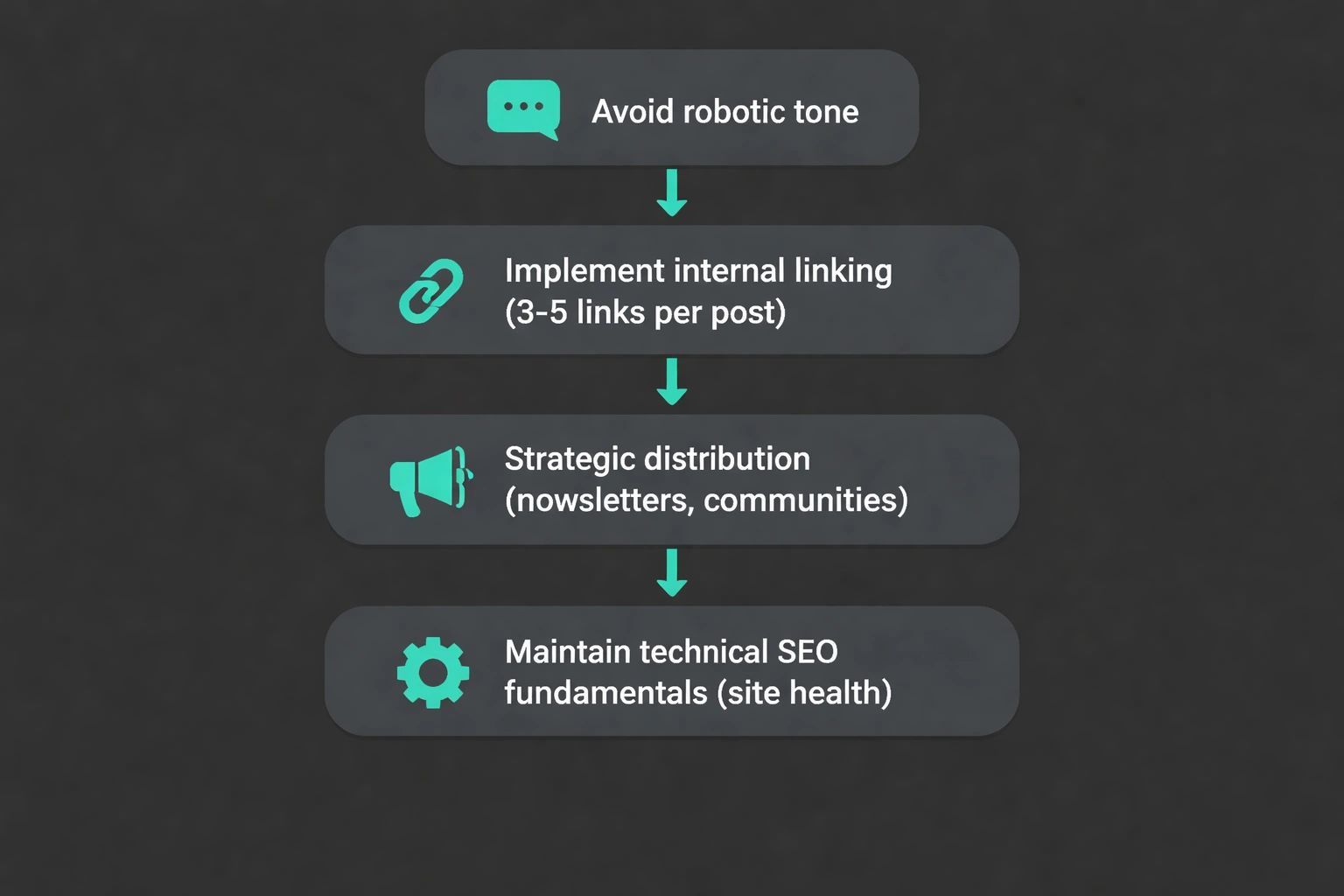
The biggest risk is sounding like a robot. If you let AI run wild, you'll produce generic garbage that erodes trust. Google's "helpful content" guidelines essentially say "be a human." You need to inject original data or customer quotes stuff an AI can't hallucinate.
Don't ignore internal linking strategy. Every new post needs to link to 3-5 older ones. Distribution matters too. You can't just hit publish. Share posts in newsletters or communities to get initial signals. And watch technical SEO fundamentals. If your site is broken, content won't save you.
Platform Selection for Lean Teams
Don't burn engineering resources building a blog from scratch. WordPress is a resource drain constant updates, security patches, plugin conflicts. Look for automated publishing infrastructure that handles the tech for you.
Evaluate platforms on simplicity. You should go from signup to first post in under an hour.
LeafPad is built for this. It combines drafting, linking, and publishing under your domain. It handles meta tags and sitemaps automatically. Compare platform alternatives by total cost, including the developer time you'd waste elsewhere.
Scaling from 5 to 50 Posts Monthly
Around 15-20 posts a month, manual processes break. You need a playbook.
Write down the workflow. Specialize roles: one person on strategy, one on prompting, one on editing. Batch tasks. Generate 10 briefs in one sitting.
If your editing time scales linearly with volume, your prompts are bad. Scaling shouldn't just mean more work for humans.
Building Long-Term Competitive Advantage
AI automation is a tactic, not a strategy. The strategy is owning a topic. Focus on areas where you have proprietary data or expertise that a competitor's AI can't copy.
Survey your customers. Publish original research. Build case study libraries with real metrics. AI can write the draft, but you have to provide the story.
Invest in topical authority through pillar content. Create resource hubs that link to 20 related posts.
The teams winning in 2026 aren't just using AI to write; they're using it to build infrastructure that compounds while they sleep. AI-powered automation makes this possible, but you still have to drive the car.
Published with LeafPad