If you've been dumping time into SEO, you have one question keeping you up: Is any of this actually working?
You're publishing, fixing meta descriptions, linking internally but without clear signals, you're flying blind. You don't have to guess anymore. In 2026, checking if your SEO works is about tracking specific metrics and using tools that give you feedback in days, not quarters.
Here's how to know if you're wasting your time or gaining traction.
Why "Is My SEO Working?" Is Hard to Answer
SEO isn't paid ads. You can't trace every dollar to a conversion. It builds slowly. That doesn't mean you should operate blind.
The old approach manually checking rankings, waiting for traffic spikes leaves too much to chance. With SEO automation tools and real-time indexing, you can see movement in days.
The problem isn't data. It's knowing which data matters.
7 Signals Your SEO Is Working
These are the metrics that prove momentum.
1. Organic Traffic (The Right Kind)
Are more people finding you via search?
A viral post or branded search spike doesn't count. You need:
- Non-branded keyword traffic growing (people finding you who don't know your name)
- Consistent monthly growth, not random spikes
- Traffic hitting blog posts and programmatic pages, not just the homepage
Check it:
- Google Analytics 4: Acquisition > Traffic Acquisition, filter "Organic Search"
- Look at landing pages. Are they content pages?
- Compare against the same month last year (seasonality matters).
Flat or declining traffic? Your SEO isn't working, or competitors are eating your lunch.
2. Rankings Are Moving
Rankings are a leading indicator. Moving from position 15 to 8 usually means traffic follows.
Don't check manually. It's tedious and personalized.
Check it:
- Use Google Search Console, Ahrefs, SEMrush, or LeafPad's automated tracking
- Watch average position for target keywords
- Track impressions
Position and impressions stagnant? Something is stuck.
3. Pages Are Getting Indexed
Google can't rank what it doesn't index. The most common silent failure? Publishing content that never enters the index.
Check it:
- Google Search Console: Pages > Indexing
- Look for "Discovered – currently not indexed"
- Use the URL Inspection Tool for specific pages
In 2026, real-time indexing is standard. If content isn't indexed in 48 hours, check your technical SEO.
Platforms like LeafPad handle indexing signals automatically so posts are discoverable immediately.
4. CTR Is Improving
Rankings mean nothing if nobody clicks.
CTR shows if your titles work. A low CTR at position 3 means you're losing clicks to results below you.
Check it:
- Google Search Console: Performance > Search Results
- Compare CTR across queries.
- Averages: Position 1 ~30%, Position 3 ~15%.
Low CTR? Rewrite your titles and metas. Improving? Good sign.
5. Backlinks Are Growing
Backlinks still matter. If sites link to you, it signals authority.
Track this:
- Referring domains (10 links from 10 sites beats 100 links from 1 site)
- Domain authority of linking sites
- Link velocity (consistent growth vs. stall)
Check it:
- Ahrefs, Moz, SEMrush, or GSC Links section.
- Look for editorial links, not low-quality directories.
Natural backlink growth, especially from strong domains, means your content is hitting the mark.
6. Engagement Is Up
Google watches engagement. If users land and bounce immediately, that hurts.
Watch:
- Average session duration
- Pages per session
- Bounce rate
Check it:
- GA4: Engagement > Pages and Screens
- Compare organic vs. other sources.
Improving engagement means content resonates. Google rewards that.
7. Conversions Are Growing
SEO needs to drive business results signups, demos, sales.
Check it:
- Set up conversion tracking in GA4
- Segment "Organic Search"
- Track goals
Traffic growing but conversions flat? You might rank for the wrong keywords.
How to Diagnose Flat Results
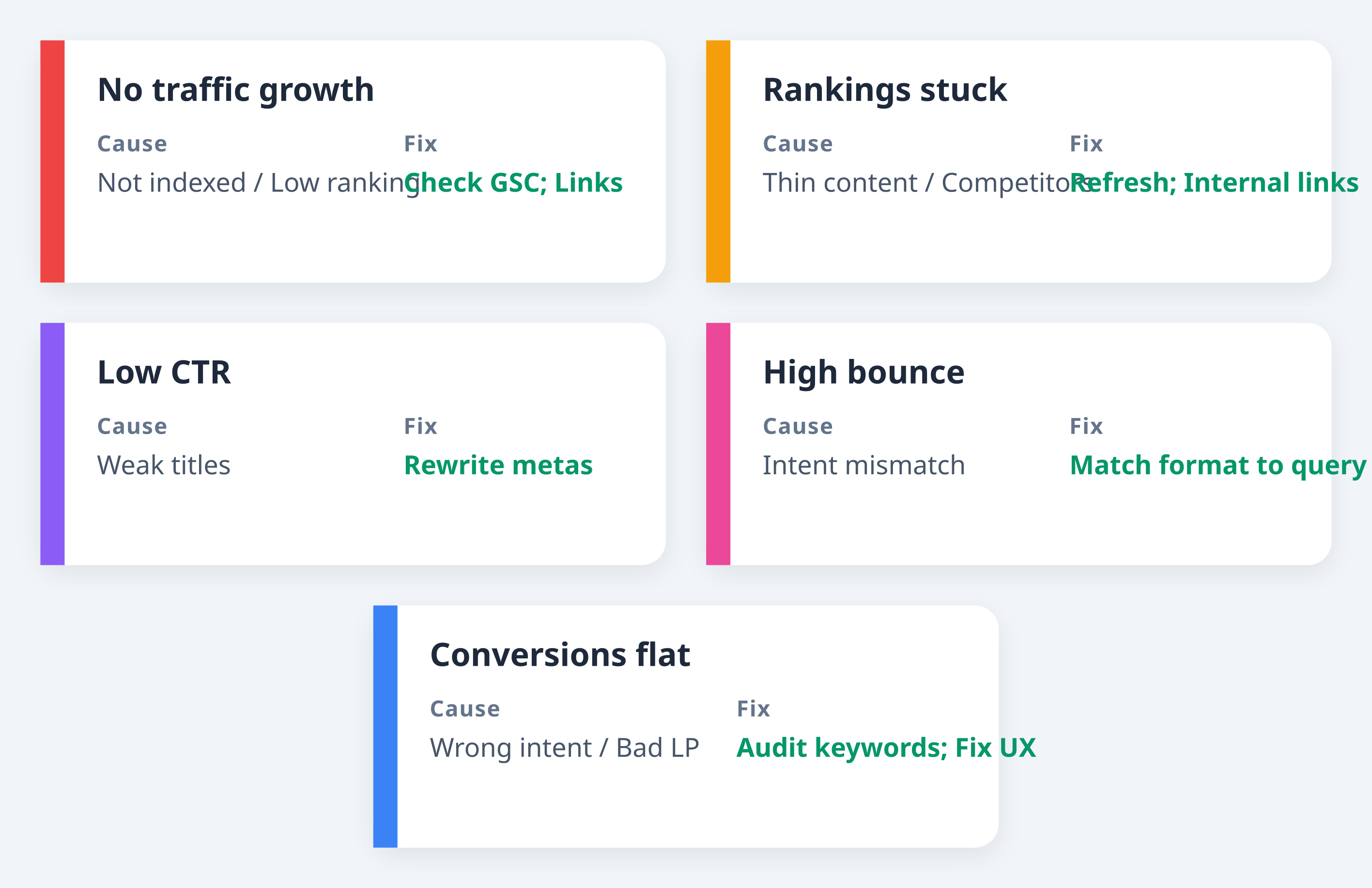
Checked the signals and nothing moved? Here's where to look:
| Problem | Likely Cause | Fix |
|---|---|---|
| No traffic growth | Not indexed or ranking too low | Check GSC; fix content; build links |
| Rankings stuck | Thin content or stronger competitors | Refresh content; improve internal links |
| Low CTR | Weak titles | Rewrite metas |
| High bounce | Intent mismatch | Match format to query type |
| Conversions flat | Wrong intent or bad landing page | Audit keywords; fix UX |
Tools for Real-Time Feedback
Stop checking manually. The best teams use automated systems daily.
Google Search Console (Free)
The gold standard for seeing how Google views your site. Use it for indexing, CTR, and queries.
Ahrefs / SEMrush / Moz (Paid)
Deep keyword and backlink data. Great for analysis, but can be overkill for small teams.
LeafPad (SEO Automation)
Built for teams that want to publish without staring at dashboards. It handles:
- Automatic internal linking
- Real-time indexing
- SEO recommendations while you write
- Programmatic SEO at scale
If you're tired of juggling plugins, LeafPad is worth a look.
Google Analytics 4 (Free)
Essential for traffic and conversions. Build custom reports for organic.
How Often to Check
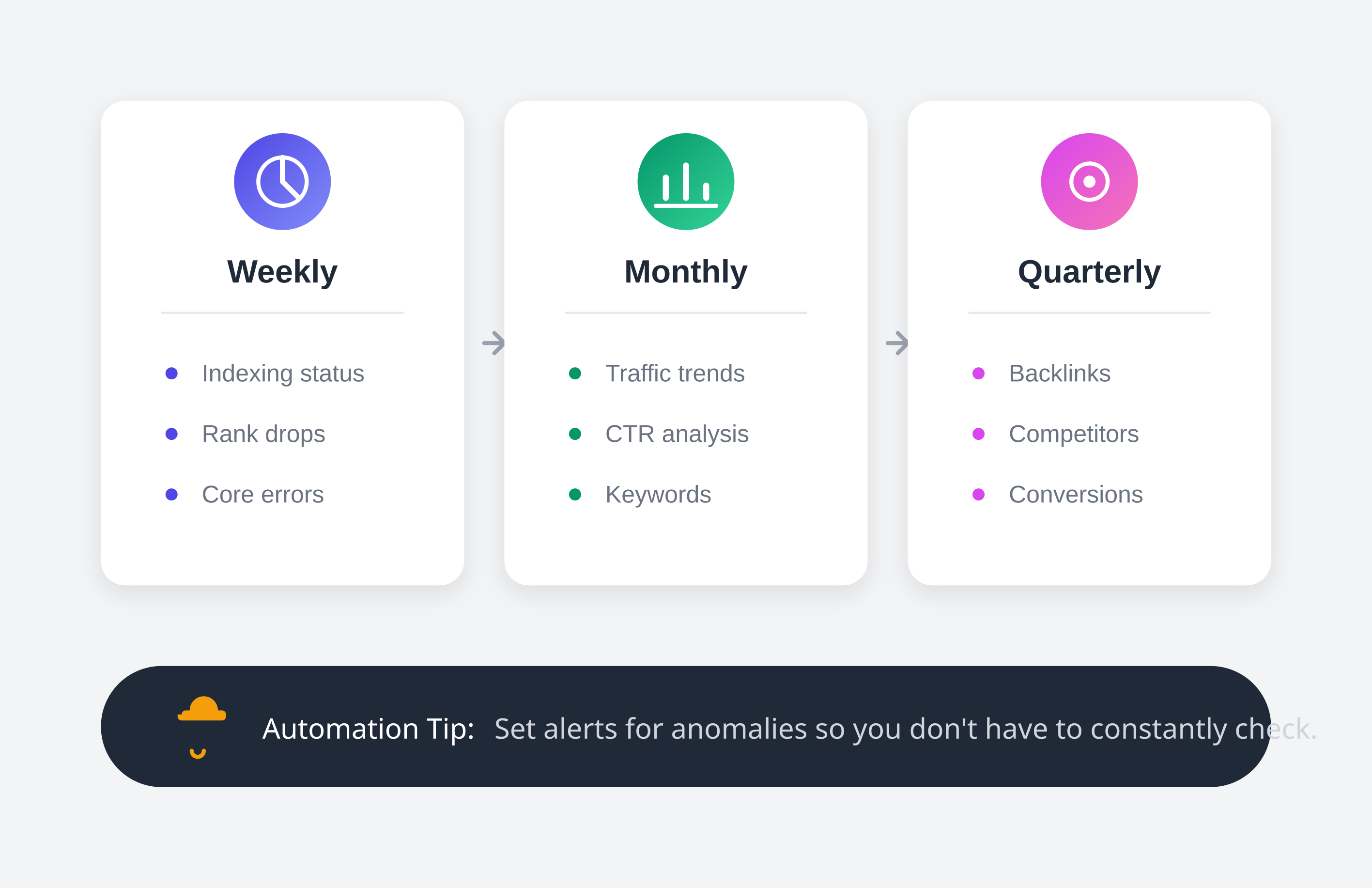
Depends on your volume, but here's a sane cadence:
- Weekly: Indexing status, big ranking drops
- Monthly: Traffic trends, CTR, keyword movement
- Quarterly: Backlinks, competitive position, conversions
If you use SEO automation tools, set alerts for anomalies so you aren't constantly monitoring.
What Success Looks Like
SEO rarely gives you hockey stick growth overnight.
- 30 days: Indexing confirmed, long-tail rankings appear
- 60-90 days: Impressions and position improve
- 6 months: Traffic grows, backlinks build, conversions tick up
- 12+ months: Compounding authority, top 3 rankings for real terms
Three months in with zero movement? Something is broken technical, content, or strategy.
When to Pivot
Sometimes the answer is "no." That's fine. Change course when:
- 6+ months, no movement
- Pages won't index
- Competitors own every keyword
- Traffic up, conversions flat
Try this:
- Audit technical SEO (speed, mobile, crawl errors)
- Fix keyword intent
- Move to a platform that automates the busywork
If you're stuck fixing broken links or waiting days for indexing, a platform like LeafPad kills most of that friction.
Measure What Matters
Forget vanity metrics. Track these:
- Non-branded organic traffic
- Ranking improvements
- Indexed pages
- CTR
- Backlinks
- Engagement
- Conversions
Moving in the right direction? Keep going. Flat or dropping? Audit and fix.
The teams winning in 2026 use automation, publish fast, and optimize in real time.
Stop guessing. LeafPad lets you publish, track, and grow from one platform. No developer needed.
Published with LeafPad