
SEO tracking has changed. By 2026, you shouldn't be checking rankings manually. Your tools should be telling you what's happening before you even think to look.
If you're scaling content operations or managing SEO automation in 2026, spreadsheet dashboards won't cut it. You need systems that anticipate problems, spot opportunities, and push recommendations without you having to hunt for them.
Here's my breakdown of the SEO tracking tools that actually work for automation-first workflows, what each one gets right, and how to build a stack that doesn't require constant babysitting.
What "Copilot-Level" Actually Means
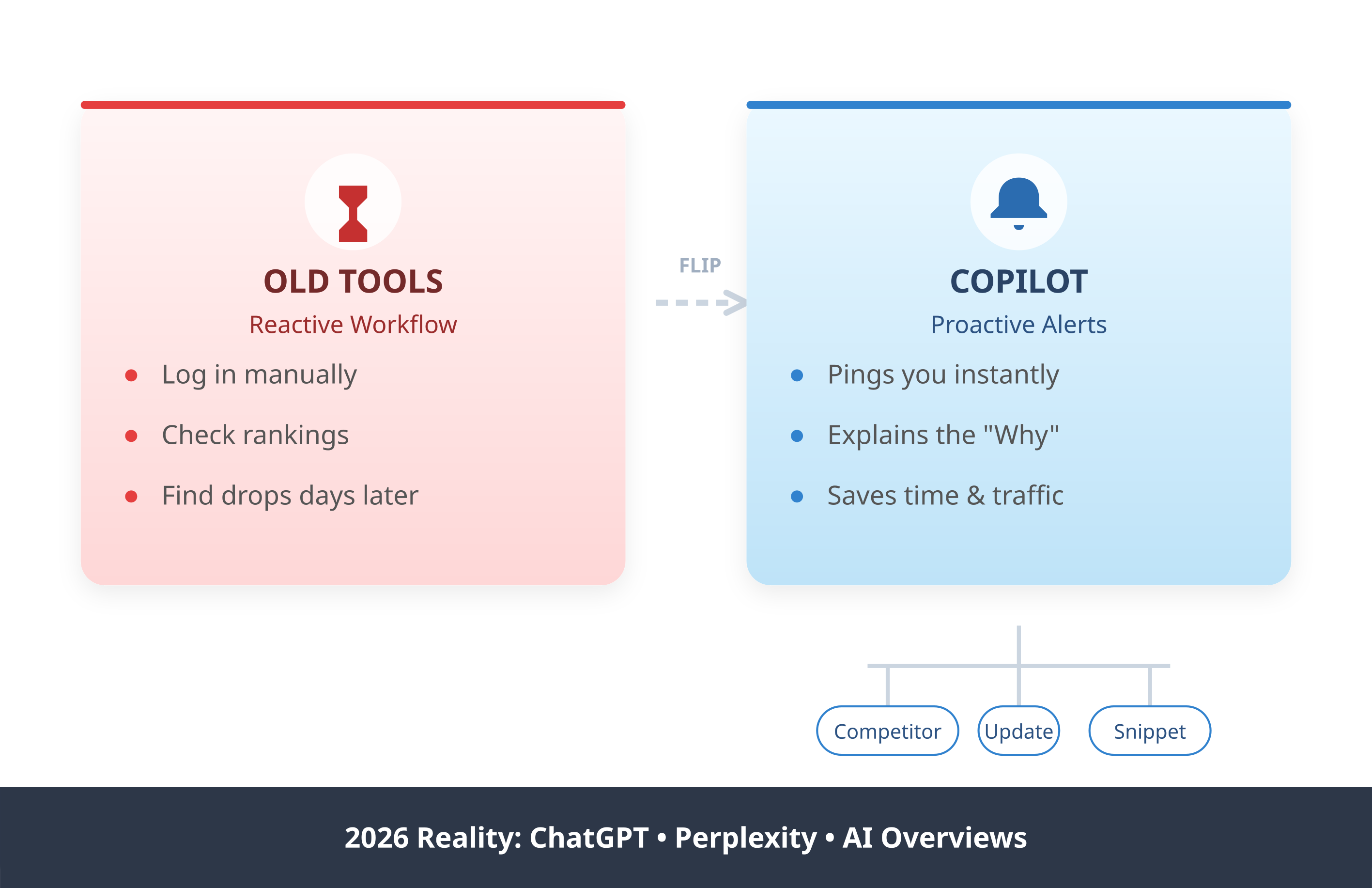
Old SEO tools were reactive. You logged in, checked your rankings, saw something dropped, and then tried to figure out why. Copilot tools flip that. They ping you.
The difference sounds small but it changes how you work. Instead of discovering a ranking drop a week later, you get an alert within hours. Some tools will even tell you why a competitor published a new guide, Google rolled out a core update, or your page lost a featured snippet.
In 2026, this matters more because SEO isn't just Google anymore. You need to track how your content appears in ChatGPT, Perplexity, and Google's AI Overviews. If you're only watching traditional SERPs, you're missing where a growing chunk of discovery happens.
The best copilot tools also integrate directly with your publishing stack. If you're using automated SEO tools, your tracking should feed into them updating keyword targets, reshuffling internal links, and flagging content that needs a refresh.
The Tools Worth Your Time
I've spent more hours than I'd like testing these platforms. Here's what actually works.
Ahrefs Copilot (2026 Edition)
Ahrefs has always been solid for backlink and keyword data. Their 2026 Copilot layer adds real-time rank tracking with anomaly detection that's genuinely useful.
The daily rank tracking covers desktop, mobile, and AI search engines. What I find more valuable is the traffic forecasting it looks at your current ranking trajectory and click-through rates to predict where you're headed, not just where you are. You also get content gap alerts when competitors publish something targeting your keywords.
The AI-generated briefs are hit-or-miss, but when they hit, they save you an hour of research. They pull from top-ranking pages and give you a starting outline based on what's actually working in the SERP.
Who it's for: Teams publishing daily who need insights without hovering over dashboards.
Semrush Position Tracking with AI Insights
Semrush added AI layers to their position tracking in 2026, and it shows. The volatility scoring is the feature I didn't know I needed it flags SERP instability and tells you whether to refresh content or hold steady.
Their cannibalization detection catches when multiple pages compete for the same keyword. This is one of those problems that's hard to spot manually but obvious once you see the data. They also track SERP features (snippets, People Also Ask, AI overviews) and alert you when competitors take them.
Who it's for: Agencies and in-house teams managing multiple domains who need side-by-side comparisons.
Mangools SERPWatcher
If you're a solo founder or running a small team, Mangools is the budget option that doesn't feel like one.
It does the basics well: daily tracking, email and Slack alerts, a single performance index score so you're not drowning in metrics. The local tracking is solid for businesses with multiple locations. It connects to Google Search Console and Analytics without the enterprise complexity.
Who it's for: Startups and indie hackers. If you're managing three sites or fewer, this is plenty.
AccuRanker
AccuRanker is built for speed and API access. It offers on-demand rank checks instant, not daily.
The API is the selling point. You can build custom dashboards, feed ranking data into your own tools, and create automated feedback loops. If your CMS can talk to an API, AccuRanker can update internal links or content priorities based on ranking changes without human intervention.
Who it's for: Technical SEO teams and engineering-heavy organizations that want to build their own systems.
Nightwatch (AI Search Tracking)
Nightwatch is one of the first platforms to track AI search visibility. It monitors how your content appears in ChatGPT, Perplexity, and Google's AI Overviews not just traditional SERPs.
The AI search visibility score tells you how often your brand gets cited in generative answers. This is becoming the new backlink metric. You also get traditional SERP tracking, backlink monitoring, and SEO health checks in one place.
Who it's for: Brands that care about AI search SEO. If your audience discovers you through AI answers, you need this.
Google Search Console + DataForSEO API (Roll Your Own)
If you have engineers and want full control, combine GSC with DataForSEO's API.
You get free core data from Search Console. The API adds historical rank tracking and SERP feature data. Build whatever dashboards you want in Looker or Tableau. The flexibility is unlimited you can automate alerts for specific position drops, internal link updates when keyword priorities shift, whatever you can code.
Who it's for: Engineering-led teams that want to own their stack.
How to Actually Choose
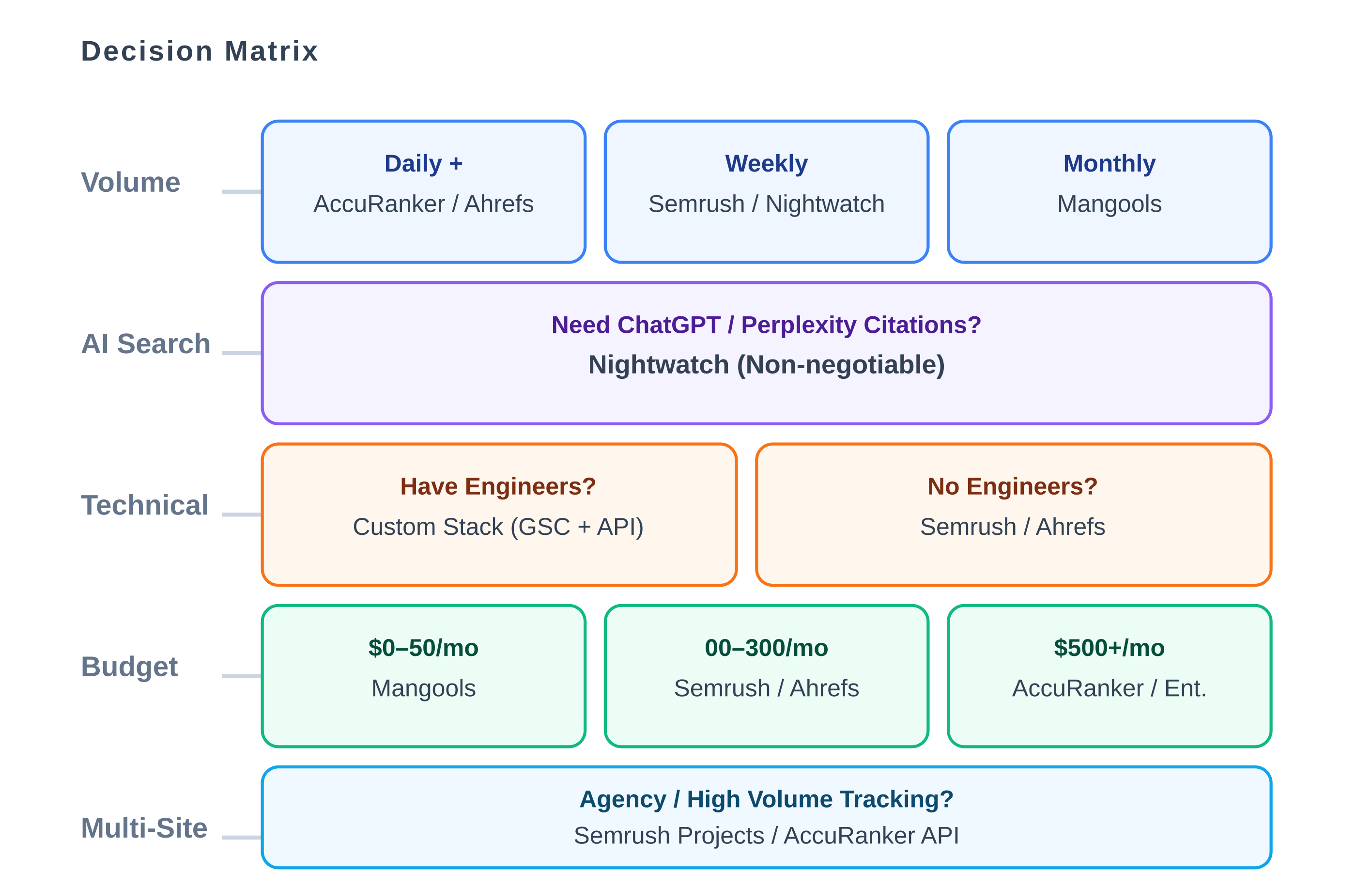
Don't start with features. Start with your workflow.
Publishing volume: Daily or more? AccuRanker or Ahrefs. Weekly? Semrush or Nightwatch. Monthly? Mangools.
AI search visibility: If ChatGPT and Perplexity citations matter to your traffic, Nightwatch is non-negotiable.
Technical capacity: Have engineers? Build a custom stack with GSC + APIs. Don't? Semrush or Ahrefs.
Budget: $0–50/month gets you Mangools. $100–300 gets you Semrush or Ahrefs. $500+ gets you AccuRanker or enterprise Semrush.
Multiple sites: If you're an agency, Semrush's multi-project tracking or AccuRanker's API will save you serious time.
Making Tracking Talk to Your Content Stack
This is where most teams fail. They buy a tracking tool, buy a publishing tool, and never connect them.
In 2026, the connection matters. Your tracking should feed into your publishing platform. When a post starts losing rankings, your system should flag it for refresh. When a keyword opportunity pops up, it should create a content brief. When a post gains traction, internal links should shift to point more authority its way.
If you're using something like LeafPad, this happens automatically. Your publishing platform pulls tracking data and adjusts keyword targeting and internal links without you touching anything. If you're doing this manually, you're losing time.
What to Track Beyond Position
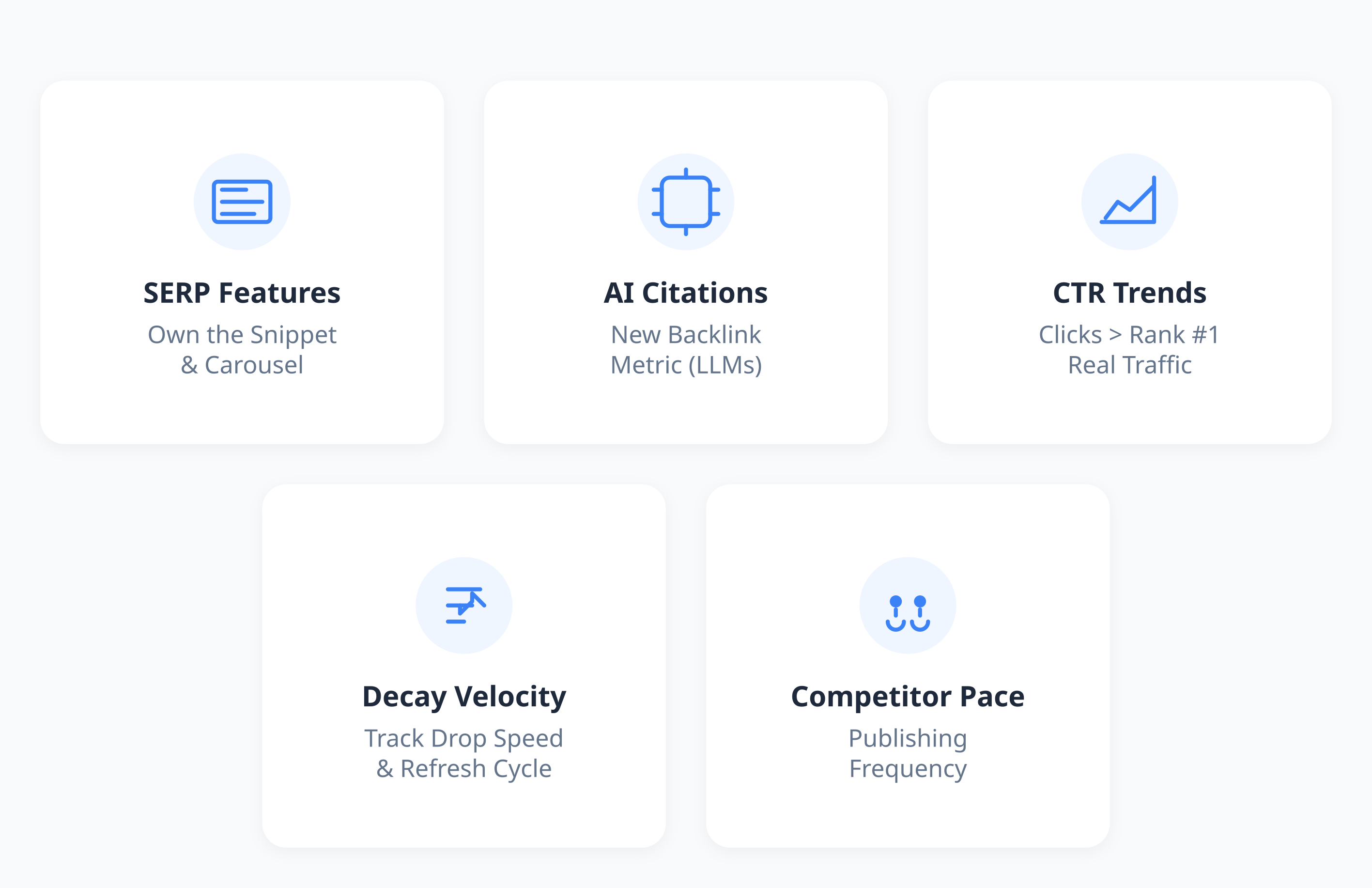
Rankings aren't enough. Here's what else I watch:
SERP features: Who owns the featured snippet? The People Also Ask box? The video carousel? You can rank #2 and get crushed because position #1 owns the snippet.
AI citations: How often does ChatGPT or Perplexity cite your content? This is the new backlink metric.
CTR trends: Position #3 with a 15% click-through rate beats position #1 with 8%. Track clicks, not just position.
Decay velocity: How fast do your posts drop after publishing? If it's fast, you need a refresh system.
Competitor publishing frequency: If they're publishing 3x/week and you're publishing 1x/week, you know who wins.
Mistakes I Keep Seeing
Tracking too much: Focus on 50–100 keywords that actually matter. Tracking 10,000 long-tail variations creates noise, not signal.
Ignoring AI engines: If you're not tracking visibility in ChatGPT and Perplexity, you're missing where search is going.
Logging in manually: If you're checking dashboards daily, set up alerts instead. The tool should come to you.
Disconnecting data from action: Every insight should trigger something. Ranking drop? Refresh content. Competitor movement? Publish a counter-piece. Keyword opportunity? Create a brief.
Where This Is Going
By late 2026 and into 2027, tracking tools are becoming autonomous agents. Not just alerting you taking action.
The tool detects a ranking drop. It analyzes the top competitors. It generates a content brief. It schedules a refresh with your writer (human or AI). It publishes the update and adjusts internal links.
You're not there yet. But the best teams are building workflows that get close.
What I'd Buy
If you're running a high-velocity content operation in 2026:
Core tracking: Ahrefs Copilot or Semrush. AI search visibility: Nightwatch. Real-time API: AccuRanker (if you have engineers). Publishing: LeafPad for SEO-optimized automation.
If you're a startup or solo founder:
Tracking: Mangools SERPWatcher. Free baseline: Google Search Console. Publishing: LeafPad.
Don't buy everything. Buy the few tools that talk to each other and cut out the manual work. That's the entire point.
Published with LeafPad