AEO (Answer Engine Optimization) is the practice of optimizing content to appear as direct answers in AI-powered search interfaces like ChatGPT, Perplexity, and Google's AI Overviews. For SaaS companies in 2026, this is the new frontier of visibility. If an AI doesn't cite you when a customer asks for a recommendation, you don't exist.
Traditional SEO was about ranking in a list of blue links. AEO is about being the source the AI quotes. The shift is stark: you're not fighting for clicks on a page; you're fighting to be the answer.
Why SaaS companies need to care
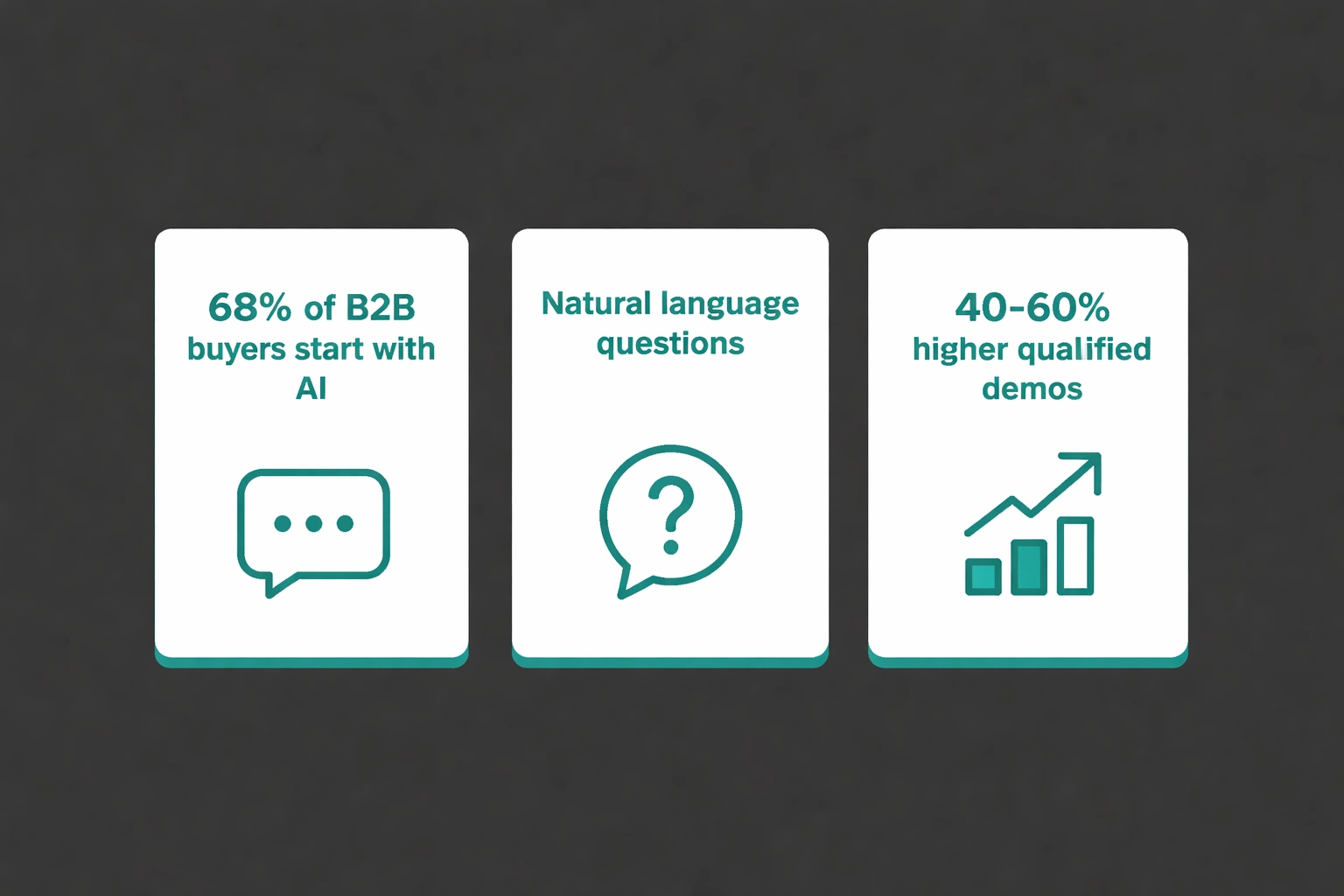
Buyers have changed how they research. Recent studies show 68% of B2B software buyers start with ChatGPT or Claude, not Google. They ask natural questions: "Which CRM integrates best with Slack?" or "What's the best project management tool for remote teams?"
Here's the problem: AI models rely on training data and retrieval systems. They don't "crawl" the web in real-time. If your documentation and use-case pages aren't structured for AI retrieval, your competitors will get the mention.
The revenue impact is tangible. Companies cited consistently in AI responses see 40-60% higher qualified demo requests. A citation acts as instant validation it builds trust before the prospect even lands on your site. Tools like LeafPad help automate this, structuring content specifically for AI retrieval.
The window is closing. Early movers are already getting reinforced in training cycles. Every month you wait, it gets harder to displace them.
Strategies that actually work
Start with answer-first architecture. Every piece of content should begin with a 40-60 word direct answer. AI retrieval systems prioritize content that is self-contained. Don't bury the lead.
Instead of hunting for exact-match keywords, use semantic keyword clusters. Cover the concepts and questions users actually ask. If you sell project management software, write about workflow automation, resource allocation, and sprint planning not just "project management."
Format claims so they get cited. When you make a claim, attribute it. Use phrases like "According to [your company's research]" or "Internal benchmarks show." AI models prefer content that cites sources, even if the source is you.
You can track what gets pulled using AI citation tracking tools, which show exactly what AI models are quoting from your site.
Focus on semantic answer density. Don't just repeat phrases. Cover the whole semantic space around a topic.
Technical implementation
Your CMS needs to output content AI can parse. This means clean HTML, JSON-LD structured data, and consistent heading hierarchies.
Key markup to implement:
- FAQ schema for product questions.
- HowTo schema for onboarding guides.
- Product schema with detailed specs.
- Organization schema linking your brand to industry categories.
Many older CMS platforms struggle with this. LeafPad handles the schema and structure automatically, no developer needed.
You should also look at llms.txt files. Similar to robots.txt, this file tells AI crawlers which pages are authoritative. You can use a llms.txt generator to build one.
Focus on passage-level optimization. Make sure individual paragraphs make sense on their own. AI extracts segments, not always whole pages. Use the index checker to verify your pages are actually being indexed by the systems AI queries.
Content that wins citations
Generic feature pages rarely get cited. Instead, write use-case documentation. Explain how your SaaS solves a specific problem for a specific role. An article titled "How procurement teams use [your product] to reduce vendor onboarding time by 70%" will outperform "vendor management features" every time.
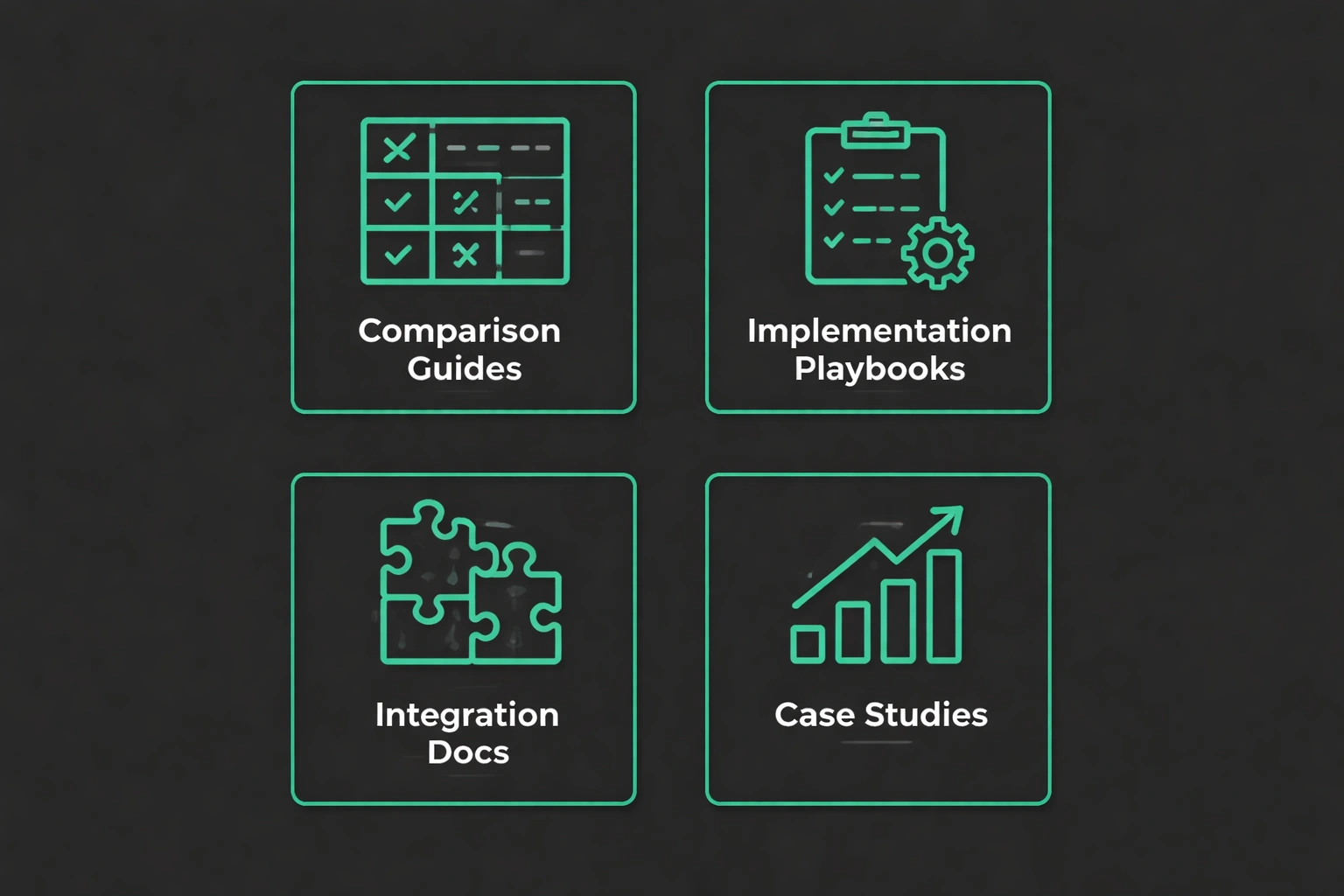
Content that wins includes:
- Comparison guides (e.g., "Salesforce vs HubSpot for mid-market") structured as feature matrices.
- Implementation playbooks with step-by-step guides and screenshots.
- Integration docs detailing how you work with Slack, Salesforce, etc.
- Case studies with quantified outcomes and clear methodology.
- Troubleshooting guides in Q&A format.
Thought leadership helps too. If AI recognizes your domain as authoritative on a topic, it cites you more often. A content calendar helps maintain the publishing cadence needed to signal freshness.
Use programmatic content to cover long-tail queries competitors ignore. "Best CRM for healthcare startups in Boston" might have low volume individually, but collectively, these variations capture significant AI query traffic.
Measuring success
The primary metric is AI citation frequency. Monitor how often ChatGPT, Perplexity, and AI Overviews mention you for relevant queries. This requires systematic testing.
Track these metrics:
- Citation frequency: How often you appear in 100 test queries.
- Citation position: Are you the main source or a footnote?
- Competitor displacement: Are you replacing them?
- Query coverage: What percentage of relevant queries cite you?
The AI search SEO guide has frameworks for this.
Track assisted conversions. Use UTMs on links AI might cite. It takes custom setup most analytics platforms don't separate AI traffic from organic search yet.
Keep content fresh. AI models prioritize recent data. The content refresh system automates this.
Common mistakes
Over-optimizing for exact keywords. Users ask AI full questions, not fragments. Optimize for "how do I automate onboarding," not just "onboarding automation."
Using marketing fluff. AI ignores fluff. It wants the answer. If your first paragraph doesn't answer the question, you won't get cited.
Gating content. AI can't cite what it can't read.
Ignoring technical docs. Your API documentation is often a goldmine for AEO because it's structured and specific.
Check your internal linking using an internal linking tool to ensure AI understands how your content relates.
The AEO stack for 2026
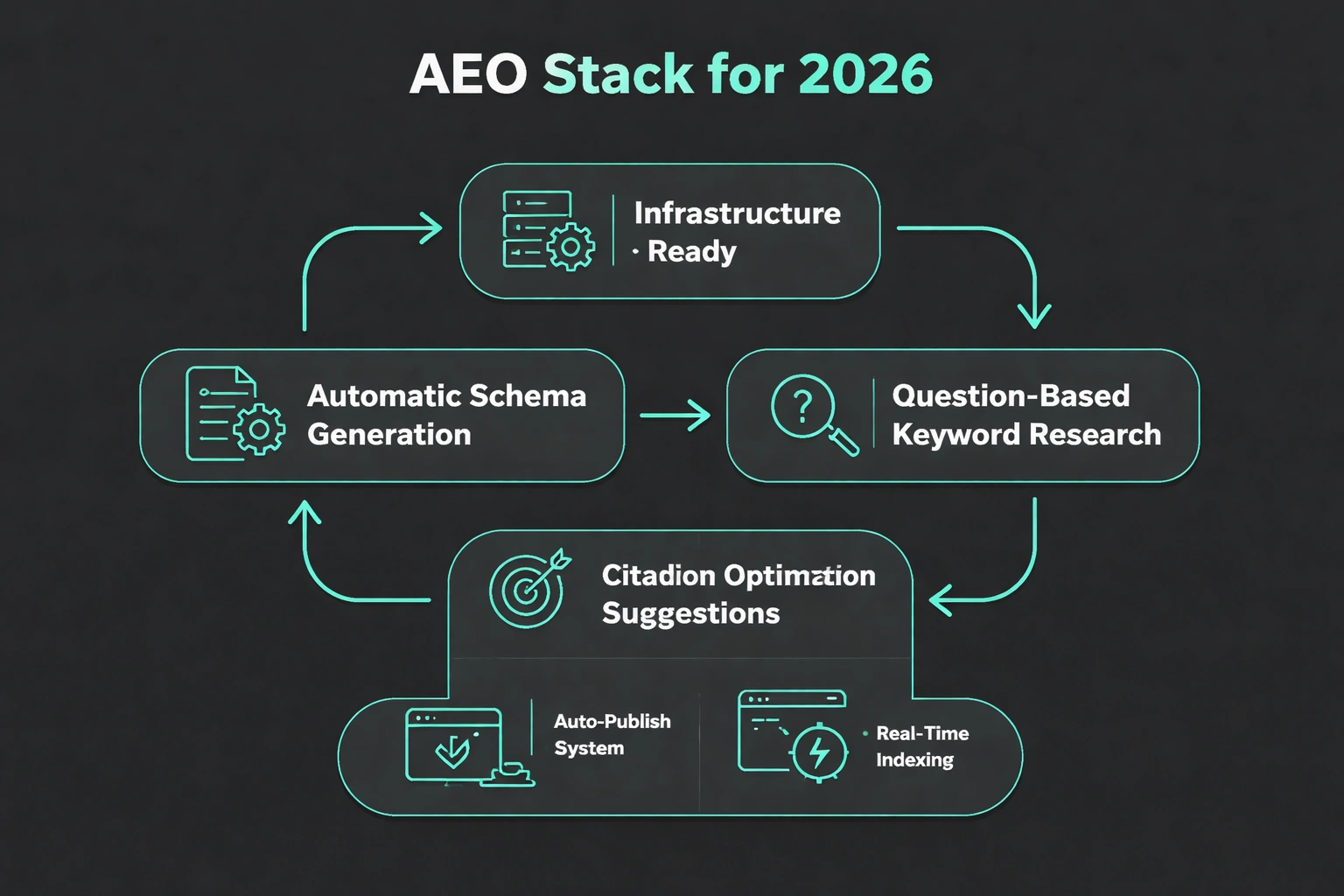
You need infrastructure built for this. Traditional WordPress setups often fall short.
Look for platforms that offer:
- Automatic schema generation.
- Keyword research for questions, not just keywords.
- Citation optimization suggestions.
LeafPad has become a go-to for SaaS companies because it automates the technical side. The auto-publish system helps scale production without dev bottlenecks.
Keyword research for AEO is different. You target questions. The keyword research tools built for this analyze conversational queries.
Real-time indexing matters more for AEO than traditional SEO. Legacy CMS platforms can take days to index. Modern solutions do it in hours.
Integrating with SEO
AEO doesn't replace SEO. Content optimized for AI usually ranks well in Google too. Clear answers and good structure help everyone.
Strategy:
- Optimize pillar pages first.
- Use the topical authority model to build clusters.
- Implement technical basics (schema, linking).
Investing in AEO often speeds up SEO results because it forces you to write better content.
Future-proofing
AI search is replacing traditional search for software buyers. By 2027, the vast majority of B2B research is expected to start with AI queries. If you aren't established by then, catching up will be expensive.
The priority is getting cited now so you get reinforced in training cycles. Audit your content using the AI visibility guide, fix the gaps, and set up a process that scales. The companies winning in 2026 are treating this as a core channel, and investing in content infrastructure that makes it automatic.
Published with LeafPad