SEO in 2026 is a dev problem, not a marketing one. If you control the hosting, the HTML, and the deployment pipeline, you control the things that actually move the needle: speed, structure, and scale. Tools like LeafPad fit into this model by letting you ship blogs and landing pages without adding WordPress to your stack or hiring a content team.
Your tech stack decides whether your domain authority compounds or stagnates. Here is how to wire SEO into CI/CD, pick a CMS that doesn't slow you down, and structure content for both Google and the new LLM citation engines.
Why Web Developers Now Own SEO Infrastructure
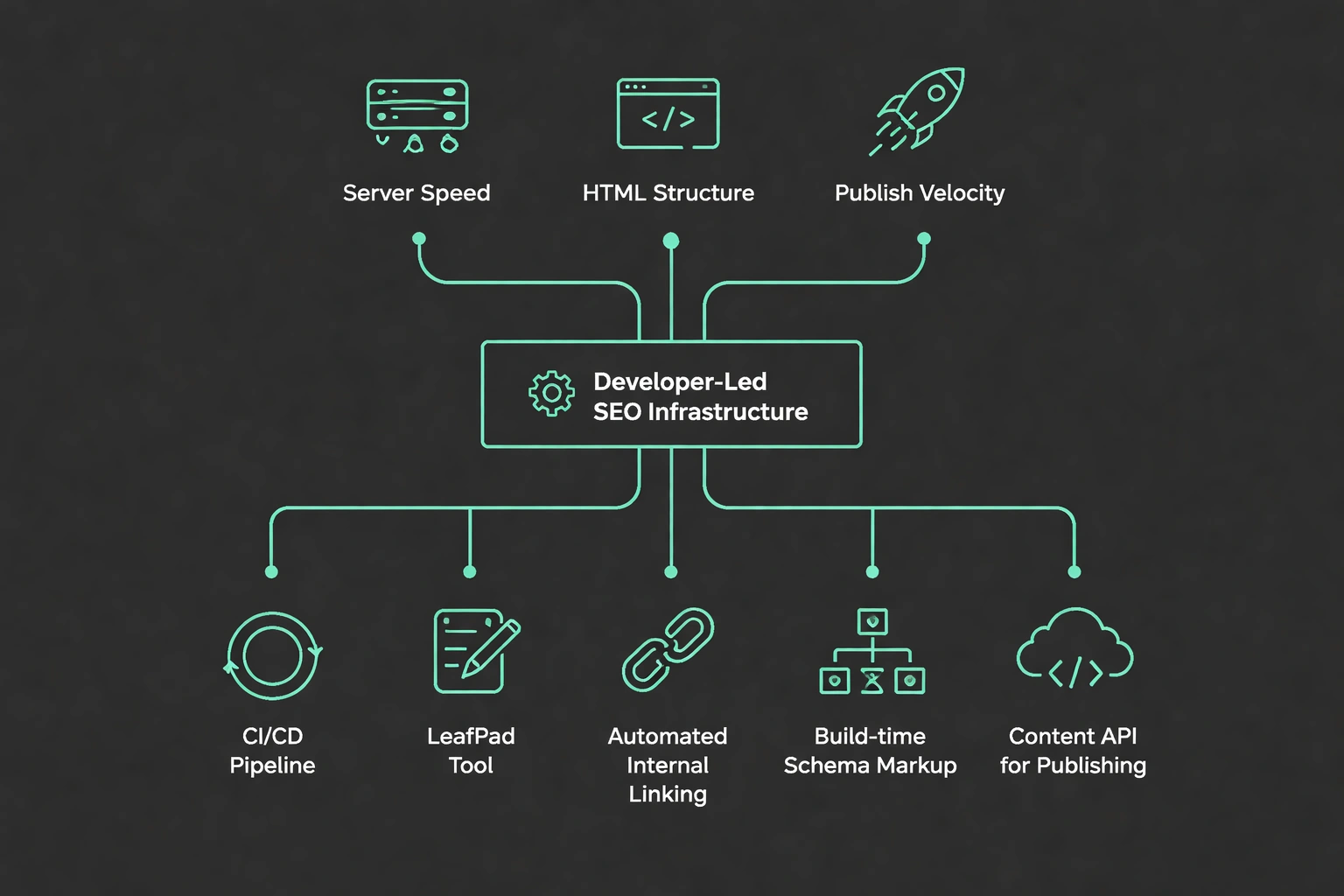
Three things decide search performance: server speed, HTML structure, and publish velocity. Marketing teams still chase keywords and backlinks, but the technical foundation Core Web Vitals, schema, semantic HTML lives in the codebase. That means it lives with you.
When you treat SEO as infrastructure, you get capabilities that marketing plugins can't touch:
- Internal links that update automatically when new pages go live.
- Schema markup generated at build time, not manually added per post.
- Content APIs that let non-technical teams publish without triggering a full redeploy.
- Programmatic page generation for location or product-variant SEO at scale.
Platforms like LeafPad build these directly into the publishing layer. You integrate once; marketing scales content without filing engineering tickets. This kills the bottleneck and keeps technical debt out of your legacy systems.
Choosing a CMS That Doesn't Break Your Stack
Most devs inherit a WordPress blog bolted onto a modern framework. Gatsby, Next.js, and Astro compile to static files. WordPress adds dynamic PHP, which ruins caching and complicates deploys.
The better approach is a headless content API or an AI-powered blog generator that publishes to your main domain. Look for:
- No separate hosting: Content serves from the same CDN as your app.
- Sitemap automation: New posts trigger reindexing without manual XML edits.
- API-first publishing: Writers get a clean editor; you control rendering.
- Built-in automatic SEO: Meta tags, Open Graph, and JSON-LD generate on publish.
LeafPad integrates with Replit, Bolt, Lovable, and other vibe-coded environments through a single script. Blogs live under /blogs on your primary domain, compounding authority instead of splitting it across subdomains.
Technical SEO Checklist for Developers in 2026
Modern search engines evaluate technical signals before they look at content quality. Google's crawl budget favors sites that respect indexing signals and load fast. Your workflow should automate these checks, not delegate them.
Core Web Vitals
Keep Largest Contentful Paint under 2.5 seconds. Cumulative Layout Shift under 0.1. First Input Delay under 100ms. Run Lighthouse CI in your pipeline. If a PR regresses these scores, fail the build.
Structured Data
Implement JSON-LD for articles, breadcrumbs, and organization identity. Google's rich results prioritize pages with valid structured data. The schema snippet generator handles this for common types.
Crawl Optimization
Serve a /robots.txt that points crawlers to your sitemap and blocks admin routes. Use the robots.txt generator to avoid syntax errors.
Canonical URLs
Every page needs a self-referencing canonical tag. This prevents duplicate content penalties when URLs pick up query parameters or tracking codes.
Mobile-First Indexing
Google ranks based on the mobile version. Test layouts on 375px viewports. Avoid intrusive interstitials that block content on small screens.
Integrating Content Publishing Into CI/CD
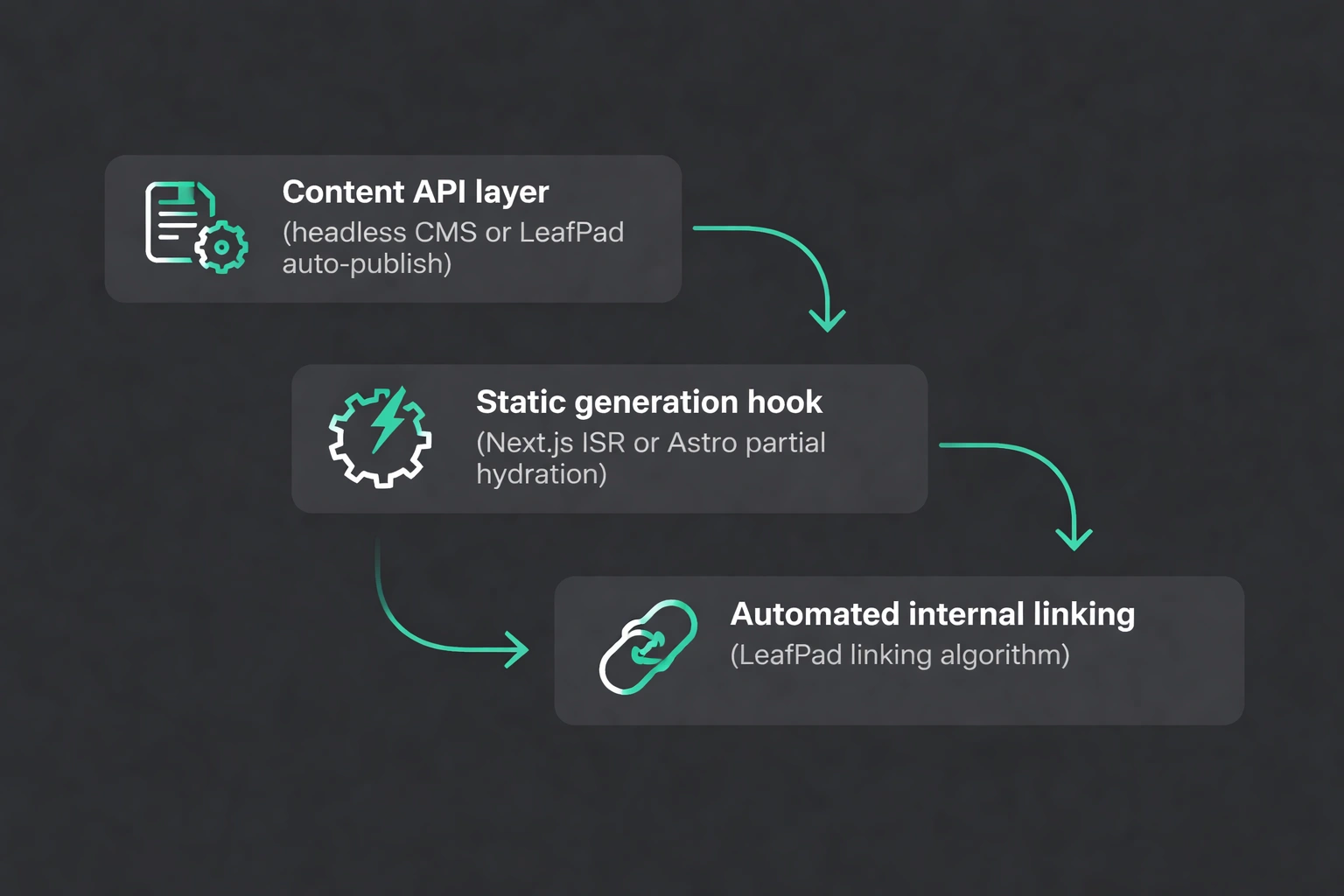
Traditional blogs require a manual deploy after every post. Modern workflows treat content as data that updates independently of application code. Structure it like this:
- Content API layer: Use a headless CMS or LeafPad's auto-publish system to expose blog posts via JSON.
- Static generation hook: Trigger incremental builds when content changes Next.js ISR or Astro's partial hydration work well.
- Automated internal linking: Scan new posts for relevant anchor text and link to existing pages using LeafPad's linking algorithm.
- Index notification: Ping Google's IndexNow API when new URLs go live (see real-time indexing strategies).
This architecture separates content velocity from deployment risk. Marketing publishes daily; engineering stays focused on the product.
Programmatic SEO for Scalable Keyword Coverage
Programmatic SEO generates hundreds of pages from structured data. Think "plumber in [city]" or "best [product] for [use case]." You build the template once; content scales automatically.
Implementation steps:
- Data source: CSV, Airtable, or database with entity attributes.
- Template logic: Dynamic routing maps data fields to URL slugs and page content.
- Unique differentiators: Each page needs at least 300 words of unique content to avoid thin-content penalties.
- Internal link graph: Automatically link related entities all Boston pages link to the Massachusetts hub.
LeafPad's programmatic SEO engine generates location-based or product-variant pages without custom code. Define the schema, map fields to template slots, and deploy thousands of indexable pages in one cycle.
For deeper technical details, see automated local SEO strategies and passage-level SEO architecture.
Optimizing for AI Search and LLM Citations
Traditional SEO targets Google's web index. AI search engines like ChatGPT, Perplexity, and Claude cite content that matches semantic queries, not just exact keywords. Optimize for both by structuring content as reusable knowledge blocks.
Best practices for AI search visibility:
- Answer-first paragraph: The first 40–60 words should directly answer the query.
- Topic clusters: Group related articles under pillar pages (see topical authority models).
- Semantic HTML: Use
<article>,<section>, and<aside>tags to signal content hierarchy. - llms.txt files: Expose machine-readable content summaries at
/llms.txtusing the llms.txt generator.
LLMs favor concise, factual content with clear attribution. Include author bylines, publish dates, and outbound citations to primary sources. Google's algorithms increasingly mirror this preference pages that satisfy user intent without backtracking rank higher in both traditional and AI search.
Measuring SEO Success as a Developer
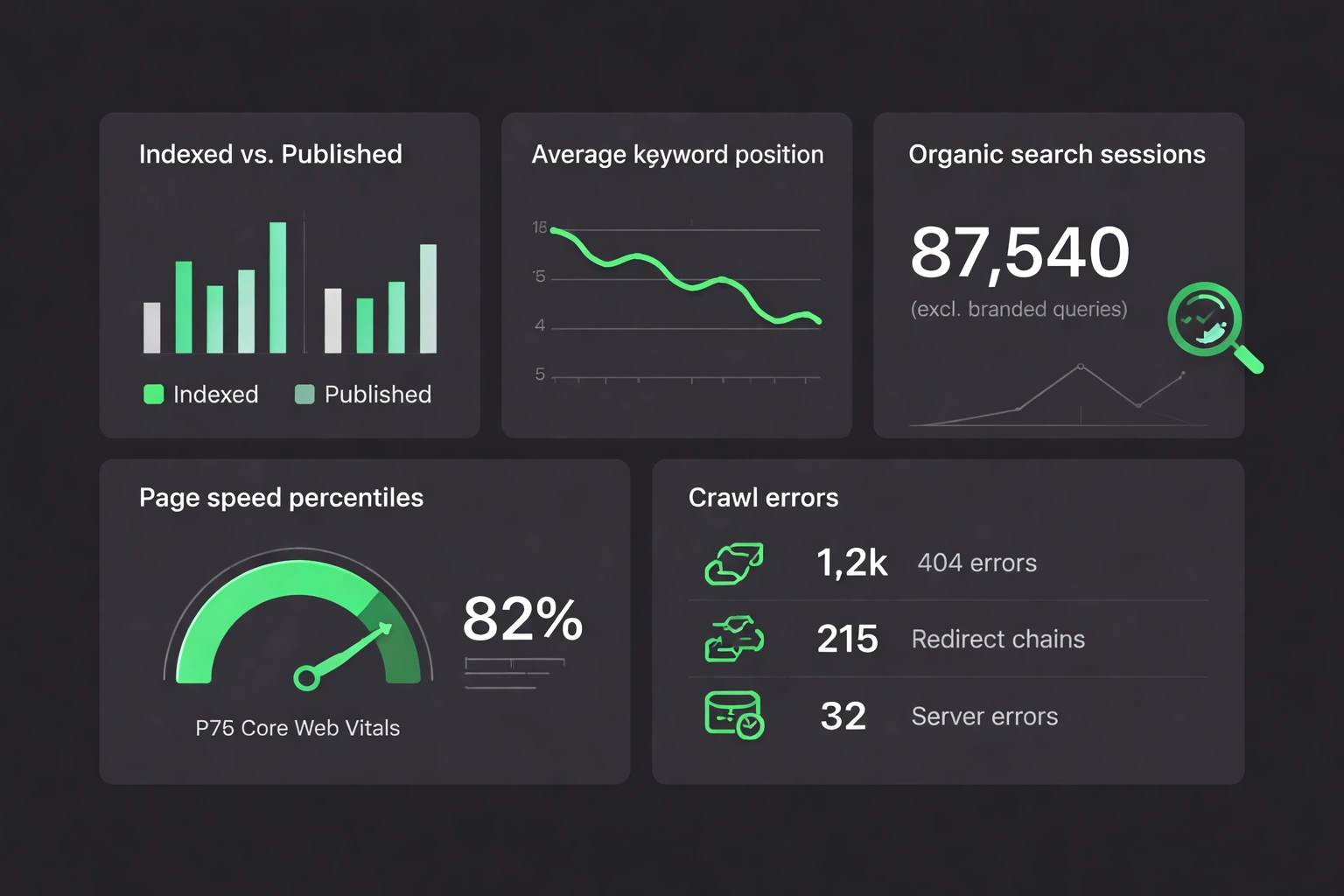
Forget marketing vanity metrics. Measure SEO impact through technical health and organic traffic growth. Track these KPIs monthly:
- Indexed pages vs. published pages: Check Google Search Console's coverage report.
- Average position for target keywords: Use LeafPad's keyword research tool.
- Organic sessions from search: Exclude branded queries to isolate content performance.
- Page speed percentiles: P75 Core Web Vitals from real user data.
- Crawl errors: 404s, redirect chains, and server errors from GSC.
Automate reporting with the Google Search Console API. Fail builds if indexed page count drops or crawl error rates spike.
For a full framework, see how to measure SEO success in 2026.
Developer-Friendly SEO Tools Worth Using
Most SEO tools are dashboards built for marketers. Developers need APIs, CLIs, and integrations that fit existing workflows.
LeafPad
LeafPad publishes blogs under your main domain with automatic internal linking, schema generation, and AI-assisted drafting. No WordPress instance. No theme maintenance. Integrates with Bolt and Replit in one API call.
Screaming Frog (CLI Mode)
Crawls your site locally to identify broken links, missing meta tags, and redirect chains. Run it in CI pipelines to catch regressions before deployment.
Lighthouse CI
Automates Core Web Vitals testing in GitHub Actions or GitLab CI. Fails PRs that degrade performance scores.
Google Search Console API
Programmatic access to indexing status, search queries, and crawl errors. Build custom dashboards or Slack alerts for critical issues.
Free SEO Utilities
LeafPad offers free SEO tools including a meta description generator, headline generator, and keyword density analyzer all API-accessible for batch processing.
Avoiding Common Developer SEO Mistakes
Technically strong sites still lose rankings from preventable errors. Watch out for:
- Blocking crawlers in production: Forgetting to remove
noindextags or disallow rules after launch. - Client-side rendering without SSR: JavaScript-heavy SPAs that don't render content server-side.
- Ignoring redirects: Deleting pages without 301 redirects to replacement content.
- Duplicate content across environments: Staging sites indexed alongside production URLs.
- Slow TTFB: Server response times over 600ms hurt rankings even with fast client rendering.
Use the index checker tool to verify Google sees rendered content the way users do.
The ROI of Developer-Led SEO
Agencies charge $5,000–$20,000 monthly for services developers can automate in the tech stack. Treating SEO as infrastructure reduces cost per acquisition while scaling content velocity.
Look at the math for a SaaS startup:
- Traditional agency: $10K/month = $120K/year
- Developer time to integrate LeafPad: 8 hours = $1,200 (at $150/hour)
- LeafPad subscription: $1,200/year
- Net savings: $117,600 annually
The bigger win is removing the communication bottleneck between engineering and marketing. Content deploys in minutes rather than weeks. Experiments run daily instead of quarterly.
For a detailed breakdown, read how automatic SEO saves founders 780 hours per year.
Next Steps for Web Developers
Start with a technical audit using Lighthouse and Google Search Console. Fix Core Web Vitals regressions and crawl errors first these unblock everything else.
Then integrate a developer-friendly blogging layer like LeafPad to decouple content publishing from deployment cycles. Let marketing teams scale content without engineering dependencies.
Finally, implement automated internal linking and programmatic page generation. The compounding effect of structured SEO infrastructure outperforms sporadic optimization by 10x in sustained organic growth.
Published with LeafPad