
Topical authority basically means your site actually knows what it's talking about. It's not just about one page ranking for one keyword anymore. In 2026, both Google's passage indexing and ChatGPT's retrieval mechanisms prioritize sites that map entire knowledge graphs, not isolated keyword targets. They're looking for semantic coverage, internal linking consistency, and cross-reference density across related content.
The reason this matters? Fragmented content ranks poorly and almost never gets cited by LLMs. Google's algorithm now evaluates how thoroughly a site explores subtopics, synonyms, and user intent variations. ChatGPT and similar AI engines pull answers from sources that demonstrate systemic coverage, not just one-off articles.
How topical authority differs from traditional keyword optimization
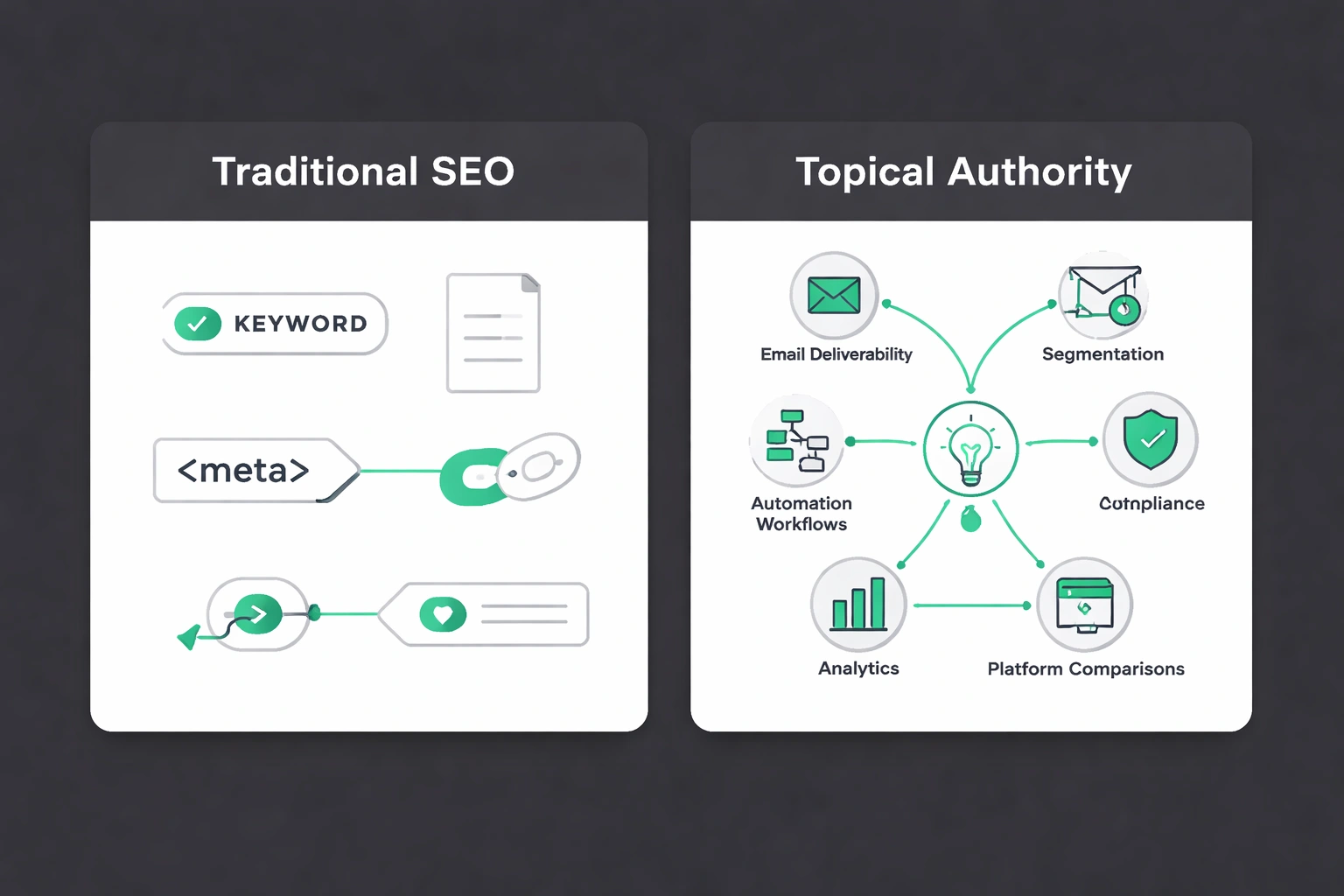
Traditional SEO was simple: focus on ranking individual pages for specific queries. You identify a keyword, write a post, optimize meta tags, and build backlinks. That approach worked when Google just matched queries to pages. It falls flat in 2026.
Topical authority treats your site as a knowledge repository. Instead of targeting "email marketing tips," you build a content ecosystem covering email deliverability, segmentation, automation workflows, compliance, analytics, and platform comparisons. Google sees this interconnected structure and elevates your domain for all related queries.
AI search engines operate on a similar principle. When ChatGPT generates answers, it references sources that comprehensively address a topic. A single blog post on email marketing won't get cited. A cluster of 15 interlinked articles covering the full spectrum will.
The shift from keyword density to semantic relationships means your content must demonstrate depth and breadth. Coverage gaps lower authority. Redundant content without internal linking wastes it.
The pillar-cluster model: architecture that builds authority
Pillar content is a comprehensive guide covering a topic's core concepts. Cluster content explores specific subtopics in detail, linking back to the pillar. This structure signals topical authority to search engines and LLMs.
Designing a pillar page
Your pillar page should be 2,000 to 4,000 words, covering the topic's fundamentals, frameworks, and key questions. It is the hub. Every section in the pillar should link to a corresponding cluster article.
For example, a pillar on "Content Marketing in 2026" might include sections on strategy development, content types, distribution channels, measurement frameworks, and automation tools. Each section links to a dedicated cluster post.
Pillar content strategies work because they give search engines a clear map of your expertise. The pillar's breadth combined with cluster depth creates semantic density.
Building effective cluster content
Cluster posts dive into specifics. They answer granular questions, provide actionable steps, and include examples. Each cluster links to the pillar and to related clusters, forming a knowledge web.
A cluster post on "Email Segmentation Strategies" would cover behavioral triggers, demographic splits, engagement scoring, and platform implementation. It links back to the email marketing pillar and sideways to clusters on automation and analytics.
LeafPad's topical authority model automates internal linking between pillars and clusters, ensuring no orphaned content. This structural consistency strengthens authority signals.
How Google's AI evaluates topical depth
Passage ranking, introduced in 2021, allowed Google to rank subsections of pages independently. By 2026, this evolved into entity-relationship scoring. Google maps how your content addresses entities, attributes, and relationships within a topic.
When you write about "local SEO," Google checks whether you cover citations, Google Business Profile optimization, review management, on-page signals, and schema markup. Partial coverage ranks lower. Comprehensive coverage ranks higher.
Content optimization in 2026 requires entity completeness. Your pillar and clusters must address every major entity and relationship Google associates with your topic.
Google's natural language models also evaluate semantic coherence. Contradictory statements across your site damage authority. Consistent terminology and definitions build it.
Optimizing for ChatGPT and LLM citation
AI search engines like ChatGPT, Perplexity, and Google's AI Overviews cite sources that demonstrate comprehensive knowledge. They retrieve content from sites that cover topics systematically, not sporadically.
How LLMs select sources
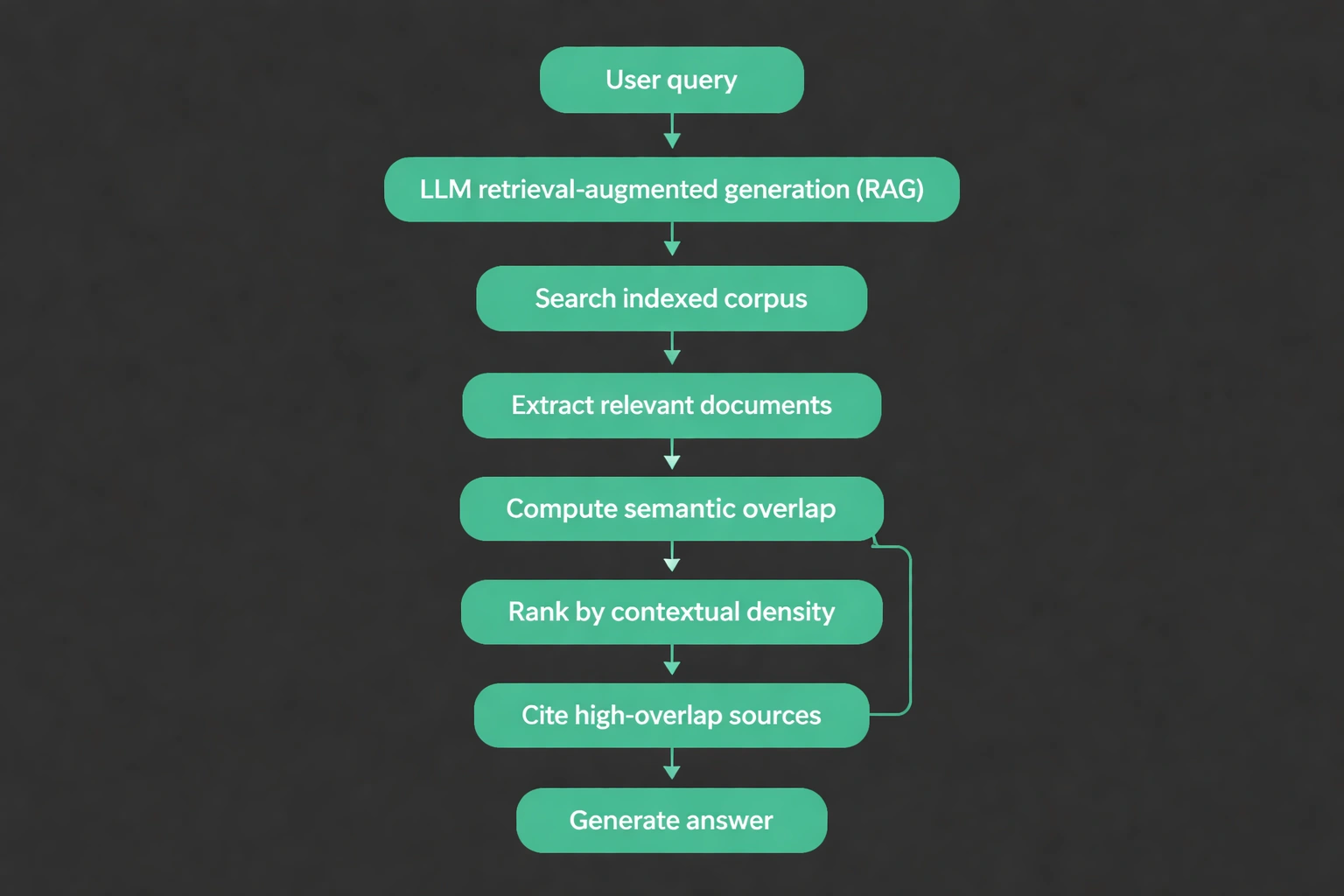
LLMs use retrieval-augmented generation (RAG). They search their indexed corpus for relevant documents, extract key passages, and synthesize answers. Sources cited are those with high semantic overlap to the query and strong contextual density.
A site with one article on "AI SEO" might appear in results. A site with 20 interlinked articles covering AI keywords, automated content, LLM optimization, semantic search, and AI visibility will get cited more frequently and prominently.
AI citation tracking shows that LLMs favor domains with structured knowledge graphs. Your content's internal linking architecture directly affects citation probability.
Structuring content for LLM retrieval
Each article should include a concise answer block in the first 60 words. LLMs extract this as the primary reference. Subsequent sections provide supporting detail.
Use consistent headings and formatting. LLMs parse structured content more accurately. Bullet points, tables, and numbered lists improve extraction quality.
Blog architecture for AI discovery includes semantic HTML, clear heading hierarchies, and schema markup. These elements help LLMs understand content relationships and context.
Building topical authority with AI content automation
Manual content creation limits scale. Writing 50 interlinked articles on a topic takes months. AI content automation accelerates this process without sacrificing quality.
AI tools generate drafts based on topic clusters you define. You provide the pillar structure and subtopic list. The system produces cluster articles that align semantically and link appropriately.
Automating cluster generation
Start with a pillar topic. Break it into 10 to 20 subtopics. Use AI to draft each cluster post, ensuring coverage of related entities, common questions, and actionable insights.
Review each draft for accuracy and brand voice. Edit for clarity and depth. Publish with automated internal linking to the pillar and related clusters.
LeafPad's content calendar schedules cluster publication over weeks, building authority progressively. Search engines interpret consistent publishing as topical commitment.
Maintaining semantic consistency
AI-generated content can drift in terminology and structure. Use style guides and entity glossaries to maintain consistency across articles. Define key terms once and reference them uniformly.
Automated SEO ensures consistent metadata, heading structures, and internal linking patterns. This uniformity strengthens topical signals.
Internal linking strategies that amplify authority
Internal links distribute authority and clarify topic relationships. They tell search engines which pages are central to your expertise and how content connects.
Hub and spoke linking
Your pillar is the hub. Every cluster links to it. Clusters also link to each other when contextually relevant. This creates a dense semantic network.
A pillar on "SEO Automation" links to clusters on keyword research automation, content optimization tools, technical SEO automation, and link building automation. Each cluster links back to the pillar and to related clusters.
Automatic internal linking identifies contextual opportunities and inserts links dynamically. This eliminates manual linking overhead and ensures no orphaned content.
Contextual anchor text
Use descriptive anchor text that includes target keywords. Avoid generic phrases like "click here." Google uses anchor text to understand page topics and relationships.
If linking from a cluster on "local SEO audit tools" to a pillar on "local SEO strategy," use anchor text like "comprehensive local SEO strategy guide" rather than "learn more."
Organic internal linking algorithms analyze content semantics and suggest optimal anchor text based on target page topics and user intent.
Link depth and distribution
Ensure every page is within three clicks of the homepage. Shallow link depth improves crawlability and distributes authority more evenly.
Balance link distribution so no page becomes a link sink. Too many internal links to one page can dilute others. Aim for 5 to 10 internal links per article, distributed across pillars and clusters.
Measuring topical authority in 2026
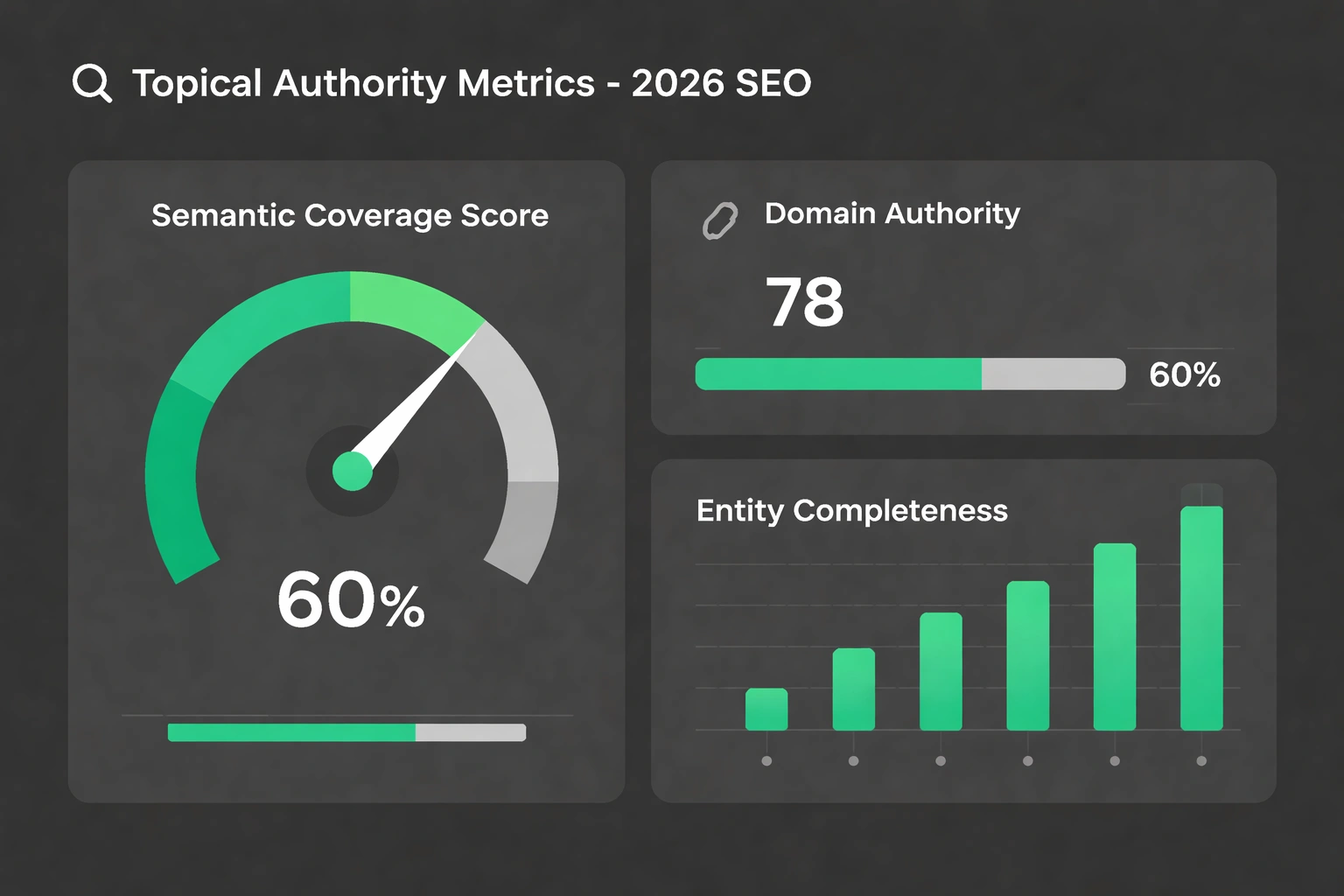
Authority metrics differ from traditional SEO KPIs. Domain authority scores don't capture topical depth. You need metrics that reflect semantic coverage and entity completeness.
Semantic coverage score
Calculate the percentage of subtopics and related entities you cover within a topic cluster. Tools that analyze your content against Google's entity graph provide this metric.
A score of 60% means you cover 60% of expected subtopics. Increasing coverage to 80% typically correlates with ranking improvements across the topic.
SEO success measurement in 2026 includes coverage scoring, citation tracking, and passage ranking performance.
AI citation frequency
Track how often your content gets cited in AI-generated answers. Tools like LeafPad's AI Citations monitor your domain's appearance in ChatGPT, Perplexity, and Google's AI Overviews.
High citation frequency indicates strong topical authority. Low frequency suggests coverage gaps or poor content structure.
Internal link graph density
Visualize your internal linking structure. A dense graph with multiple interconnections indicates strong topical authority. Sparse graphs with isolated clusters indicate weak authority.
Graph density correlates with ranking performance. Sites with interconnected content clusters outperform those with isolated posts.
Practical steps to build authority starting today
Immediate actions establish your authority foundation. These steps work whether you have five articles or 500.
Audit existing content: Identify your strongest topic. List all related articles. Map coverage gaps.
Create a pillar page: Write or expand a comprehensive guide covering that topic's fundamentals. Aim for 2,500 words minimum.
Develop cluster list: Identify 10 to 15 subtopics. Draft outlines for each.
Generate cluster content: Use AI blog generation to draft articles. Edit for accuracy and depth.
Implement internal linking: Link every cluster to the pillar. Add contextual links between clusters.
Publish consistently: Schedule one cluster post per week. Consistent publishing signals topical commitment.
Monitor authority metrics: Track coverage scores, citation frequency, and ranking improvements.
Expand to new topics: Once your first topic cluster is complete, repeat the process for adjacent topics.
LeafPad's automated publishing handles scheduling, metadata optimization, and internal linking, letting you focus on content strategy and quality control.
Common mistakes that undermine authority
Content sprawl without structure dilutes authority. Publishing 100 unrelated articles signals no expertise. Publishing 100 interconnected articles on three core topics signals mastery.
Avoid keyword cannibalization. Don't publish multiple articles targeting the same query. Consolidate them into a single comprehensive resource.
Neglecting updates erodes authority. Information decays. Content refresh automation keeps articles current, maintaining authority signals.
Ignoring internal linking wastes existing content. Orphaned posts don't contribute to topical authority, no matter how well written.
The future of authority: systems over tactics
Topical authority is a system, not a tactic. It requires architectural thinking, not keyword chasing. In 2026, domains that treat content as interconnected knowledge systems dominate search results and AI citations.
SEO in 2026 emphasizes systems over algorithms. Your competitive advantage comes from building content infrastructure that scales authority across topics.
As AI search grows, citation-worthy sources win. Those sources are comprehensive, structured, and semantically consistent. Building topical authority is building citation-worthiness.
Start with one pillar. Build its cluster. Measure authority growth. Repeat. This systematic approach compounds results faster than any keyword tactic ever could.
Published with LeafPad