Search has changed. By 2026, "SEM" doesn't really mean what it used to it's not just bidding on keywords and hoping for clicks anymore. The whole thing has gotten messier and more interesting.
If you're still running paid search in one silo and content in another, you're probably bleeding budget. The teams winning right now have merged paid campaigns, organic content, programmatic pages, and AI discoverability into something that actually talks to itself.
Here's what digital search engine marketing looks like in 2026, and where platforms like LeafPad fit into the picture.
What SEM Actually Means Now
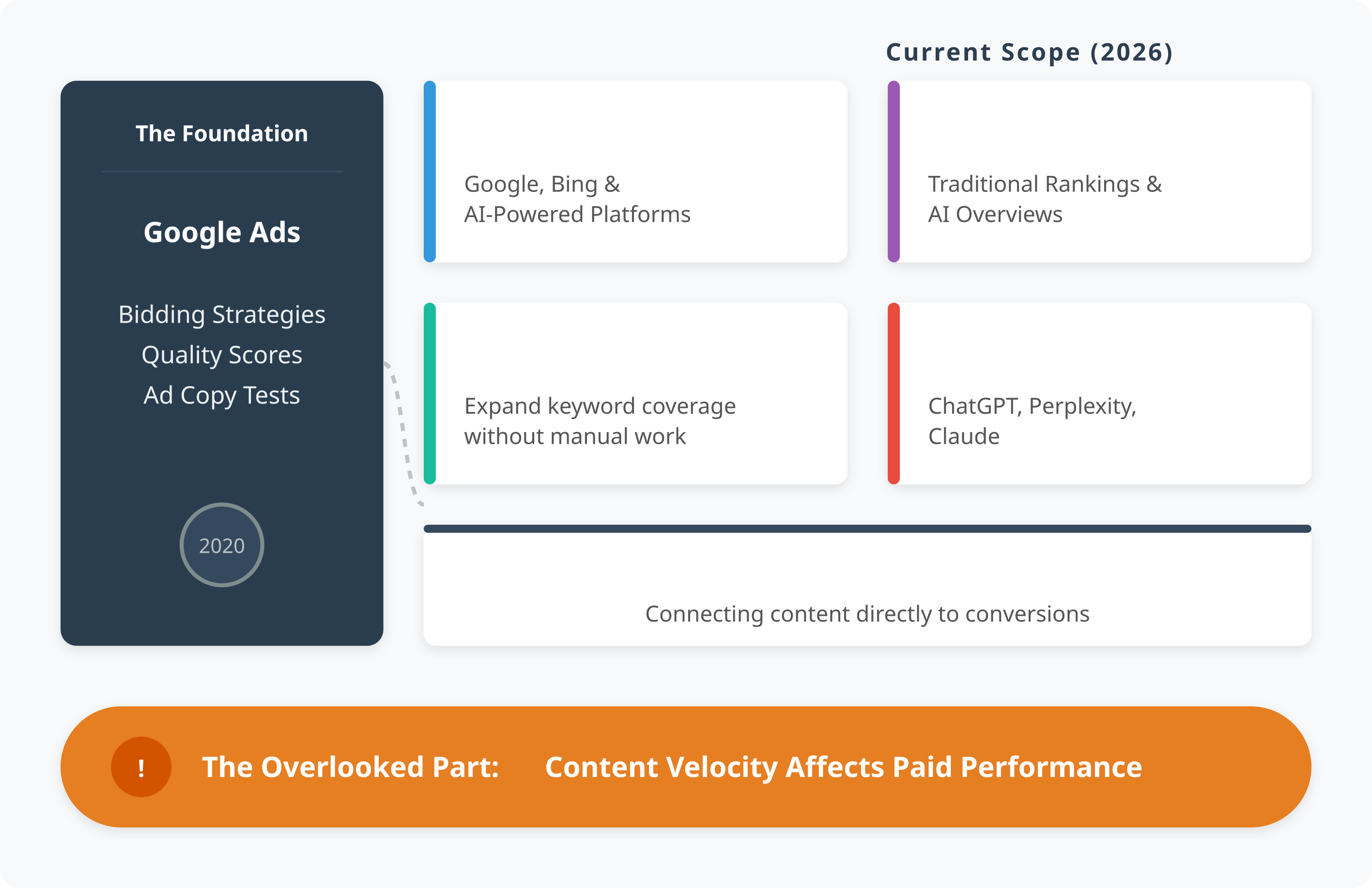
The old model was simple: Google Ads, bidding strategies, Quality Scores, ad copy tests. That still exists, but calling it "SEM" in 2026 undersells it.
Current scope includes:
- Paid campaigns across Google, Bing, and AI-powered platforms
- Organic SEO content that feeds both traditional rankings and AI overviews
- Programmatic landing pages that expand keyword coverage without manual work
- AI search optimization for ChatGPT, Perplexity, Claude
- Attribution that actually connects content to conversions
The part people overlook: content velocity affects paid performance. Sites publishing consistent, optimized content tend to see better Quality Scores and lower CPCs because Google recognizes domain authority. This is why SEO Automation in 2026: The New Standard for Scaling Traffic has become relevant for marketers who can't scale content manually.
The Siloed Channel Model Fell Apart
Five years ago, paid and organic teams barely spoke. PPC managed Google Ads, SEO handled blogs, and they met during budget season to fight over resources.
That stopped working when Google started rewarding domain-wide signals:
- Sites with active blogs see 30-40% better Quality Scores
- Landing pages with internal links convert 2-3x better than orphan pages
- Consistent publishing correlates with lower CPCs over time
- Organic rankings reduce paid spend on top-funnel queries
The 2026 approach combines automated content with paid amplification build authority through programmatic SEO, then accelerate conversions with paid.
Why Manual Content Can't Keep Up
If you're competing in anything remotely competitive, you probably need:
- 50-100+ landing pages for keyword variants
- Weekly blog content
- Location pages for each market
- Comparison and feature pages for bottom-funnel intent
Doing this manually takes months. Automation takes days.
Platforms built for automated SEO tools in 2026 handle:
- Programmatic landing pages for long-tail variations
- Weekly SEO-optimized blog posts without a full writing team
- Internal linking structures
- Publishing cadence that signals freshness
This infrastructure is what makes paid campaigns efficient traffic goes to relevant pages instead of generic ones.
Paid Search + Content Velocity: What Actually Happens
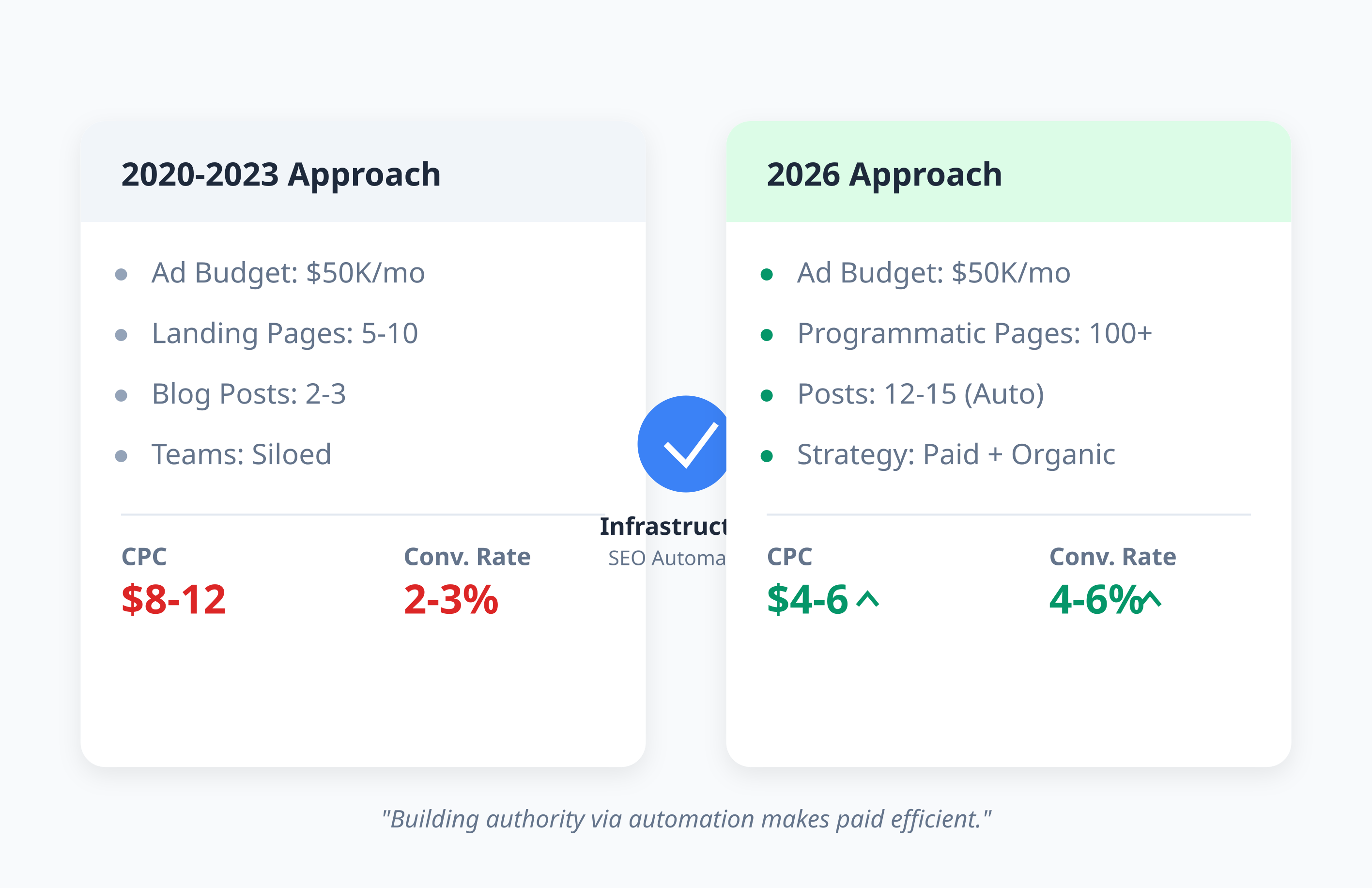
This scenario is playing out across SaaS companies right now:
2020-2023 approach:
- $50K/month on Google Ads
- Traffic to 5-10 manual landing pages
- 2-3 blog posts monthly
- Paid and organic teams don't talk
- CPC: $8-12
- Conversion rate: 2-3%
2026 approach:
- Same $50K/month
- Traffic to 100+ programmatic pages
- 12-15 posts monthly (automated)
- Paid amplifies best organic content
- CPC: $4-6
- Conversion rate: 4-6%
The difference is infrastructure. Using SEO automation copilot tools, teams build the authority that makes paid efficient.
Programmatic SEO for SEM: Scaling Without Engineers
The bottleneck has always been landing page creation. Each keyword cluster deserves a dedicated page, but building hundreds manually is expensive and slow.
Programmatic SEO generates pages from templates:
- Service + Location: "SEO agency in Seattle," "SEO agency in Portland"
- Product + Use case: "Project management for agencies," "for consultants"
- Comparison: "Product A vs Product B"
- Industry variations: "Healthcare CRM," "Real estate CRM"
These aren't thin pages they're structured and useful, just built from shared patterns.
For SEM, this means:
- Ad groups with perfectly matched landing pages
- Better Quality Scores from relevance
- Lower CPCs
- Campaign scaling without development delays
LeafPad handles this without engineering support. Templates and data sources generate pages on your main domain, not subdomains that split authority.
AI Search Optimization: The New Variable
Traditional SEM meant Google and Bing. In 2026, that's incomplete.
ChatGPT, Perplexity, Claude, and others handle billions of queries. Users ask questions; models synthesize answers from web sources.
The implication: your content needs to work for AI discovery, not just traditional search.
This means:
- Clear heading structure
- Concise, definitive answers to specific questions
- Factual, cite-worthy content
- Technical markup (schema, structured data)
- Fresh, updated content
Companies using automated SEO infrastructure are building assets that rank traditionally and get cited in AI responses.
This compounds: organic content reduces paid costs while capturing AI platform traffic where ads don't exist yet.
What Working Infrastructure Looks Like
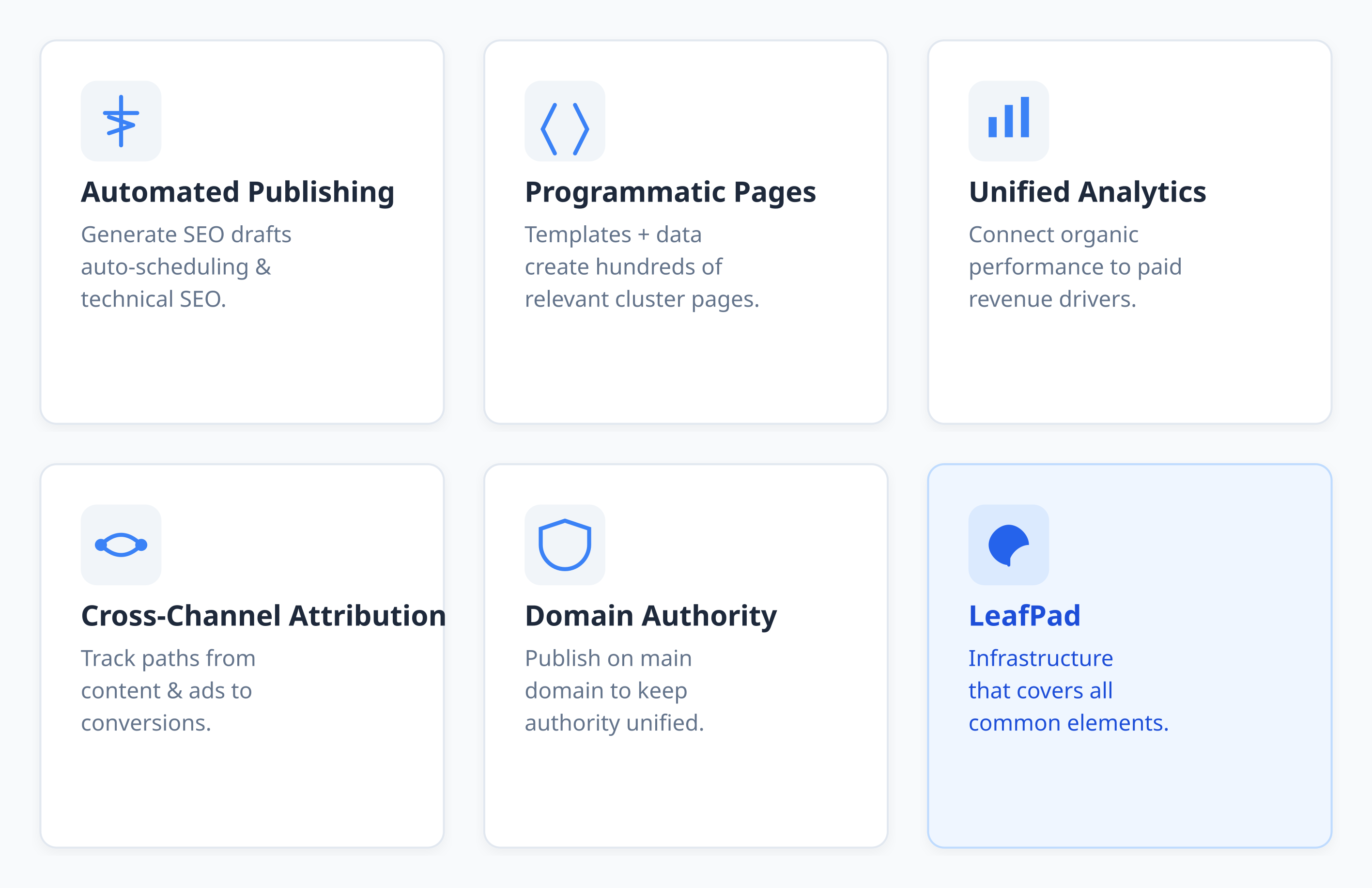
Teams doing this well share common elements:
Automated Publishing. Manual creation is too slow. Platforms generate SEO drafts from targets, maintain schedules, handle technical SEO.
Programmatic Pages. Templates and data create hundreds of relevant pages for keyword clusters.
Unified Analytics. Connecting organic performance to paid results shows what actually drives revenue.
Cross-Channel Attribution. Understanding user paths between content, ads, and conversions informs priorities.
Domain-Level Authority. Publishing on the main domain (not subdomains) keeps authority unified.
LeafPad covers all five why SaaS companies and agencies use it as their content foundation.
Metrics Beyond ROAS
CPC, CTR, and ROAS still matter, but integrated strategies need more.
| Metric Category | What It Measures | Why It Matters |
|---|---|---|
| Content Velocity | Posts/pages monthly | Signals freshness, builds authority |
| Organic Keyword Coverage | Keywords with ranking content | Reduces paid dependency |
| Quality Score Trends | Paid campaign efficiency | Shows domain authority impact |
| Cross-Channel Conversion Paths | Touchpoints before conversion | Reveals content's role |
| AI Platform Citations | Times content is referenced | Future-proofs discoverability |
| Domain Authority Growth | Overall site strength | Lowers CPC, improves organic |
The teams paying attention to all six categories are the ones seeing content investment reduce paid costs.
Why Developer-Free Publishing Changes Things
Traditional publishing requires developer time, designer involvement, IT approval, and weeks of lead time.
This kills agility. When you find a converting keyword cluster, you need landing pages immediately.
LeafPad removes these bottlenecks marketing teams publish instantly, create programmatic page sets, maintain brand through templates, and deploy without delays.
Tool Integration
Content platforms enhance existing stacks they don't replace them.
LeafPad integrates with Google Ads, Analytics, Search Console, SEMrush, Ahrefs, CRM and marketing automation platforms for conversion tracking.
Your content infrastructure becomes part of the unified system, not a separate silo.
Where This Is Going
The line between "paid search" and "organic search" is dissolving. Competitive advantage in 2026 comes from systems that build authority through automated content, amplify high-performers with paid, optimize for AI discovery, scale programmatically, and maintain publishing velocity.
Companies still isolating paid and organic are running into teams that stopped doing that two years ago.
If you're running digital search engine marketing, the question isn't whether to integrate content automation it's whether you can afford to wait while competitors figure it out.
Platforms like LeafPad simplify the transition. No engineering teams, no complex migrations, no months of setup. Just infrastructure that publishes, ranks, and compounds authority over time.
That's the difference between SEM that plateaus and SEM that keeps growing.
Published with LeafPad