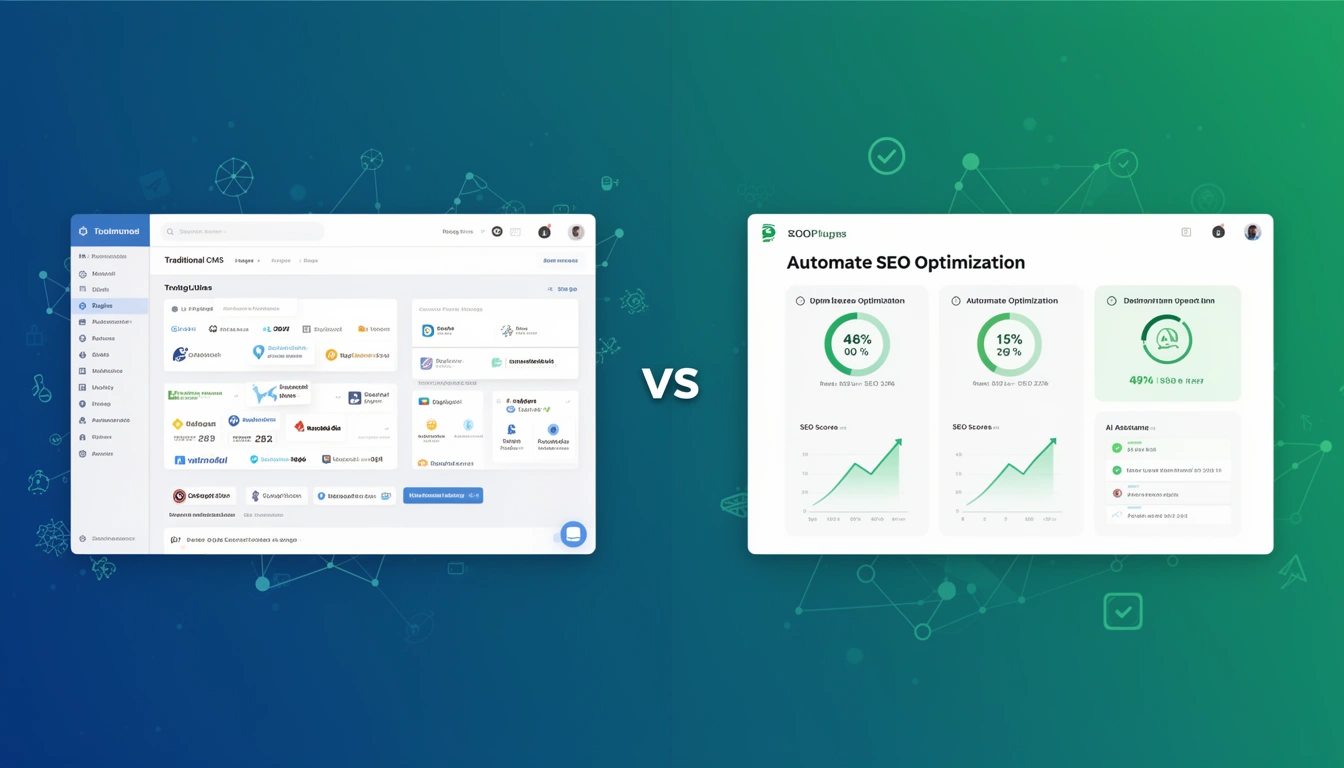
When founders think about SEO, they often picture months of keyword research, content calendars, and endless optimization cycles. But what if your blog could do the heavy lifting while you focus on building your product?
In 2026, the gap between traditional blogging platforms and SEO-automated systems has never been wider. While most platforms give you a blank canvas and wish you luck, modern content systems are actively working to boost your rankings—automatically.
What Makes a Blog Platform "SEO-Automated"?
An SEO-automated blog platform doesn't just publish content—it actively optimizes, monitors, and improves your search performance without constant manual intervention.
Traditional platforms like WordPress require you to:
Install multiple SEO plugins (Yoast, Rank Math, etc.)
Manually optimize every meta tag
Research and implement internal linking strategies
Monitor keyword performance across dozens of tools
Update content regularly based on ranking changes
Modern SEO-automated platforms handle these tasks as core features, not afterthoughts. The difference is like comparing a manual transmission to a Tesla—both get you there, but one requires constant attention while the other optimizes itself.
The 7 Core Features of SEO-Automated Platforms
1. Real-Time SEO Scoring and Recommendations
While you write, the platform analyzes your content against current search intent and competitive benchmarks. You get instant feedback on:
Keyword density and placement
Heading structure optimization
Content length relative to top-ranking pages
Readability scores for both humans and AI
Missing semantic keywords
This means every piece of content is optimized before it goes live, not after you notice it's not ranking.
2. Automatic Internal Linking
Internal linking is one of the most powerful (and most neglected) SEO strategies. SEO-automated platforms scan your existing content and automatically suggest or implement contextual internal links.
Instead of manually combing through hundreds of posts to find linking opportunities, the system identifies semantic relationships and creates link pathways that boost both user experience and PageRank flow. Learn more about how automatic internal linking outperforms manual strategies.
3. AI-Powered Keyword Discovery
Traditional keyword research involves hours in tools like Ahrefs or SEMrush. SEO-automated platforms integrate keyword discovery directly into your workflow.
As you write about a topic, the system identifies:
Related long-tail opportunities
Questions your audience is asking
Trending variations of your core topics
Content gaps in your existing coverage
This transforms keyword research from a separate planning phase into a continuous discovery process. Check out our guide on automated keyword research systems for 2026.
4. Programmatic SEO Capabilities
For businesses targeting multiple locations, industries, or product variations, programmatic SEO is essential. SEO-automated platforms let you create templates that generate hundreds or thousands of unique, optimized pages.
Instead of manually creating "Best Coffee Shop in [City]" for 500 cities, you build one intelligent template and let the system generate location-specific pages that feel handcrafted. Auto-generated location pages can drive massive local SEO revenue when done correctly.
5. Domain-First Architecture
Many platforms publish blogs on subdomains (blog.yoursite.com), which splits your SEO authority. SEO-automated platforms prioritize main domain publishing (yoursite.com/blogs) so every post strengthens your core domain.
This architectural decision compounds over time. After a year of publishing, your main domain accumulates all the backlinks, social signals, and search authority—rather than building up a separate subdomain you don't control.
6. AI Search Optimization
In 2026, ranking in traditional Google search is only part of the equation. Your content also needs to appear in ChatGPT responses, Perplexity results, and other AI-powered search interfaces.
SEO-automated platforms optimize content for both traditional and AI search engines by:
Structuring content for AI parsing
Including clear, quotable answers
Implementing schema markup automatically
Formatting content for featured snippets
Learn how to rank in ChatGPT and AI Overviews with proper AI search SEO.
7. Performance Analytics Without the Complexity
Traditional platforms require you to connect Google Analytics, Search Console, and various rank tracking tools. SEO-automated platforms consolidate this data into actionable insights.
You see which content is driving traffic, which keywords are gaining traction, and which pages need updates—all in one dashboard designed for content decisions, not data analysis.
Why Traditional Platforms Fall Short
WordPress, Medium, and similar platforms were built in an era when SEO was an add-on, not a core feature. Their architectures reflect this legacy:
WordPress: The Plugin Puzzle
WordPress requires assembling a stack of plugins to achieve basic SEO automation:
Yoast or Rank Math for on-page SEO
Link Whisper for internal linking
SEMrush or Ahrefs plugins for keyword research
Separate schema markup plugins
Performance optimization plugins
Each plugin adds complexity, potential conflicts, and security vulnerabilities. More importantly, they don't work together seamlessly—you're still manually connecting dots across systems. Discover why LeafPad is a lighter, faster WordPress alternative that auto-publishes content.
Medium: Zero Control, Zero Automation
Medium offers simplicity but at the cost of SEO control. You can't optimize meta descriptions, implement programmatic SEO, or build domain authority on your own site. Your content lives on Medium's domain, building their SEO strength, not yours.
Ghost: Better, But Still Manual
Ghost improved on WordPress with better performance and cleaner interfaces, but SEO optimization remains largely manual. You still need external tools for keyword research, rank tracking, and content optimization.
The Business Impact of SEO Automation
The efficiency gains from SEO-automated platforms aren't just convenient—they're transformative for resource-constrained teams.
Time Savings That Compound
Manual SEO typically requires 4-6 hours per blog post when you factor in:
Keyword research: 1-2 hours
Content outlining: 30-60 minutes
Writing: 2-3 hours
SEO optimization: 30-60 minutes
Internal linking review: 30 minutes
SEO-automated platforms reduce this to 1-2 hours by handling research, optimization, and linking automatically. For a team publishing 10 posts per month, that's 30-40 hours saved monthly—nearly a full-time employee. Read about how automatic SEO saves founders 780 hours per year.
Consistency at Scale
Human-driven SEO optimization is inconsistent. Even with checklists, quality varies based on who's writing, their SEO knowledge, and their available time.
Automated systems apply the same optimization standards to every piece of content. Your 50th blog post gets the same rigorous SEO treatment as your first—without fatigue or oversight.
Faster Time to Results
Traditional content strategies often take 6-12 months to show SEO results because the first several months are spent learning what works.
SEO-automated platforms incorporate best practices from day one. Your content is structured correctly, optimized properly, and linked strategically from the start—shortening the time to meaningful traffic.
How LeafPad Implements SEO Automation
LeafPad was built specifically to eliminate the manual overhead of traditional blogging platforms while maximizing SEO impact.
Integrated SEO Intelligence
Rather than bolting SEO onto a general-purpose CMS, LeafPad's editor provides real-time optimization guidance as you write. You see exactly how to improve each post before publishing—no separate tools or analysis required.
Automatic Optimization Without Configuration
Features like automatic internal linking, meta tag generation, and schema markup work out of the box. There's no plugin configuration, no technical setup, no choosing between competing solutions.
Programmatic SEO for Scale
LeafPad's programmatic content capabilities let you create SEO-optimized page collections that would take months to build manually. Create one template, define your variations, and publish hundreds of unique pages optimized for specific keyword targets.
Main Domain Publishing
Every blog publishes to your main domain's /blogs directory, ensuring all SEO authority compounds on your primary site. No subdomain splits, no separate properties to manage.
Shopify merchants can connect their store in minutes and start publishing SEO-optimized blog content directly to their storefront. Follow the Shopify Leafpad integration guide to grow your Shopify blog on autopilot.
See how automatic blogging systems transform content strategy for modern teams.
Comparing Platform Approaches to SEO Automation
Feature | WordPress | Medium | Ghost | SEO-Automated Platforms |
|---|---|---|---|---|
Real-time SEO scoring | Via plugins | No | No | Built-in |
Automatic internal linking | Paid plugins | No | Manual | Automatic |
Keyword research integration | External tools | No | External tools | Integrated |
Programmatic SEO | Complex setup | No | Custom dev | Native feature |
AI search optimization | Manual/plugins | No | Manual | Automatic |
Domain authority building | Yes (if configured) | No (Medium's domain) | Yes | Optimized by default |
Shopify blog integration | Via plugin | No | No | Native (1-click) |
Setup complexity | High | Low | Medium | Low |
When Manual SEO Still Makes Sense
SEO automation is powerful, but it's not always the right choice for every situation.
Highly Specialized Content
If you're writing extremely technical content for a niche audience, manual keyword research and custom optimization might uncover opportunities automation misses.
Established Sites with Complex Needs
Large sites with years of content and complex information architectures might need custom SEO strategies that go beyond automated systems.
When You Have Dedicated SEO Resources
If you already have a full-time SEO team, they might leverage manual tools more effectively than automated platforms. However, even SEO teams benefit from automation handling routine optimization while they focus on strategy.
For most startups, SaaS companies, and growing businesses, automation delivers better results with fewer resources. Learn more about manual SEO vs automatic SEO.
The Future of Content Platforms in 2026 and Beyond
As AI search continues to grow and search algorithms become more sophisticated, the gap between manual and automated SEO will only widen.
AI-First Content Optimization
Future platforms won't just suggest improvements—they'll automatically implement optimizations based on performance data. Content will continuously evolve to maintain rankings without manual updates.
Predictive SEO
Rather than reacting to keyword trends, automated systems will predict emerging topics and suggest content before competitors cover them. Early adoption of trending topics becomes a systematic advantage.
Cross-Platform Optimization
Content will be automatically formatted and optimized for different platforms—traditional search, AI assistants, social media, and emerging channels—from a single source.
Automated Content Refresh
Platforms will identify outdated content and either flag it for updates or automatically refresh statistics, examples, and facts to maintain relevance.
Understand how to architect your blog for AI discovery in 2026.
Making the Switch to SEO-Automated Platforms
If you're currently using a traditional platform and considering SEO automation, here's how to evaluate the transition:
Audit Your Current SEO Effort
Calculate how much time your team spends on:
Keyword research
On-page optimization
Internal linking
Performance monitoring
Content updates
This baseline helps you measure ROI from automation.
Identify Your Content Volume Goals
If you want to publish more content but lack resources, automation multiplies your team's output. If you're satisfied with current volume but want better results, automation improves quality without increasing effort.
Consider Your Technical Resources
Traditional platforms often require developer time for setup, maintenance, and optimization. SEO-automated platforms reduce technical dependencies, freeing developers for product work.
Evaluate Migration Complexity
Most modern platforms support content import from WordPress, Medium, and other sources. The migration itself is usually straightforward—the decision is the hard part.
Learn more in our comparison with other platforms.
Real-World Impact: SEO Automation in Practice
The theoretical benefits of SEO automation are compelling, but the real test is practical results.
Startup Scenario: Limited Resources, Maximum Impact
A typical early-stage SaaS company has one marketer juggling content, social media, email, and product marketing. They might publish 2-3 blog posts per month with manual SEO.
With SEO automation:
Publishing frequency increases to 8-10 posts monthly (same resource)
Each post is consistently optimized (no quality variance)
Internal linking happens automatically (previously neglected)
Programmatic pages cover 100+ keyword variations (previously impossible)
Result: 4-5x more indexed pages, better optimization per page, and dramatically increased keyword coverage—all with the same one-person team.
Agency Scenario: Client Scale Without Team Scale
Marketing agencies managing multiple client blogs face a scaling challenge: each new client requires proportional resource increases.
SEO automation allows agencies to:
Maintain consistent optimization standards across all clients
Reduce per-client management time by 60-70%
Take on more clients without proportional hiring
Demonstrate measurable SEO improvements faster
Product Company Scenario: Content as Growth Engine
Product-focused companies often neglect content because it competes with feature development for resources. SEO automation makes content sustainable:
Product managers can publish updates without SEO expertise
Documentation automatically contributes to SEO
Programmatic content covers product variations systematically
Content maintenance becomes automatic rather than a perpetual backlog
Explore how automatic SEO transforms startup growth.
Key Takeaways: Choosing Your Platform in 2026
The content platform landscape has fundamentally changed. The question is no longer "Should we blog?" but "Should our platform do the SEO work for us?"
Choose SEO-automated platforms if you:
Want to publish more content without proportional resource increases
Lack dedicated SEO expertise on your team
Need consistent optimization across all content
Want to leverage programmatic SEO for scale
Prefer building on your main domain rather than subdomains
Value time-to-results over customization flexibility
Stick with traditional platforms if you:
Have a dedicated SEO team that prefers manual control
Require highly custom functionality beyond standard blogging
Already have years invested in a well-optimized WordPress setup
Publish infrequently enough that manual optimization isn't burdensome
For the vast majority of modern teams—especially startups, SaaS companies, and growing businesses—SEO automation delivers better results with dramatically less effort. The compounding effect of consistent, optimized publishing beats occasional manual optimization every time.
Getting Started with SEO-Automated Blogging
If you're ready to move beyond traditional platforms and embrace SEO automation, the process is straightforward:
Evaluate your current platform's limitations - Where does manual SEO slow you down?
Define your content goals - How much do you want to publish, and how fast do you need results?
Test an automated platform - Most offer free trials that let you experience the workflow difference
Migrate strategically - You don't have to move everything at once; start with new content
Measure the difference - Track publishing velocity, optimization consistency, and traffic growth
The content marketing landscape rewards teams that can publish consistently, optimize systematically, and scale efficiently. SEO-automated platforms turn these goals from aspirations into default behaviors.
See how to publish blog content 10x faster in 2026 with the right platform and approach.
In 2026, the competitive advantage goes to teams that let automation handle optimization while they focus on creating genuinely valuable content. The platforms that make this possible aren't just tools—they're force multipliers that transform how modern teams approach content strategy.
Ready to experience the difference? Explore LeafPad and see how SEO automation can transform your content strategy.
Published with LeafPad