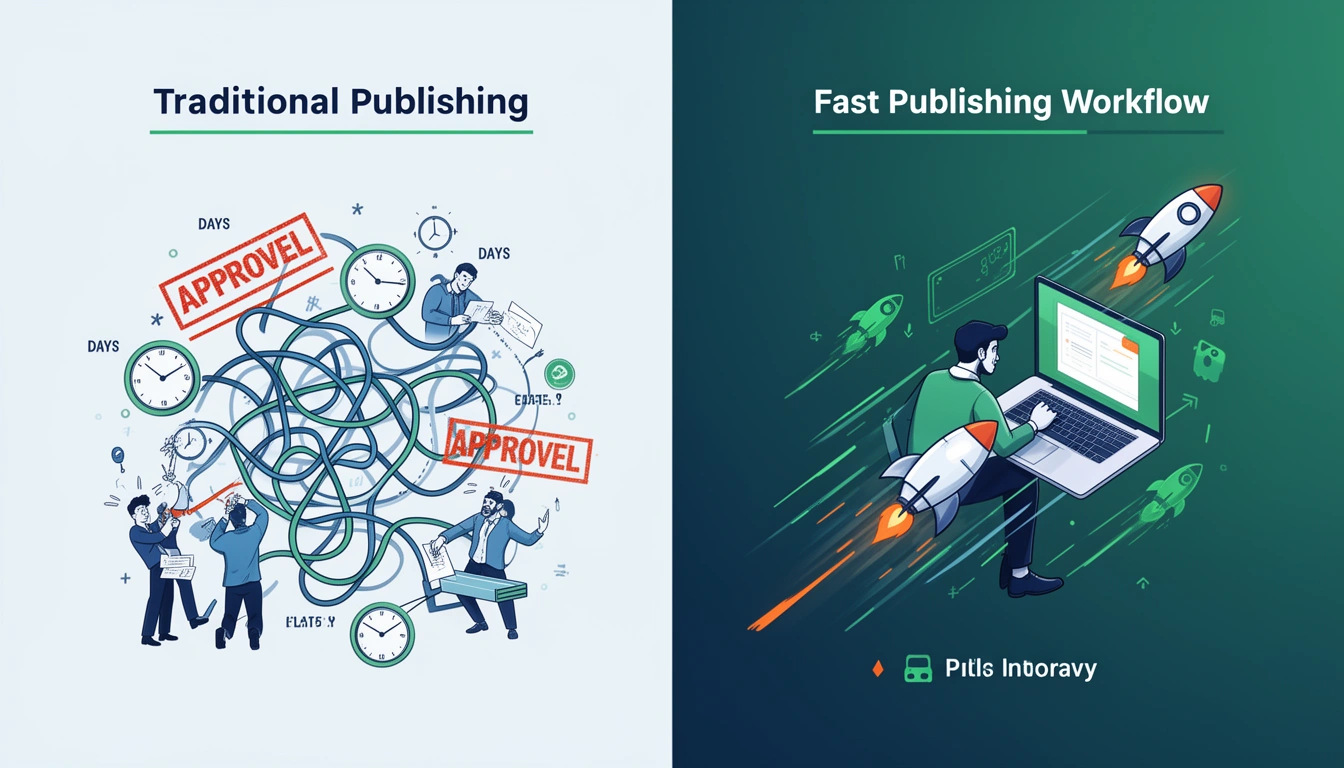
Most founders treat blog publishing like launching a rocket: endless reviews, copy edits, design tweaks, and approval chains that turn a 2-hour writing session into a 2-week ordeal. By the time content goes live, the opportunity window has closed, competitors have published similar pieces, and your team has lost momentum.
In 2026, speed isn't just a competitive advantage—it's the difference between capturing search visibility and watching it slip away. With AI search engines indexing content within hours and Google rewarding fresh, relevant information, your publishing velocity directly impacts your organic growth trajectory.
This guide reveals the exact systems high-growth startups use to publish blog content 10x faster without sacrificing quality, SEO performance, or brand consistency.
Why Traditional Blog Publishing Kills Your SEO Momentum
The traditional content workflow looks like this:
- Writer drafts post (3-5 hours)
- Editor reviews and requests changes (2-3 days wait time)
- Designer creates featured image (1-2 days)
- Developer uploads to CMS (1 day)
- SEO team optimizes meta tags (2-3 hours)
- Legal/compliance review (2-5 days)
- Final stakeholder approval (1-3 days)
- Publication and promotion (30 minutes)
Total time: 7-14 days per blog post
The SEO cost of this delay is massive:
- Missed trending topics: Search volume spikes last 3-7 days; slow publishing means you miss the wave entirely
- Competitor advantage: Faster publishers claim featured snippets and top positions while you're still in review
- AI indexing windows: ChatGPT, Perplexity, and Claude prioritize recently published content; delays reduce AI visibility
- Lower content output: Slow workflows mean fewer total posts, reducing your keyword footprint and topical authority
- Team burnout: Content creators lose motivation when their work sits in endless approval loops
The 10x Publishing Velocity Framework
High-velocity content operations share three core principles:
1. Eliminate Technical Bottlenecks
Every step requiring developer intervention adds 1-3 days to your timeline. Modern platforms like LeafPad remove technical dependencies entirely:
- Writers publish directly from the editor—no CMS handoffs
- SEO optimization happens inline during writing, not as a separate step
- Design templates auto-apply, eliminating custom image creation delays
- Content goes live instantly without deployment cycles
This single shift can reduce publishing time from days to hours.
2. Automate SEO Tasks That Don't Require Human Judgment
Manual SEO work is necessary for strategy and content quality, but 70% of SEO tasks are mechanical:
- Meta tag formatting
- Keyword density checks
- Internal link discovery
- Image alt text
- Schema markup
- URL slug optimization
Platforms with built-in automatic SEO handle these tasks in real-time, saving 2-4 hours per post and ensuring consistency across all content.
3. Implement Trust-Based Publishing Workflows
The approval bottleneck exists because organizations lack confidence in their content quality controls. Fix the quality system, not the approval chain:
- Pre-approved topic clusters: Create editorial guidelines for evergreen topics that don't require individual sign-off
- Quality checklists: Writers self-review against standardized criteria before publishing
- Post-publication review: Shift from pre-approval to rapid post-publication edits (content can be live within hours, then refined)
- Rolling 30-day audits: Review published content in batches rather than individually
Real-World Publishing Velocity Benchmarks
Here's what different publishing speeds look like in practice:
| Publishing Speed | Time to Publish | Posts per Month | Typical for |
|---|---|---|---|
| Traditional | 7-14 days | 2-4 | Enterprise, agencies |
| Moderate | 3-5 days | 6-8 | Small marketing teams |
| Fast | 1-2 days | 12-20 | Content-focused startups |
| High-velocity | 2-6 hours | 30-50+ | SEO-first companies, media sites |
The difference in SEO impact is exponential: a company publishing 40 posts per month builds topical authority 10x faster than one publishing 4 posts, even if individual post quality is similar.
The Same-Day Publishing System
Here's how to restructure your workflow for same-day or next-day publishing:
Step 1: Move to Platform-Native Publishing
Stop using external tools (Google Docs, WordPress drafts, design software) that require content transfer. Write, optimize, and publish in one environment.
LeafPad's editor provides everything you need in one interface:
- Distraction-free writing experience
- Real-time SEO scoring and keyword suggestions
- Automatic internal linking to relevant posts
- One-click publishing with instant live URLs
Step 2: Create Reusable Content Templates
Instead of starting from scratch each time, build templates for common post types:
- How-to guides: Problem statement → Solution framework → Step-by-step process → Results/benefits
- Comparison posts: Introduction → Feature comparison table → Use case analysis → Recommendation
- Trend analysis: What's happening → Why it matters → Data/examples → Actionable takeaways
- Case studies: Challenge → Approach → Implementation → Results → Lessons
Templates reduce decision fatigue and cut writing time by 40-60%.
Step 3: Batch Research, Individual Writing
Separate research from writing to avoid context switching:
- Monday: Research and outline 5-10 topics using automated keyword research
- Tuesday-Friday: Write and publish 1-2 posts daily from pre-researched outlines
This batching approach leverages focused work modes and maintains consistent output.
Step 4: Publish First, Perfect Later
Shift your mindset from "perfect before publishing" to "good enough to publish, excellent within 48 hours."
The publishing sequence:
- Hour 0: Complete draft with 80% quality threshold
- Hour 1: Self-review against quality checklist
- Hour 2: Publish live
- Hour 3-24: Share with team for feedback
- Hour 25-48: Implement edits and refinements
This approach gets content indexed by search engines and AI immediately while still ensuring quality through rapid iteration.
Automating the Bottlenecks: What to Automate vs. What to Keep Human
Not everything should be automated. Here's the decision framework:
Automate These Tasks:
- SEO metadata generation: Auto-generate title tags, meta descriptions, and OG tags based on content
- Internal linking: Use automatic internal linking to connect related posts
- Keyword optimization: Real-time suggestions for keyword placement and density
- Image optimization: Automatic compression, sizing, and alt text
- Publishing workflow: One-click publish with no manual deployment
- Content distribution: Auto-post to social channels and update sitemaps
Keep These Human:
- Topic selection and strategy: Requires market understanding and competitive analysis
- Original insights and expertise: Your unique perspective is your competitive advantage
- Voice and brand tone: Human writing creates connection and trust
- Complex arguments: Nuanced positions need human judgment
- Quality assessment: Final judgment on whether content meets standards
Case Study: How One SaaS Company Went from 4 Posts to 40 Posts per Month
A B2B SaaS company was publishing 4 blog posts monthly using WordPress with a traditional workflow. Each post took 10-14 days from concept to publication.
The changes they made:
- Migrated to LeafPad for integrated publishing
- Created 8 reusable content templates
- Shifted to trust-based publishing (writers could publish directly)
- Implemented batched research sessions
- Adopted "publish first, perfect within 48 hours" workflow
Results after 90 days:
- Publishing output increased from 4 to 42 posts per month
- Average time from draft to published: 4 hours (down from 10-14 days)
- Organic search traffic increased 340%
- Featured in AI search results (ChatGPT, Perplexity) for 18 target queries
- Domain authority increased from 28 to 41
- Content team satisfaction scores improved 65%
The key insight: velocity itself became a competitive moat. Competitors couldn't match their publishing speed, allowing them to dominate long-tail keywords in their niche.
How AI-Generated Drafts Accelerate Publishing (When Used Correctly)
AI writing tools are controversial, but when used strategically, they can dramatically accelerate publishing without sacrificing quality.
Effective AI usage:
- Generate first drafts for data-heavy or technical topics
- Create outlines and structure for complex posts
- Research and compile statistics and examples
- Generate variations for testing headlines and meta descriptions
Always add human value:
- Inject original insights and experiences
- Verify all facts and update with current data
- Rewrite for your specific brand voice
- Add examples from your industry or customers
The combination of AI speed and human expertise creates the optimal balance for high-velocity publishing. Learn more about automatic blogging best practices.
Measuring Publishing Velocity Impact on SEO
Track these metrics to quantify the SEO benefit of faster publishing:
Leading Indicators (1-30 days):
- Time to index: How quickly Google and AI search engines discover new content
- Content output volume: Total posts published per month
- Keyword targeting expansion: Number of new keywords targeted
- Internal link density: Average internal links per post
Lagging Indicators (30-90 days):
- Organic traffic growth: Month-over-month increase in search visitors
- Keyword rankings: Average position improvement across target keywords
- Featured snippets: Number of posts earning position zero
- AI search visibility: Mentions in ChatGPT, Perplexity, and other AI search results
- Domain authority: Overall site authority metrics
Business Impact (90+ days):
- Organic conversion rate: Leads and customers from organic search
- Cost per acquisition: CAC for organic channel vs. paid channels
- Customer lifetime value: LTV of customers acquired through content
Common Publishing Velocity Mistakes to Avoid
Mistake #1: Sacrificing Quality for Speed
Publishing 50 low-quality posts won't outperform 10 excellent posts. The goal is to maintain quality while increasing output. Set minimum quality thresholds (word count, original insights, sources cited, etc.) and don't publish content that falls below them.
Mistake #2: Ignoring Content Strategy
Publishing fast without strategic direction creates noise, not authority. Before accelerating, ensure you have:
- Clear target audience definition
- Keyword research and topic clusters mapped
- Content pillar content framework
- Conversion goals for different content types
Mistake #3: Not Updating Old Content
High publishing velocity doesn't mean abandoning existing content. Allocate 20-30% of content time to refreshing and improving top-performing posts from previous months.
Mistake #4: Platform Complexity
Using platforms that require developer involvement for publishing defeats the purpose of velocity optimization. Choose tools that empower writers to publish independently.
The Technical Setup for Maximum Publishing Speed
Your technology stack directly impacts publishing velocity. Here's the optimal setup:
Core Requirements:
- Integrated editor and CMS: No content handoffs between tools
- Real-time SEO analysis: Optimization during writing, not after
- Automatic internal linking: Suggests relevant existing posts while writing
- One-click publishing: No deployment, staging, or approval workflows
- Version history: Confidence to publish knowing you can rollback changes
- Team collaboration: Comments and suggestions without blocking publication
LeafPad provides all these features natively, which is why companies see immediate velocity improvements after migration. Check out the getting started guide to see setup time (typically under 30 minutes).
Integration Considerations:
- Domain structure: Publish blogs on main domain (
/blogs) not subdomain to consolidate SEO authority - Analytics tracking: Auto-implemented without manual tag management
- Social sharing: Automatic OG tags and Twitter cards
- Mobile optimization: Responsive by default
Building Your 90-Day Velocity Transformation Plan
Here's a practical roadmap to 10x your publishing speed:
Month 1: Foundation and Migration
Week 1: Audit current workflow
- Map every step in your current publishing process
- Identify bottlenecks and delays
- Calculate average time from draft to published
Week 2: Select and implement new platform
- Evaluate platforms for velocity optimization (consider platform comparisons)
- Migrate existing content
- Set up team accounts and permissions
Week 3: Create templates and guidelines
- Build 5-8 reusable content templates
- Write quality checklists for each template
- Document new publishing workflow
Week 4: Team training and pilot
- Train team on new platform and workflow
- Publish 5-10 pilot posts using new system
- Gather feedback and refine process
Month 2: Scaling Output
Week 5-6: Implement batched research
- Research and outline 20+ topics
- Set publishing targets (start with 2x current output)
- Begin daily publishing rhythm
Week 7-8: Optimize and automate
- Identify remaining manual tasks to automate
- Implement automatic SEO systems
- Set up content distribution automation
Month 3: Full Velocity Operations
Week 9-12: Maximum output
- Publish at target velocity (10x original speed)
- Monitor quality metrics to ensure standards maintained
- Track SEO impact and adjust strategy
- Document learnings and optimize workflow further
Why Publishing Velocity Matters More in 2026
The SEO landscape has shifted dramatically with the rise of AI search:
- AI search engines prioritize recency: ChatGPT and Perplexity heavily weight recently published content in their responses
- Google's freshness algorithms: Search results increasingly favor recently updated content, especially for trending topics
- Competition intensity: More companies are investing in content; slower publishers get buried
- Topic authority signals: Comprehensive coverage of topic clusters (which requires volume) signals expertise to search engines
Learn more about optimizing for AI search SEO in the current landscape.
The Compound Effect of Publishing Velocity
The true power of high-velocity publishing isn't linear—it's exponential:
Month 1: You publish 40 posts vs. competitor's 4
- You have 10x more indexed pages
- You're targeting 10x more keywords
- You have 10x more internal linking opportunities
Month 3: You've published 120 posts vs. competitor's 12
- Your domain authority has increased faster
- You're appearing in AI search results regularly
- You've established topical authority in your niche
- Your organic traffic is growing 5-10x faster
Month 6: You've published 240 posts vs. competitor's 24
- You dominate long-tail keywords in your space
- Your content ranks faster due to domain authority
- Competitors can't catch up without similar velocity
- Your organic channel drives predictable, scalable growth
This compounding effect makes publishing velocity one of the most powerful levers for SEO success.
Getting Started: Your First Week of High-Velocity Publishing
Ready to transform your publishing speed? Here's what to do this week:
Day 1: Audit your current process
- Time each step in your publishing workflow
- Identify the biggest bottleneck
- Calculate your current average time to publish
Day 2: Evaluate your platform
- Does your current tool enable same-day publishing?
- Can writers publish without developer involvement?
- Is SEO optimization happening during or after writing?
- If answers are no, explore alternatives like LeafPad
Day 3: Create your first template
- Choose your most common post type
- Build a reusable outline structure
- Document quality criteria for this template
Day 4: Write and publish using the template
- Use your new template for a post
- Time yourself from start to published
- Note what slowed you down
Day 5: Implement one automation
- Choose one manual SEO task to automate
- Set up the automation in your platform
- Test with a new post
Day 6-7: Batch research for next week
- Research and outline 5-10 topics
- Prioritize by SEO opportunity
- Schedule writing time for each
Conclusion: Velocity as Competitive Advantage
In 2026, the companies that win organic search aren't necessarily those with the biggest budgets or the most writers—they're the ones that can consistently publish high-quality, optimized content faster than their competitors.
Publishing velocity is a system, not a skill. By eliminating technical bottlenecks, automating repetitive SEO tasks, and implementing trust-based workflows, you can 10x your content output without hiring more people or working longer hours.
The question isn't whether you can afford to invest in publishing velocity—it's whether you can afford not to. Every day you publish slowly is a day your competitors are building the topical authority and search visibility that should be yours.
Start by auditing your current workflow, identifying the biggest bottleneck, and eliminating it. Then tackle the next one. Within 90 days, you'll have transformed your content operation from a slow-moving publishing machine into a high-velocity growth engine.
Ready to accelerate your publishing speed? Get started with LeafPad and publish your first post in under an hour.