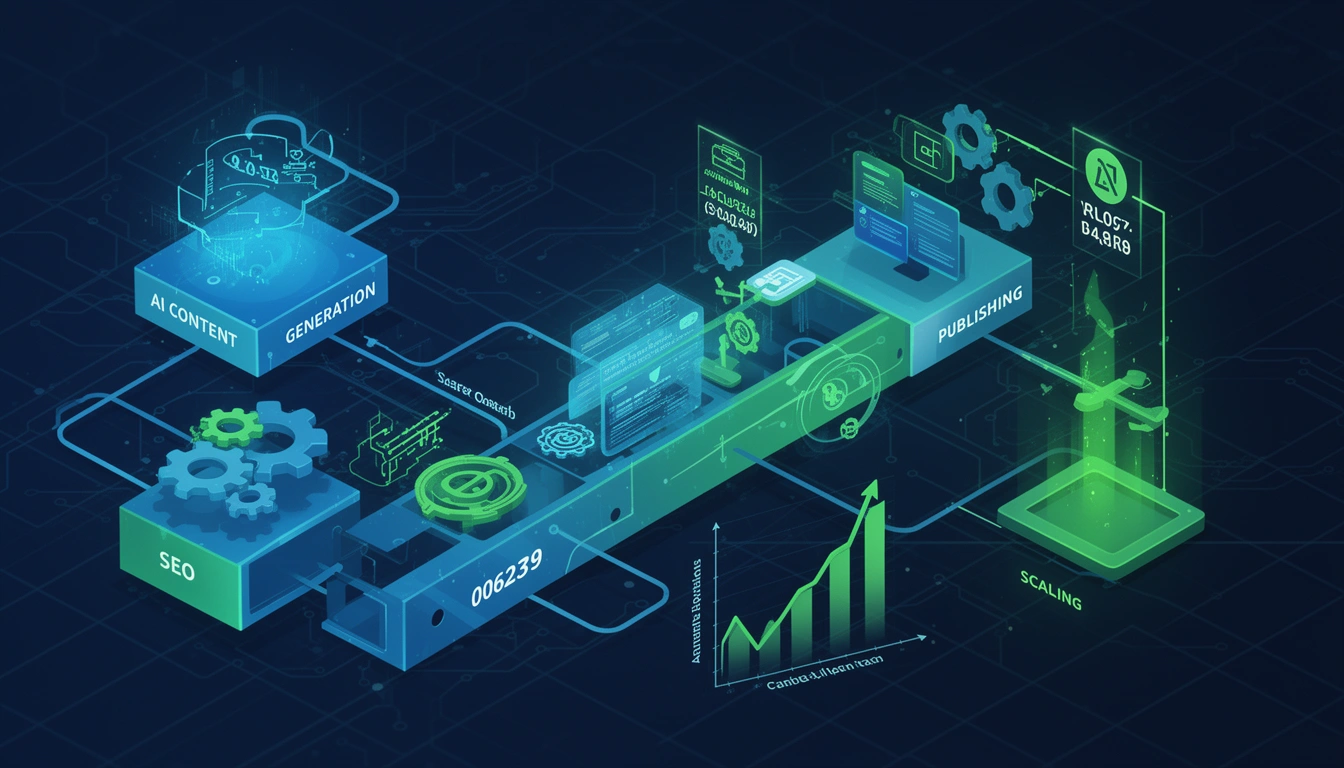
Most founders spend thousands on content creation, only to watch their blogs sit at position #47 in search results. The problem isn't the quality of your content—it's that you're treating blog publishing like it's still 2020.
In 2026, the gap between companies that publish sporadically and those with content systems is widening into a chasm. While you're manually optimizing meta descriptions and hoping for the best, your competitors are deploying automated content infrastructure that publishes, optimizes, and scales without constant human intervention.
Here's what separates winning content strategies from the rest: systematic automation, not heroic effort.
Why Traditional Blog Publishing Is Dying in 2026
The traditional blog publishing workflow looks something like this:
- Writer creates draft in Google Docs
- Editor reviews and requests changes
- Content sits in revision limbo for 2-3 weeks
- SEO team manually optimizes keywords and meta tags
- Designer creates featured image
- Developer uploads to CMS
- Marketing schedules social promotion
Total time from idea to publish: 3-6 weeks.
Meanwhile, search algorithms have evolved. Google's AI systems now prioritize content freshness, topical authority, and publishing consistency over individual post perfection. ChatGPT and Perplexity index and surface content based on recency and comprehensive coverage of topic clusters.
If you're publishing 2-3 posts per month using manual workflows, you're being outpaced by companies publishing 2-3 posts per day using content velocity strategies.
The New Content Publishing Stack for 2026
Modern content infrastructure isn't about replacing writers—it's about removing the 80% of publishing work that doesn't require human creativity. Here's what the new stack looks like:
1. Automated SEO Optimization Layer
Every piece of content should automatically receive:
- Dynamic keyword integration based on current search trends
- Meta tag generation optimized for click-through rates
- Semantic analysis to ensure comprehensive topic coverage
- Readability scoring that matches your target audience level
- Internal linking suggestions to strengthen topical clusters
Platforms like LeafPad build this directly into the publishing workflow, so optimization happens at creation time—not as an afterthought. This is what automatic SEO systems deliver without requiring a dedicated SEO team.
2. AI-Assisted Content Generation
The most effective 2026 content strategies use AI for structural heavy lifting:
- Outline generation from target keywords
- First draft creation that writers refine and enhance
- Content gap analysis identifying what competitors cover that you don't
- Variant creation for programmatic SEO pages
This doesn't mean publishing robot-written fluff. It means your writers spend time on strategy, unique insights, and brand voice—while automation handles research aggregation and structural formatting.
3. Programmatic Content Scaling
If your business serves multiple locations, industries, or use cases, you need programmatic content infrastructure. This means creating template-based content that dynamically populates with location-specific, industry-specific, or product-specific information.
For example, instead of manually writing 50 different "SaaS Marketing in [City]" posts, you create one template with dynamic variables. The system generates 50 unique, SEO-optimized pages that feel handcrafted but deploy in minutes.
This approach has driven massive local SEO revenue growth for companies scaling to new markets.
4. One-Click Publishing Without Developer Dependencies
The moment you need a developer to publish a blog post, you've introduced a bottleneck that will kill your content velocity.
Modern content infrastructure lets non-technical team members:
- Draft and publish without touching code
- Schedule content calendars weeks in advance
- Update existing posts without redeploying your entire site
- A/B test headlines and meta descriptions
This is why platforms designed for 10x faster publishing focus on removing technical friction entirely.
Building Your Content Infrastructure: The 4-Week Implementation Plan
You don't need to rebuild your entire content operation overnight. Here's a phased approach to modernizing your blog publishing infrastructure:
Week 1: Audit Current Bottlenecks
Map your current publishing workflow and identify where time disappears:
- How many hours from draft to live?
- How many people touch each piece of content?
- What percentage of time is spent on manual SEO tasks?
- How often do technical issues delay publication?
Most teams discover that 60-70% of publishing time is spent on tasks that could be automated.
Week 2: Implement Automated SEO
Switch to a publishing platform with built-in SEO automation:
- Automatic meta tag generation
- Real-time keyword optimization
- Internal linking recommendations
- Structured data markup
This alone can save your team 780+ hours annually on manual optimization work.
Week 3: Set Up AI-Assisted Workflows
Integrate AI tools into your content creation process:
- Use AI for outline generation from keyword clusters
- Generate first drafts that writers enhance with expertise
- Automate content gap analysis against competitors
- Create variant templates for programmatic scaling
The goal isn't to eliminate writers—it's to let them focus on high-value creative work instead of formatting and research aggregation.
Week 4: Launch Programmatic Content Experiments
Identify one content opportunity that scales programmatically:
- Location-based service pages
- Industry-specific use case guides
- Product comparison matrices
- "How to [task] with [tool]" tutorial series
Deploy 20-50 variations and measure which templates drive the most organic traffic and conversions.
The Content Infrastructure Mindset Shift
The biggest challenge isn't technical—it's psychological. Most content teams are stuck in an artisanal publishing mindset:
Old mindset: "Every blog post should be a masterpiece that takes weeks to perfect."
New mindset: "Consistent, good content beats sporadic perfection. Ship fast, measure, iterate."
This doesn't mean lowering quality standards. It means recognizing that:
- A good post published today beats a perfect post published next month
- Publishing frequency builds topical authority that individual posts can't
- Search algorithms reward consistency and comprehensiveness over isolated brilliance
- Content can be updated and improved after publication based on performance data
Companies that embrace content velocity consistently outrank competitors with "higher quality" but less frequent content.
Measuring Infrastructure ROI
How do you know if your content infrastructure is working? Track these metrics:
Efficiency Metrics
- Time from idea to publish: Should decrease by 60-80%
- Hours spent on manual SEO per post: Should approach zero
- Posts published per month: Should increase 3-5x
- Technical blockers per quarter: Should approach zero
Performance Metrics
- Organic sessions month-over-month: Should grow 15-30% consistently
- Pages ranking in top 10: Should increase with publishing volume
- AI search citations: Track mentions in ChatGPT, Perplexity, and Claude
- Topical authority score: Measured by coverage of semantic keyword clusters
Business Metrics
- Content-attributed leads: Should grow proportionally to content volume
- Customer acquisition cost (CAC): Should decrease as organic share grows
- Content ROI: Revenue per dollar spent on content infrastructure
Common Infrastructure Mistakes to Avoid
Mistake #1: Over-Automating Creative Work
Automation should handle mechanical tasks—keyword research, meta tag generation, formatting, internal linking. Human expertise should guide strategy, unique insights, and brand voice.
Don't publish AI-generated content without human review and enhancement. Do use AI to eliminate 80% of the grunt work so humans focus on the 20% that drives differentiation.
Mistake #2: Ignoring Blog Architecture
Publishing lots of content without strategic architecture creates a mess. You need:
- Topical clusters organized around pillar content
- Internal linking strategies that strengthen semantic relationships
- Taxonomy systems that help users and search engines navigate
- AI-optimized structure that helps ChatGPT and Perplexity surface your content
Learn how to structure blogs for AI discovery in 2026.
Mistake #3: Building Custom Instead of Buying Platform
Many engineering-led companies try to build custom content infrastructure. This rarely works because:
- Content platforms aren't your core competency
- SEO best practices evolve faster than custom builds can iterate
- Maintenance costs exceed platform subscription costs within months
- Your engineers should build product, not CMS features
Modern SEO-automated platforms provide better functionality at a fraction of the cost of custom builds.
Mistake #4: Neglecting Domain Authority Strategy
Publishing blogs on subdomains (blog.yoursite.com) or third-party platforms fragments your SEO equity. All content should live on your main domain under /blogs to compound authority.
Every post you publish should strengthen your entire domain's search performance, not build authority for someone else's platform.
The Competitive Advantage of Infrastructure
Here's what most companies miss: content infrastructure is a moat.
Competitors can copy your blog topics. They can't easily replicate a content system that publishes 10x faster, optimizes automatically, and scales programmatically.
Companies with superior content infrastructure:
- Capture new keyword opportunities before competitors can react
- Build topical authority faster through consistent publishing
- Scale to new markets and segments without proportional headcount growth
- Reduce CAC by growing organic share of customer acquisition
This compounds over time. A 3-month head start in content infrastructure becomes a 12-month advantage in search rankings and a permanent gap in operational efficiency.
How to Choose the Right Infrastructure Platform
When evaluating content infrastructure solutions, prioritize these capabilities:
Must-Have Features
- Publishes to main domain (/blogs) not subdomain
- Automated SEO optimization built into workflow
- AI-assisted content creation for drafts and outlines
- No-code publishing that non-technical teams can use
- Programmatic content support for scaling variations
- Design integration that matches your brand
- Native e-commerce integrations — Shopify merchants can connect their storefront directly and start publishing SEO blog content in minutes via the Shopify Leafpad integration to grow your Shopify blog
Nice-to-Have Features
- Editorial calendar and scheduling
- Multi-blog management from one dashboard
- Collaboration workflows for teams
- Performance analytics and A/B testing
- Automatic internal linking suggestions
LeafPad was specifically designed to deliver all of these capabilities in a unified platform—eliminating the need to stitch together multiple tools or build custom infrastructure.
Getting Started: Your First 30 Days
Ready to modernize your content publishing? Here's your 30-day action plan:
Days 1-7: Assessment
- Document current publishing workflow and time costs
- Identify top 3 bottlenecks slowing content velocity
- List all manual SEO tasks currently performed per post
- Audit competitor publishing frequency and topical coverage
Days 8-14: Platform Selection
- Evaluate infrastructure platforms against must-have features
- Run trial with 2-3 test posts to measure time savings
- Calculate ROI based on time saved vs. platform cost
- Get buy-in from content, SEO, and engineering teams
Days 15-21: Migration
- Migrate existing high-performing posts to new platform
- Set up automated SEO workflows and templates
- Train content team on new publishing process
- Establish editorial calendar for next 90 days
Days 22-30: Optimization
- Publish first 5-10 posts using new infrastructure
- Measure time savings compared to old workflow
- Identify first programmatic content opportunity
- Set quarterly OKRs for content velocity and organic growth
The Future of Content Publishing
By 2027, the content landscape will be dominated by companies that invested in infrastructure in 2026. Those still manually optimizing meta tags and waiting weeks for developer deployments will be buried in search results.
The question isn't whether to modernize your content infrastructure—it's whether you'll do it before or after your competitors.
The good news: infrastructure advantages compound quickly. A 90-day commitment to building better systems can create a 12-month competitive lead.
Take Action Now
If you're serious about scaling content in 2026, start by:
- Auditing your current publishing workflow to identify automation opportunities
- Calculating time costs of manual SEO and technical dependencies
- Testing modern platforms designed for content velocity and automatic optimization
- Running a 30-day pilot to measure efficiency gains before full commitment
Content infrastructure isn't a nice-to-have anymore. It's the foundation of competitive organic growth in an AI-first search environment.
Companies that treat blogging like software infrastructure—systematic, automated, and scalable—will dominate search while others struggle to publish twice a month.
The infrastructure gap is widening. Make sure you're on the right side of it.
Ready to build content infrastructure that scales? Explore LeafPad to see how automated publishing, SEO optimization, and programmatic content can transform your organic growth strategy.
Published with LeafPad