Google's geographical understanding shifted hard in 2026. If you're still thinking about "geo-targeting" the way you did in 2020, you're playing the wrong game. AI search, hyper-local intent, and LLM-powered discovery have changed how location signals work across the board.
This isn't about stuffing city names into H1s. That trick died years ago. The mechanics are more complex now but there's real opportunity if you get the new rules.
What actually changed since 2024
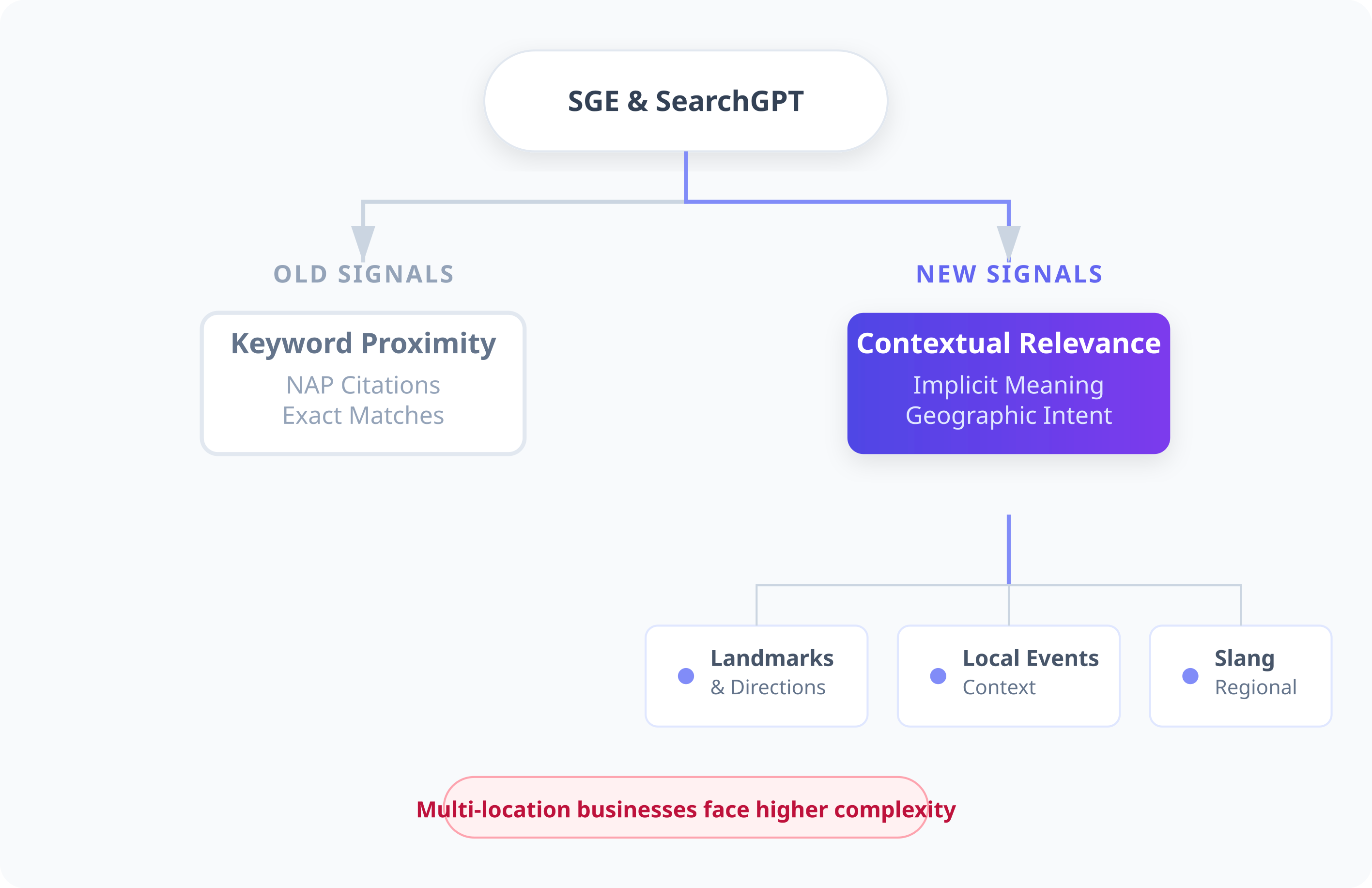
The pivot started when Google's Search Generative Experience (SGE) began prioritizing contextual location relevance over simple keyword proximity. By early 2025, SearchGPT and Perplexity's location-aware results forced Google to sharpen how it reads geographical intent.
Implicit signals matter more than explicit ones now. A search for "best coffee near me" doesn't just trigger a NAP (Name, Address, Phone) citation check. Google looks at how your content relates to neighborhood landmarks, local events, regional slang, and even how you describe directions.
Multi-location businesses have it harder. Duplicate content swaps don't cut it anymore. Google's 2025 "Venue Integrity Update" started slapping sites with location pages that lacked unique, verifiable local context.
AI overviews want synthesis, not just keywords. When Gemini or ChatGPT answers "where should I eat in Austin," they pull from sources that demonstrate local expertise. Your content has to sound like a local wrote it, not a template with the city name swapped in.
Structured data is the baseline now. JSON-LD implementations need more than an address they need service areas, geo-coordinates, and accessibility details.
New geo-intent categories
Search intent has fractured into micro-categories, each needing a different approach.
Hyper-local discovery searches like "bakery on 5th and Main" or "barber near Whole Foods downtown" is up 40% year-over-year according to BrightEdge. Content that references specific intersections, landmarks, and micro-neighborhoods wins here.
Distributed service queries "plumber serving [region]" or "HVAC repair in [county]" exploded after 2024. Service businesses realized they could capture demand across broad areas without physical locations. Service area schema and testimonials organized by sub-region work well.
Comparative location queries like "best schools in [suburb A] vs [suburb B]" used to belong to Niche.com and Numbeo. Now local businesses capture this traffic with data-driven comparison content and interactive maps.
Event-triggered geo queries are tied to concerts, games, or conferences. Timely content indexed before the event, plus event schema markup, is the play.
If you're publishing at scale, LeafPad's SEO automation features can target these intent categories without rebuilding your entire strategy.
Programmatic geo-pages in 2026
Programmatic local SEO isn't dead, but the lazy version is. Google specifically targets low-quality location pages now.
You need unique data per location. Swapping "Dallas" for "Austin" doesn't work. Each page needs location-specific details: weather patterns, demographics, local regulations, area-specific pricing.
Natural language variation is essential. Identical sentence structures across 50 cities trigger quality filters. Modern systems use LLMs to keep facts consistent while varying expression.
Verification signals matter. Google wants proof you serve the area. Location-specific testimonials with schema, locally-attributed backlinks, GMB profiles, and geo-tagged images all help.
Crawl efficiency is critical when managing hundreds of pages. Internal linking, pagination, and sitemap organization prevent crawl budget waste.
The automated local SEO strategies that work in 2026 focus on scalable uniqueness generating authentic local content without manual work for every single page.
Schema that actually moves the needle
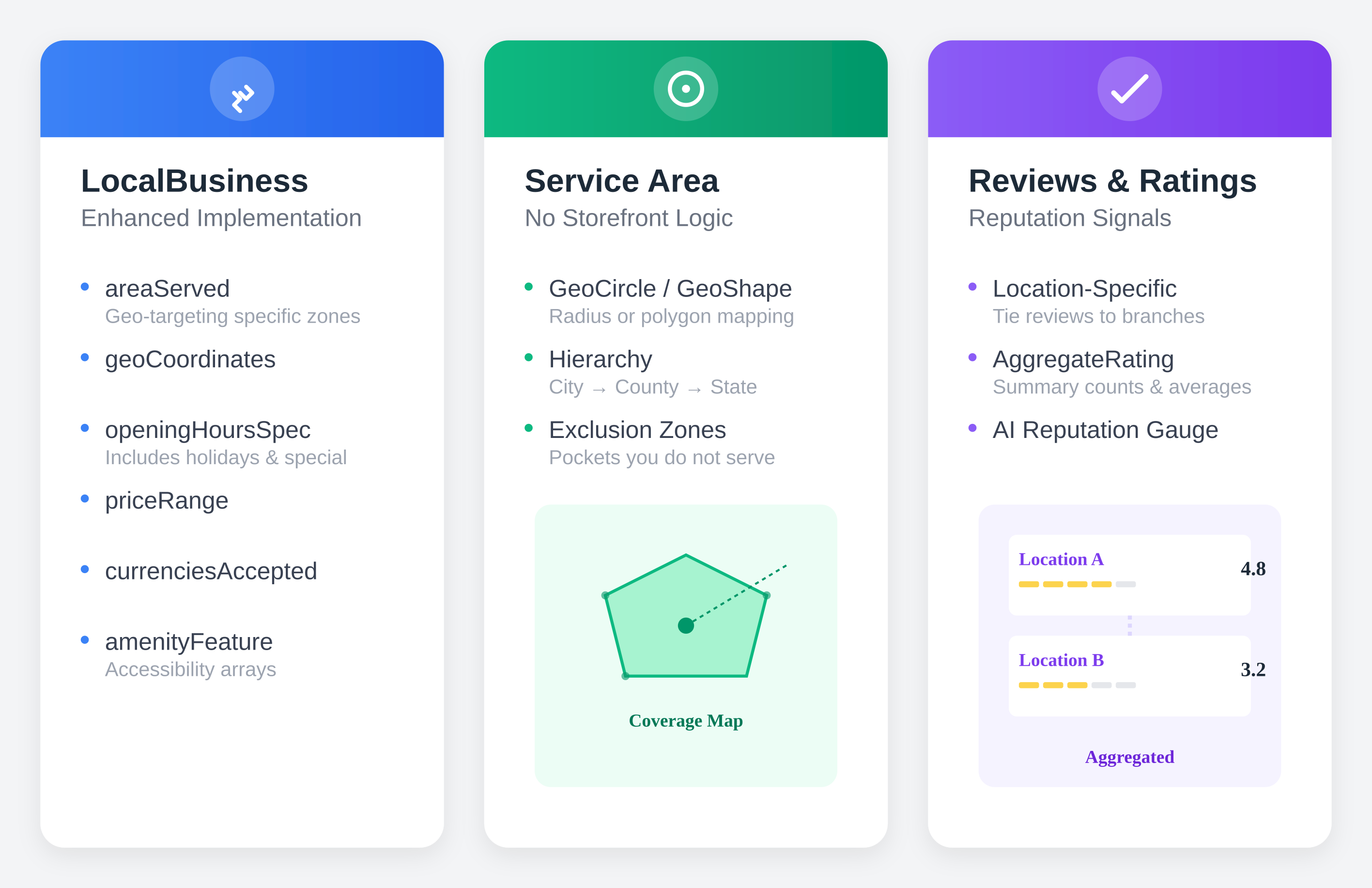
Local schema is table stakes, but most implementations are incomplete.
LocalBusiness (Enhanced)
Beyond NAP, you need areaServed properties, geoCoordinates, openingHoursSpecification (including holidays), priceRange, currenciesAccepted, and amenityFeature arrays for accessibility.
Service Area Schema
For businesses without storefronts, you need GeoCircle or GeoShape implementations, hierarchical definitions (city → county → state), and exclusion zones if you don't serve specific pockets.
Review and Rating Schema
Location-specific review markup helps AI systems gauge local reputation. Aggregate ratings at the location level not just the business level matter, as does showing consistent recent reviews.
Event Schema
If you host events or classes, event schema gets you into "things to do" queries and AI itineraries.
Implementation matters. Invalid schema can trigger manual penalties. Run everything through Google's Rich Results Test.
How AI search changed geo-discovery
ChatGPT, Perplexity, and Gemini interpret location differently. They synthesize answers rather than ranking pages.
Context density beats keyword density. AI checks for genuine local knowledge. A piece on "roof maintenance in Phoenix" needs monsoon season, heat expansion, and dust storms not generic advice with "Phoenix" pasted in.
Citation format matters. AI prefers sources with clear authorship, structured content, and verifiable claims. Promotional fluff gets ignored.
Passage-level optimization is critical. AI pulls paragraphs, not pages. Each section should stand on its own.
If you aren't optimizing for how AI search algorithms discover content, you're behind.
Mobile-first geo
Mobile is 78% of local search (up from 61% in 2023).
Micro-moments are everything. Mobile searchers want answers in under 3 seconds. Location pages need instant load times, click-to-call above the fold, embedded maps, real-time inventory, and one-tap directions.
Voice search means natural questions. "Where can I find [service] near me" needs a clear answer in the first 50 words.
App-clips and instant experiences for booking or ordering are becoming ranking factors. Google favors businesses that complete transactions without forcing an app download.
Internal linking for geo content
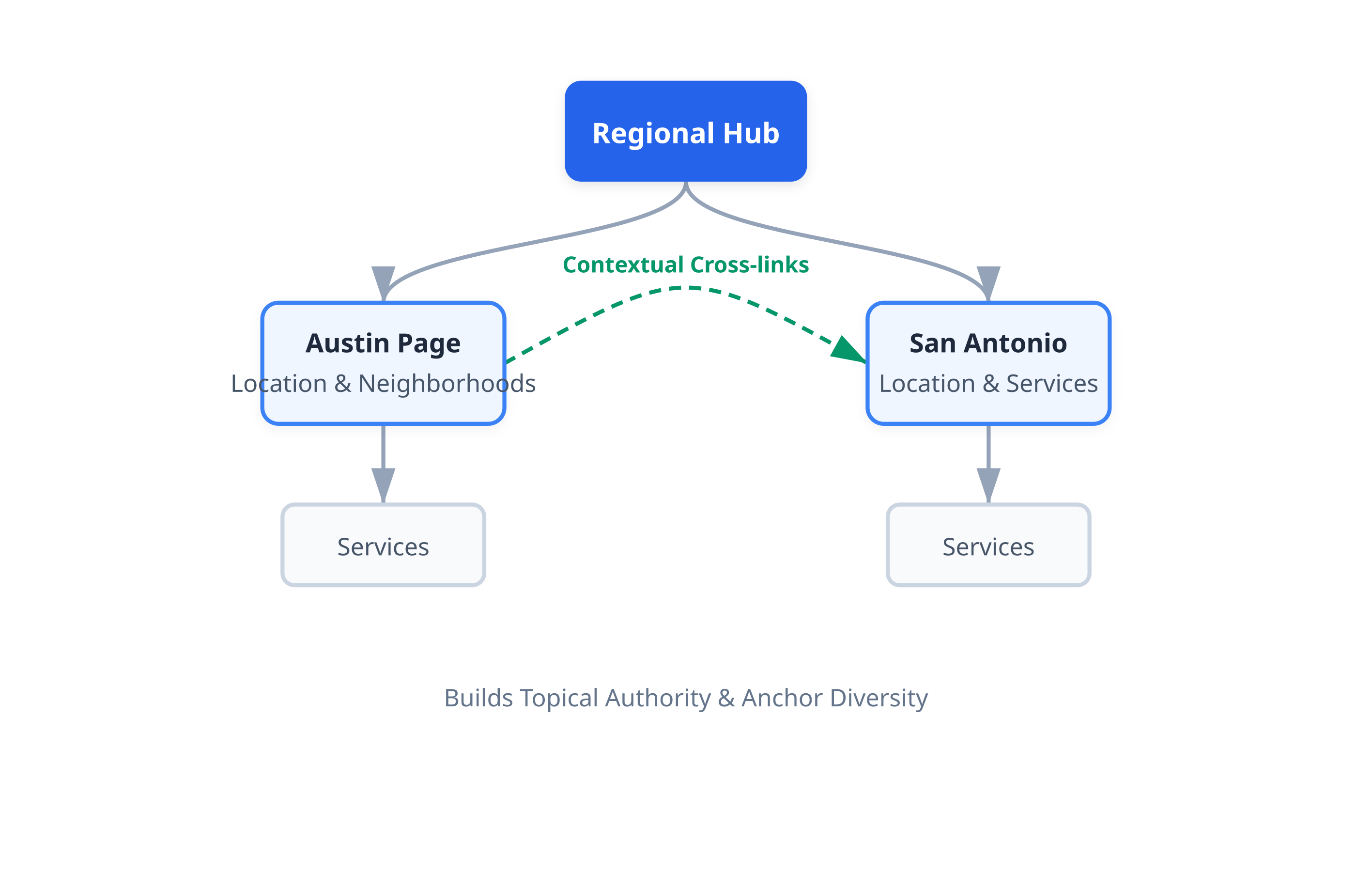
Location pages shouldn't be orphan islands.
Hub-and-spoke works: a regional page links to location pages, which link to service-specific pages. This builds topical authority clusters.
Contextual cross-linking helps. If you serve Austin and San Antonio, your Austin page should mention San Antonio where relevant.
Anchor text diversity matters. Use neighborhood names and regional identifiers, not just "Austin roofing" on repeat.
The organic internal linking approach LeafPad uses handles this without manual link management.
Tracking geo-performance
The metrics have evolved.
Position tracking needs zip code granularity. Track ranking variation, SERP features (local pack, map results, AI answers), and CTR by segment.
Conversion attribution by discovery source shows if geo-query traffic converts better than broad search.
AI citation tracking via BrightEdge or Conductor reveals when AI cites your content. This is the new backlink.
Local pack monitoring needs tools like BrightLocal or Whitespark.
See how to measure SEO success in 2026 for more on location-specific KPIs.
The real competition
Your competition isn't just the business down the street.
Aggregators like Yelp, Angi, and Thumbtack generate hyper-local content with AI faster than you can. AI-generated directory sites are popping up everywhere, built with GPT-4 and Claude to create "unique" content for every listing and location combination. National brands are finally getting local execution right.
Your edge: Authentic local presence. Real interactions, community involvement, actual expertise. You just have to surface those signals in your content.
What to do now
Audit your location pages. Check Search Console for pages with declining impressions or high-impression/low-CTR combos.
Get your schema right. LocalBusiness, Service Area, and Review schema first.
Build content that proves you know the area. Guides, stats, neighborhood comparisons.
Get one locally-relevant link per location per month. That beats 50 directory submissions.
Set up tracking. You can't fix what you don't measure.
If you're doing this at scale, LeafPad's automated publishing keeps content velocity high without sacrificing quality.
Geo-targeting in 2026 rewards authentic local presence surfaced through high-quality content. The tools are there execution is the differentiator.
Published with LeafPad