Getting local keywords right matters more than most businesses think. You can have a great product, solid reviews, a nice website and still lose to a competitor who shows up for the right searches in the right neighborhoods.
Location keywords aren't just about adding your city name to page titles. Though honestly, a lot of businesses don't even get that far.
Why Location Keywords Matter More in 2026
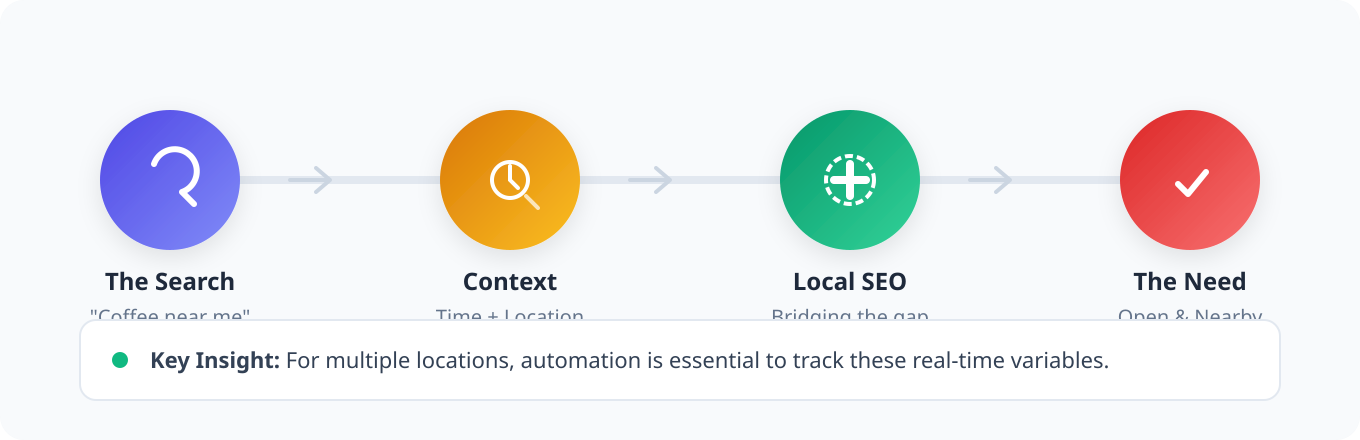
Google's gotten much better at matching searches to businesses based on where someone is, what time it is, and what they probably want.
When someone searches "coffee shop near me" at 8 AM on a Tuesday, they don't want the city's best-reviewed café. They want something nearby, open right now, probably on the way to work. The gap between what they typed and what they actually need that's where local SEO lives.
For businesses managing multiple locations, automated local SEO strategies have become necessary. You can't manually track and optimize for dozens of locations without something doing the heavy lifting.
Types of SEO Location Keywords That Drive Traffic
City + Service Keywords
These are the basics:
- "plumber in Austin"
- "Denver wedding photographer"
- "Seattle tax attorney"
Competitive, but they convert. Someone searching them is usually ready to hire.
Neighborhood-Level Keywords
Smaller than city-level:
- "Brooklyn Heights dentist"
- "Buckhead hair salon"
- "Pearl District brunch"
Often less competition. People searching at this level usually live or work nearby and are ready to walk in.
"Near Me" Search Terms
Mobile made these normal:
- "gym near me"
- "emergency vet near me"
- "open restaurants near me"
You can't optimize for "near me" by stuffing it on pages. Instead, focus on proper on-site SEO for local businesses with accurate location data, hours, and local schema markup. Google figures out the rest.
Service Area Keywords
For businesses that go to customers:
- "roofing contractor serving Orange County"
- "delivery available in North Dallas"
- "pest control Greater Phoenix area"
Works for contractors, delivery services, mobile businesses.
Landmark-Based Keywords
People navigate by landmarks more than addresses:
- "hotel near LAX airport"
- "parking near Fenway Park"
- "restaurants by Union Station"
If you're close to major landmarks, schools, hospitals, transit hubs use that. Someone searching "lunch near USC campus" has a specific need and is close by.
How to Find Your Best Location Keywords
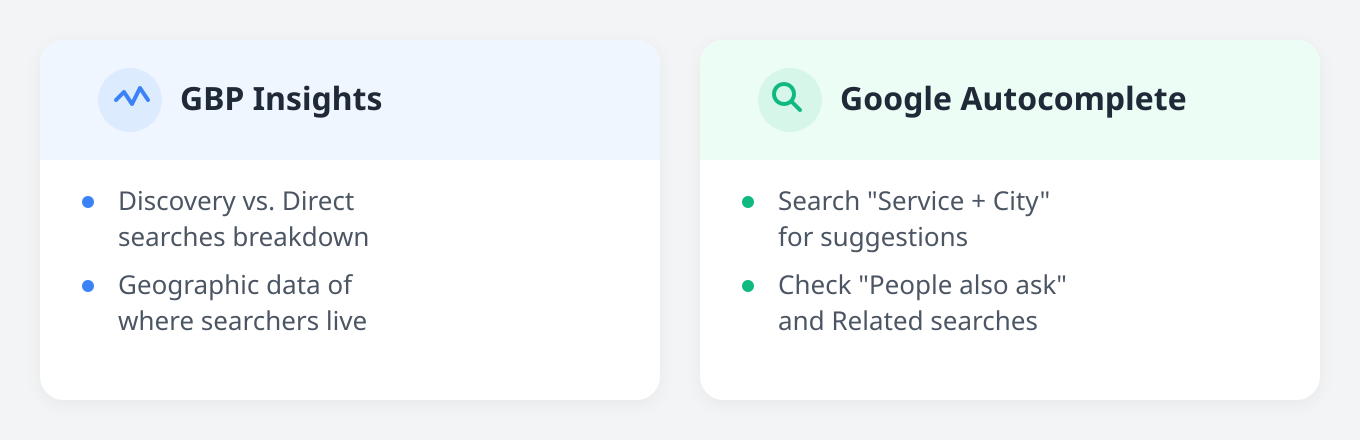
Start with Google Business Profile Insights
Your GBP data tells you what searches bring people to your listing:
- Discovery searches (how they found you)
- Direct searches (branded searches)
- Geographic breakdown of where searchers are
This beats any keyword tool because it's your actual data.
Use Google Autocomplete Strategically
Type your service plus location into Google and watch what it suggests:
- Start typing "dental implants [your city]" and see what completes
- Check "People also ask" sections
- Look at "Related searches" at the bottom
These are real queries from real users. Google is literally telling you what people search.
Analyze Local Competitors
What are the businesses ranking above you targeting? Look at:
- Their page titles and headings
- Content topics they cover
- Location pages they've built
Tools like local SERP checkers show you who's ranking for what in your target areas.
Mine Your Customer Language
How do your actual customers talk about:
- Their location ("downtown," "the East side," "by the mall")
- Your services (industry jargon vs. what they actually say)
- What they need
Real customer language beats keyword research theory. I've seen businesses rank for terms they never would have guessed because customers kept using them in reviews.
Consider Search Intent Variations
Different intents need different content:
Informational: "how to choose a mechanic in Portland" Commercial: "best car repair shops Portland" Transactional: "oil change Portland open now" Navigational: "Joe's Auto Repair Portland address"
Someone asking "how to choose" wants information. Someone saying "open now" wants to buy. Don't send the second person to a blog post.
Building Location Keyword Strategy at Scale
When you have multiple locations, manual keyword research for each one doesn't scale. Trust me I've tried.
Template-Based Keyword Frameworks
Build keyword templates that work across locations:
- [Service] + [Location]
- [Service] near [Landmark] in [Location]
- Best [Service] [Location]
- [Service] [Neighborhood/ZIP]
Then apply them systematically.
Programmatic Location Pages
When you have 10+ locations, you need unique optimized pages for each. Understanding local SEO research methods helps identify which locations and keywords deserve dedicated pages.
The hard part: each page actually needs to be good. Unique location-specific content, local business schema, embedded maps, location-specific testimonials, relevant local imagery. You can't just swap the city name and call it done.
Automated Keyword Monitoring
Tracking rankings across multiple locations and keywords by hand doesn't work. You need systems that:
- Monitor rankings by location
- Track competitor position changes
- Alert you to ranking drops
- Show seasonal trends
Platforms built for automated local SEO handle this. Whether you build or buy, you need something watching your back.
Common Location Keyword Mistakes to Avoid
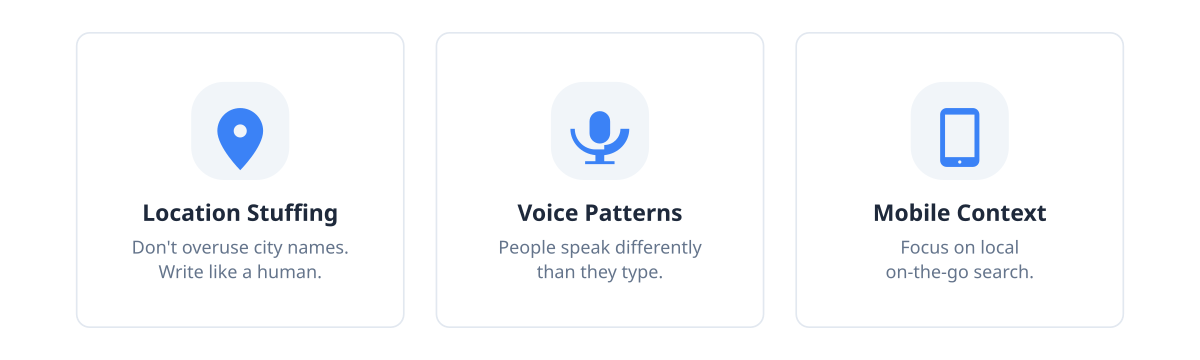
Keyword Stuffing Location Terms
Don't write: "Welcome to Bob's Plumbing in Austin. Bob's Plumbing Austin serves Austin residents with Austin plumbing services in Austin, TX."
Write: "Bob's Plumbing has served Austin homeowners for 15 years, providing repairs and installations throughout the metro area."
The second one sounds like a human wrote it. Readers notice.
Ignoring Voice Search Patterns
People speak searches differently than they type:
- Typed: "italian restaurant downtown"
- Spoken: "Where's a good Italian restaurant near me?"
Both happen. Optimize for both.
Forgetting Mobile Context
Mobile searchers want:
- Directions
- Phone numbers (click-to-call)
- Hours
- Wait times
Put these prominently on location-targeted pages. If someone has to scroll to find your hours, they'll bounce.
Creating Thin Location Pages
Don't duplicate your main page and swap the city name. I've seen this a hundred times. Each location page needs real content about:
- That specific location
- The team there
- Local community involvement
- Area-specific services
Neglecting Local Link Building
Location keywords gain power through local relevance signals:
- Local business directories
- Chamber of commerce memberships
- Local news mentions
- Community event sponsorships
These tell search engines you're actually part of the community, not just targeting it.
Measuring Location Keyword Success
Track what matters:
Rankings: Position for target keywords in target locations Traffic: Organic visits from local searches Conversions: Calls, directions requests, form submissions GBP Actions: Click-to-call, website visits, direction requests Local Pack Visibility: Are you showing in the map pack?
Rankings matter, but a #1 ranking for a keyword nobody searches is worthless. I'd rather rank #3 for a term that brings actual customers.
The Future of Location Keywords
Search keeps moving toward understanding intent and context. In 2026, we're seeing:
Hyper-local targeting: Block-level precision in some urban areas Real-time context: Time of day, weather, events affecting results AI-assisted discovery: ChatGPT and AI overviews changing how people find local businesses Visual search: Google Lens making location-based image search more relevant
The businesses doing well are the ones adapting quickly, testing constantly, and using technology to scale what works.
Getting Started Today
Your location keyword strategy doesn't need to be perfect from day one. Start with:
- Audit current performance: What's working already?
- Identify quick wins: Nearby high-intent keywords you're not targeting
- Create location content: Start with your most important locations
- Build measurement systems: Track what changes
- Iterate and expand: Scale what works
For businesses serious about local search, combining location keyword strategy with automated local SEO systems builds advantages that compound over time.
Location keywords aren't just about being found. They're about being found by the right people at the right time. Get that right, and local search gets easier.
Published with LeafPad