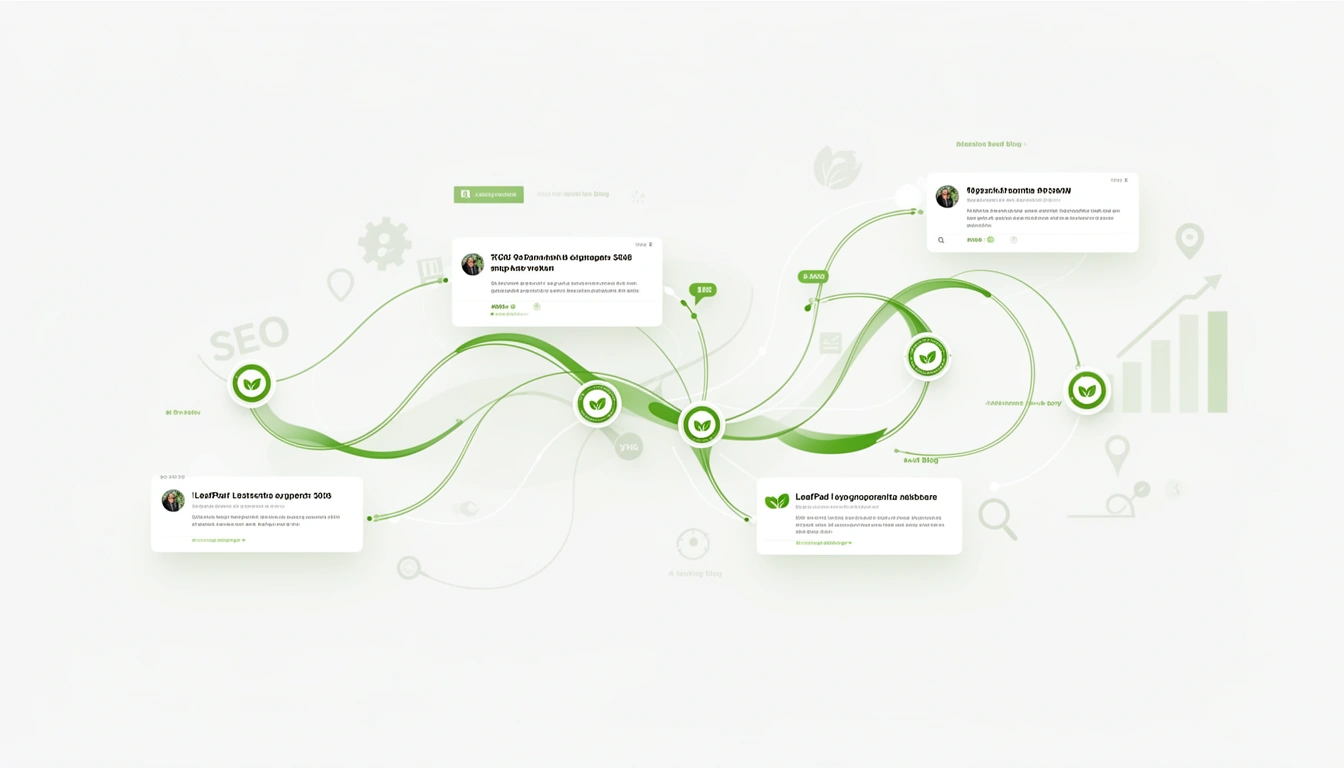
Internal linking has always been a cornerstone of SEO strategy, but in 2026, the way search engines and AI systems interpret those connections has fundamentally changed. While most blogging platforms treat internal linking as an afterthought or worse, a manual chore LeafPad has engineered a proprietary algorithm that transforms how contextual connections are discovered, evaluated, and embedded within your content.
The difference isn't just technical. It's the difference between links that feel forced and awkward versus links that enhance readability, guide user intent, and signal topical authority to search crawlers and AI models alike.
Why Traditional Internal Linking Feels Forced
Most content management systems approach internal linking in one of two ways: they ignore it entirely, leaving writers to manually hunt for relevant pages, or they use basic keyword matching that drops links wherever anchor text appears regardless of context, user intent, or narrative flow.
The result? Blog posts littered with blue underlined text that interrupts reading, confuses visitors, and signals low-quality user experience to search algorithms. Google's 2025 Helpful Content update specifically targeted sites with "manipulative linking patterns," and AI search systems like ChatGPT and Perplexity now prioritize sources with coherent information architecture.
Forced linking doesn't just hurt user experience it actively undermines your SEO efforts by creating shallow engagement signals and high bounce rates.
How LeafPad's Proprietary Algorithm Works
LeafPad's internal linking system operates on three core principles: semantic relevance, contextual placement, and intent matching.
Semantic Relevance: Rather than simple keyword matching, LeafPad analyzes the topical relationship between content pieces. The algorithm understands that a blog post about "domain authority growth" naturally connects to content about blog publishing strategies, even when exact keywords don't appear.
Contextual Placement: The system identifies optimal insertion points where links genuinely add value typically at moments when readers naturally seek deeper information or alternative perspectives. This means links appear where they enhance comprehension, not where they disrupt flow.
Intent Matching: LeafPad's algorithm evaluates user intent at the paragraph level. If a section addresses "how to optimize meta descriptions," the system won't force a link about "social media strategy" just because both fall under "marketing." Instead, it finds pages that directly advance the reader's current informational journey.
The SEO Advantage of Organic Link Distribution
Search engines in 2026 don't just count internal links they evaluate link topology, anchor text diversity, and click-through patterns to assess whether your site's architecture genuinely serves users or merely attempts to manipulate rankings.
LeafPad's organic linking approach creates several ranking advantages:
Passage-Level Authority Signals: By placing links at semantically relevant moments, LeafPad helps search algorithms understand which content sections are authoritative on specific sub-topics. This aligns perfectly with Google's passage indexing and AI systems' need for granular source attribution.
Natural Anchor Text Variation: The algorithm selects anchor text that reflects actual language patterns in your content, avoiding the repetitive exact-match anchors that trigger over-optimization penalties.
Improved Engagement Metrics: When links feel organic, readers actually click them. Higher internal click-through rates signal valuable content relationships to search algorithms, boosting both pages' authority.
Topical Cluster Reinforcement: LeafPad automatically builds content clusters around pillar topics, strengthening your site's topical authority without requiring manual taxonomy management or complex silo structures.
How This Compares to Manual Linking Workflows
Content teams managing blogs on traditional platforms spend hours identifying linking opportunities, updating old posts with new links, and maintaining spreadsheets to track internal link equity distribution. Even with dedicated SEO tools, the process remains time-intensive and prone to human bias.
LeafPad's automated approach eliminates this overhead while delivering superior results. As you publish new content, the system automatically identifies bidirectional linking opportunities updating older posts to reference new material and embedding contextual links to established content within new articles.
This dynamic linking infrastructure means your blog's SEO value compounds automatically. Every new post strengthens the entire content ecosystem without manual intervention.
Watch: Fixing a Zero-Link Page in 8 Minutes with Claude + LeafPad MCP
The video below shows a real example of this problem and how to solve it without touching a single post manually. A newly published Shopify integration page had zero internal links pointing to it across 50 existing blogs — invisible to Google and AI crawlers as a result. Using the LeafPad MCP connector inside Claude, 5 natural link opportunities were identified across the library, anchor text was matched to the target keyword, and the posts were updated in roughly 8 minutes total. It also covers why generic anchor text like "click here" wastes SEO value and what to use instead.
Real-World Impact on Content Performance
Early LeafPad users report measurable improvements in key engagement and ranking metrics:
- Average time on page increases of 35-50% due to improved content navigation
- Internal click-through rates 3-4x higher than industry benchmarks
- Faster indexing of new content as crawler budget distributes more efficiently
- Higher rankings for long-tail keywords through strengthened topical clusters
These improvements stem directly from linking that feels natural because it is natural algorithmically identified based on genuine content relationships rather than forced SEO tactics.
Why AI Search Requires Better Internal Linking
As search evolves toward AI-powered answer engines, the way systems discover and verify information relationships becomes critical. ChatGPT, Perplexity, and Google's AI Overviews don't just crawl individual pages they map knowledge graphs across your entire domain.
Organic internal linking helps AI systems understand your content hierarchy, identify authoritative sources for specific claims, and present your site as a coherent information resource rather than a collection of disconnected articles.
LeafPad's linking algorithm is specifically designed for this AI-first search landscape, creating the semantic connections that help your content get cited, featured, and recommended by next-generation search interfaces.
The Technical Foundation You Don't See
Behind LeafPad's seamless linking experience is sophisticated natural language processing, knowledge graph construction, and continuous learning from engagement patterns across the platform.
The system analyzes millions of content relationships to identify patterns that indicate genuine topical relevance versus superficial keyword overlap. It evaluates readability scores to ensure links don't disrupt comprehension flow. And it monitors click behavior to refine placement strategies based on what actually serves readers.
This technical infrastructure runs entirely in the background, requiring zero configuration or maintenance from content teams. You write; LeafPad handles the optimization.
Why This Matters for Scaling Content
For startups and growing businesses publishing content at scale, manual internal linking becomes an exponential problem. Ten blog posts require managing 45 potential bidirectional links. One hundred posts create 4,950 possible connections.
LeafPad's automated system solves this scaling challenge while maintaining quality and coherence. Whether you publish five posts or five hundred per month, every article receives optimal internal link support without increasing team workload.
This capability is particularly valuable for programmatic SEO strategies, where large content sets need consistent internal architecture to perform effectively.
The Future of Content Optimization
As search technology continues advancing toward semantic understanding and user-intent modeling, the gap between forced optimization tactics and genuinely helpful content architecture will only widen.
LeafPad's proprietary internal linking represents the direction modern SEO must move: automated systems that enhance human-created content without compromising quality, readability, or user experience.
The question isn't whether your blog needs better internal linking it's whether you want to build that infrastructure manually or let intelligent automation handle it while you focus on creating great content.
Published with LeafPad