Small businesses have it rough. You're fighting for attention against chains with marketing budgets you can't match. Local SEO doesn't fix that imbalance entirely, but it's one of the few places where money isn't the only factor. You just need to show up when your neighbors search for what you do.
Here's what actually works for local SEO in 2026, minus the fluff.
Why Local SEO Matters in 2026

People don't use phone books anymore. They search "near me" on their phones. Google says 46% of searches have local intent, and 76% of those people visit a business within 24 hours.
For small businesses, this is the opening. You're not trying to rank nationally. You just need to be visible when someone nearby types your service into Google. Automated local SEO strategies have made this manageable even if you don't have a marketing team.
The Foundation: Google Business Profile
Your Google Business Profile is the most important thing to get right. It shows up in the "map pack" at the top of local results, and it's often the first thing people see.
Get the basics sorted
Fill out everything name, address, phone number (NAP), website, hours, categories, attributes. Incomplete profiles look unprofessional to Google and to customers.
Pick the right categories. Your primary category tells Google what you do. Add secondary categories for other services, but stay honest. A pizza place listing itself as a hardware store won't fool anyone.
Write a description that includes your main keywords but still sounds like a human wrote it. Our Google My Business description SEO guide has more detail on this.
Add photos. Listings with photos get 42% more direction requests and 35% more website clicks. Show your storefront, your team, your actual work.
Building Local Citations
Citations are mentions of your business name, address, and phone number on other websites directories, review sites, social platforms.
Why they matter
Google uses these mentions to verify your business exists and is legitimate. Consistent information across multiple sites builds trust.
Where to start
Focus on the main platforms:
- Yelp
- Facebook Business
- Apple Maps
- Bing Places
- Yellow Pages
- Industry-specific directories
Quality beats quantity. Ten accurate listings on reputable sites are worth more than 100 on spammy directories. Our local search listings guide has the full breakdown.
NAP consistency is non-negotiable
Your name, address, and phone number must match exactly everywhere. Even "Street" versus "St." can cause problems. Pick one format and stick to it.
Reviews Matter More Than You Think

Reviews affect rankings. Businesses with more reviews and better ratings tend to show up higher in local results.
How to actually get reviews
Make it easy. Send customers a direct link to your Google review page. Every extra click loses people.
Time it right. Ask right after you deliver great service, when the customer is happy. Automate this with emails or texts if you can.
Respond to all of them. Good and bad. It shows you're paying attention. Our guide on Google reviews for SEO goes deeper on this.
On-Site SEO Basics
Your website needs to make your location and services obvious to both visitors and search engines.
Location pages
If you serve multiple areas, create separate pages for each. A roofer covering three cities should have pages optimized for "[Service] in [City]."
Local schema
Add LocalBusiness schema to your code. This helps search engines understand your hours, location, and services. Most website builders handle this automatically now.
Mobile matters
Over 60% of local searches happen on phones. Your site needs to load fast and have click-to-call buttons obvious enough that someone can find them while walking down the street.
Answer local questions
Write about things your customers actually ask. A landscaper could write about plants that survive your city's climate or when to plant grass in your region. Content marketing for local SEO is how you build that traffic over time.
Automation Is the Only Way This Scales
Most business owners don't have time to manually manage all of this. That's where automation helps.
What you can automate
Review requests. Set up automatic texts or emails after a purchase or service call.
Citations. Tools can push your info to dozens of directories at once, keeping everything consistent.
Rank tracking. Monitor where you show up for key terms without checking manually.
Content. Platforms like LeafPad can publish SEO-optimized blog posts on a schedule, which keeps your site active without eating your time.
Social posts. Schedule content that mentions your location and services.
Does AI help?
Yes. AI-powered local SEO tools can analyze competitors, suggest keywords, and draft content faster than any human. It's cheaper too.
Mistakes That Will Hurt You
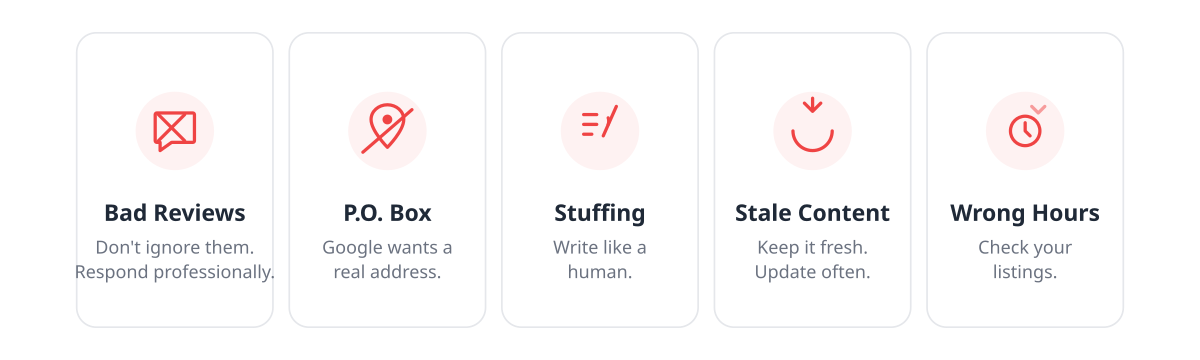
Ignoring bad reviews. Silence looks like guilt. Respond professionally, even if the review is unfair.
Using a P.O. Box. Google wants physical addresses. If you work from home, you can hide your address but still verify your service area.
Keyword stuffing. Don't wedge "best plumber Chicago" into every sentence. Write like a human.
Letting content go stale. An inactive website looks abandoned. Update it occasionally.
Wrong hours. If your profile says you're open and customers show up to locked doors, expect bad reviews and lower rankings.
How to Know If It's Working
Check these monthly:
- GBP insights: Views, clicks, calls, direction requests
- Local traffic: Use Google Analytics to filter by location
- Keyword rankings: Track where you appear for your main terms
- Reviews: Count and average rating over time
- Conversions: Phone calls and form submissions
Where to Start
Local SEO isn't a one-and-done thing. But the initial push is the hardest part. Once the foundation is there, maintenance is manageable especially if you automate.
Start with your Google Business Profile. Then reviews. Then citations and website content. Those basics will outperform any advanced tactic.
If content is the bottleneck, tools like LeafPad can handle the publishing without needing technical skills.
Your competitors are probably already doing this. The tools are accessible. The strategy is proven. You just have to start.
Published with LeafPad