You’ve probably seen "SEO" and "SEM" used interchangeably, but they aren't the same thing. Search Engine Marketing (SEM) is the paid side of the coin buying visibility on search engines. For a local business, this usually means paying to show up when someone nearby types "plumber" or "lunch" into Google.
It’s distinct from organic SEO, which is the long game of earning your spot. SEM is paying rent there. A solid local strategy usually mixes both:
Pay-per-click (PPC) ads (like Google Ads)
Local SEO efforts
Your Google Business Profile
Location-specific keywords
You use SEM to grab customers who are ready to buy right now, while SEO handles the long-term research phase.
Why SEM Matters for Local Businesses in 2026

The search results page is crowded. Between AI-generated answers, map packs, and organic listings, standing out is harder than it used to be.
Here’s the reality: waiting for SEO to kick in takes months. SEM buys you a spot at the table today. For a new business, that immediate visibility is often the difference between surviving the first year or not.
The targeting has also gotten scary good. You can restrict your ads to a tight radius, target by device (most local searches are mobile), and bid differently based on the time of day. You aren't just spraying money into the void; you're paying to appear in front of people who are physically close and searching for exactly what you do.
The Moving Parts
It’s not just "set up an ad and pray." You need a few things working together.
1. Google Ads Location Campaigns
This is the engine. Set up campaigns that strictly target your service area. There is nothing worse than paying for clicks from a town you don't service.
Get these right:
Use location terms naturally: "plumber near me" or "dentist in [city]."
Tighten your geographic targeting so you don't bleed budget.
Turn on call extensions so people can tap to call you directly from the ad.
2. Google Business Profile Integration
Your Google Business Profile (the thing that powers Maps) is the backbone of local visibility. If you haven't touched yours in a while, that's step one. We have a full Google My Business Description SEO Guide for 2026 if you need a hand.
At a minimum, make sure your hours are right, your photos aren't blurry, and you’re actually replying to reviews.
3. Local Keyword Research
You need to know what your neighbors are actually typing into that search bar. It’s not always what you think.
Focus on high-intent terms:
Service + location (classic, but it works)
"Near me" variations (we break this down in our guide on How to Rank for Near Me Searches)
Problem-based queries like "emergency AC repair" or "toothache relief"
4. Landing Page Optimization
Where does the ad send them? If you send everyone to your homepage, you’re wasting money. Build specific landing pages for the services you’re advertising.
The page needs to load fast on mobile (because that’s where the traffic is), show your phone number prominently, and match the promise of the ad. If the ad says "24/7 Emergency Repair," the landing page better say that too.
Balancing Paid and Organic

You don't have to pick a side. The best local strategies use them to cover each other's weaknesses.
Our guide on Automated Local SEO: Scale Rankings Across Locations digs into the organic side. But while you’re waiting for that to ramp up, use paid ads to:
Test which keywords actually convert before you write content for them.
Keep the phones ringing while you build organic authority.
Retarget people who visited your site but didn't call.
Budget allocation: A rough rule of thumb is 60-70% on organic for the long haul, and 30-40% on paid for immediate needs. But if you’re brand new, flip that ratio until you have steady cash flow.
Automation in 2026
Managing this stuff by hand is a headache. The platforms have gotten better at automating the tedious parts.
Google's "Smart Bidding" uses machine learning to chase your specific goal usually calls or store visits. It’s not perfect, but it often outperforms manual bidding for local campaigns. You can also set up dashboards to track the real numbers: cost per acquisition, call tracking, and store visit attribution.
Platforms like LeafPad can help sync this with your SEO work, so your paid and organic strategies aren't fighting each other.
How to Burn Cash (Common Mistakes)
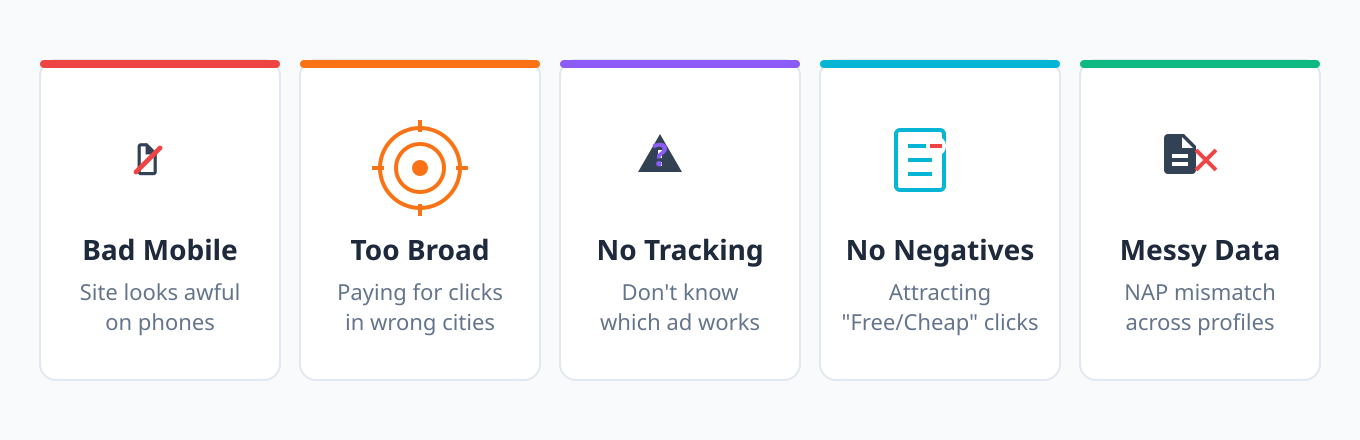
It’s surprisingly easy to waste money on SEM. Here are the most common ways it happens:
Ignoring mobile: Over 60% of local searches happen on a phone. If your site looks bad on mobile, you’re lighting money on fire.
Targeting too broad: Why pay for a click from a city you don't serve?
No call tracking: If you don't know which ad generated the call, you can't optimize.
Skipping negative keywords: If you're a high-end lawyer, you probably want to add "free" or "cheap" as negative keywords.
Messy data: If your name, address, or phone number are different on your website and your Google profile, Google trusts you less.
Measuring Success
Don't just watch the click count. That's vanity. Watch:
Cost per call/visit: What does an actual lead cost you?
Local impression share: Are you even showing up for the searches you care about?
Quality Score: Google's rating of how relevant your ad is. Low scores mean you pay more for the same spot.
ROAS: Revenue generated versus money spent.
Getting Started
Don't overthink the launch.
Claim and clean up your Google Business Profile.
Start a small Google Ads campaign targeting your immediate neighborhood.
Set a budget you’re comfortable losing maybe $20-50 a day.
Let it run for 30 days before you judge it.
Double down on what works, cut what doesn't.
Wrapping Up
SEM isn't really optional anymore. The competition is too high. You need the mix of paid visibility for today and organic strength for next year. It can be a grind to manage, but ignoring it isn't a strategy.
Get the fundamentals right, watch the data, and ignore the rest. If you're ready to build out the organic side of this, check out our other guides on local SEO strategies to round out your plan.
Published with LeafPad