What is Local SEO? Complete Guide for 2026
You search "coffee shop near me" on your phone. A list pops up. That is local SEO in action. It is the work that puts a business in front of people who are looking for services in a specific area, rather than casting a net across the whole country.
In 2026, the stakes have changed. Search is no longer just ten blue links. AI-powered answer engines and hyper-personalized recommendations have shifted how people find local businesses. Automated local SEO strategies are now necessary just to keep up with the speed of these changes.
Why Local SEO Matters in 2026
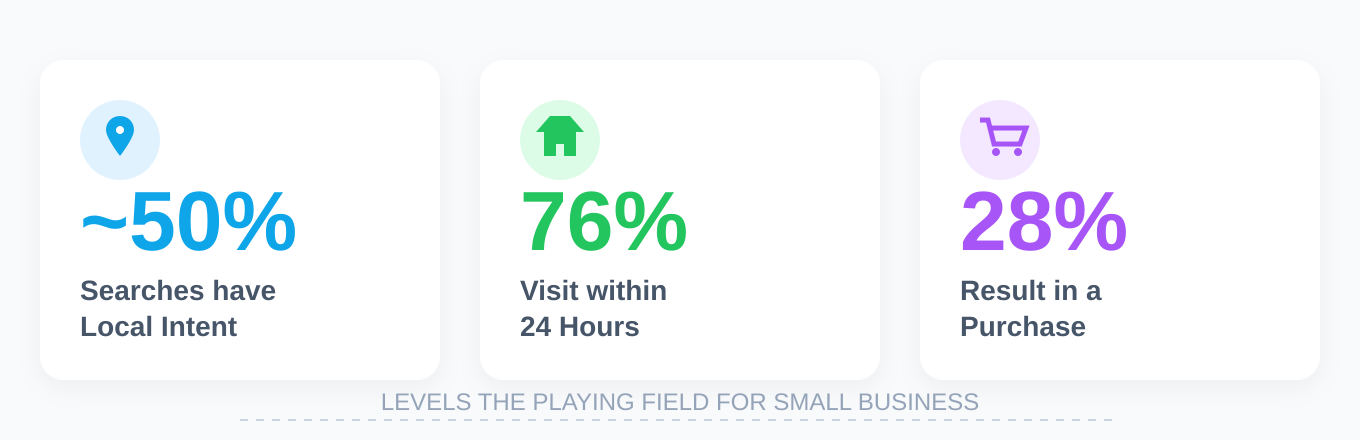
The numbers are difficult to ignore. Nearly half of all Google searches have local intent. 76% of people who search for something nearby on a smartphone visit a business within 24 hours. 28% of those searches end in a purchase.
For small businesses, this levels the playing field. You do not need a massive budget to compete with national chains. You just need to be visible when a customer a few blocks away decides they need what you sell.
Core Components of Local SEO
Google Business Profile
Your Google Business Profile is the anchor. It is the free listing that shows up in Google Maps and local search results, displaying your hours, photos, and reviews.
To get it right, claim the listing and fill out every section. Add high-quality photos. Choose your business categories carefully. Write a description that sounds like it was written by a human, not a keyword-stuffing script. A clear, well-written Google My Business description can improve both your ranking and the number of people who click through to your site.
Local Citations and NAP Consistency
Citations are mentions of your business name, address, and phone number (NAP) across the web. They appear on Yelp, Facebook, Apple Maps, industry directories, and local chamber of commerce sites.
The problem is consistency. If your phone number is different on Yelp than it is on your website, search engines get confused. It dilutes your authority. Managing these local search listings is tedious, which is why many businesses rely on tools to automate the cleanup process.
Online Reviews and Reputation Management
Reviews are a heavy ranking factor. Google looks at how many you have and what your average rating is.
Google reviews impact SEO in a few ways: they influence where you appear in the local pack, they provide social proof to humans, and the text inside them reinforces relevance. You should ask satisfied customers for reviews. You should also respond to the negative ones. It shows that the business is paying attention.
On-Page Local SEO Optimization
Your website needs to signal where you are. This means including location keywords in title tags and meta descriptions, creating separate pages for each area you serve, and embedding a Google Map on your contact page.
Mobile speed matters more than ever. If your site loads slowly on a phone, the person searching will go to the next listing. Following solid on-site SEO practices ensures you do not lose traffic after you have earned the click.
How Local SEO Ranking Works
Google uses three primary factors to decide which businesses to show.
Relevance
Does your listing match what the person typed? This depends on your categories, your services, and your content.
Distance
How far are you from the searcher? You cannot change your physical address, but if you are a mobile business, you can optimize your service area radius to capture nearby searches.
Prominence
How well-known is the business? This is a mix of offline reputation and online signals like review count, citation volume, and backlinks from local websites. Understanding these local SEO ranking factors is key to prioritizing your time.
Local SEO vs. Traditional SEO
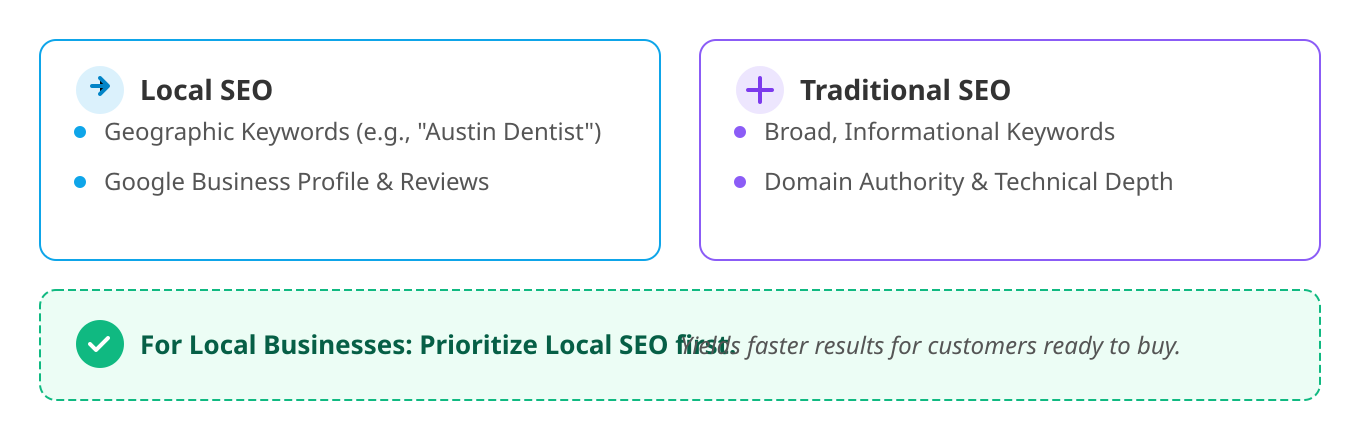
They share principles, but the focus differs.
Local SEO targets geographic keywords ("dentist in Austin"). It fixates on your Google Business Profile, local directories, and reviews.
Traditional SEO targets broad, informational keywords. It focuses on domain authority, large-scale link building, and technical depth.
Most local businesses should prioritize local SEO first. It yields faster results for the customers who are actually ready to buy.
Common Local SEO Mistakes to Avoid
- Inconsistent NAP. Different addresses or phone numbers across platforms make you look unreliable to algorithms.
- Neglecting your Google Business Profile. An incomplete profile suggests the business might be closed.
- Ignoring negative reviews. Silence looks like indifference.
- Using P.O. Boxes. Google wants physical locations.
- Keyword stuffing. Cramming your description with keywords looks desperate and can lead to penalties.
- Not tracking rankings. If you do not measure, you cannot fix what is broken.
The Future of Local SEO in 2026
The environment is shifting. AI search engines now deliver conversational answers to local queries. Your business information needs to be structured so these systems can read it.
Voice search has also matured. More people ask smart speakers for recommendations. This requires optimizing for natural language questions ("Where is the nearest pizza place?") rather than just short keywords.
Hyper-local targeting is sharper now. Search engines are better at understanding neighborhood-level nuances and can optimize results based on whether someone is walking or driving.
For businesses with multiple locations, automated local SEO solutions allow you to scale this work without burning out your team.
Getting Started with Local SEO
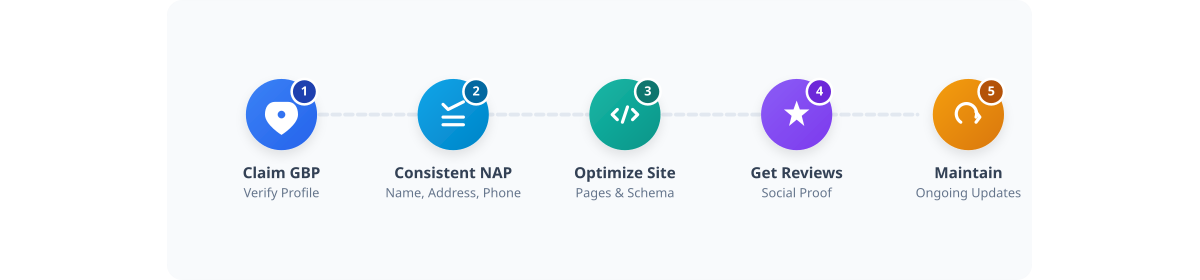
Start with the basics. Claim and verify your Google Business Profile. Ensure your name, address, and phone number are consistent across the major directories. Create location-specific pages on your website if you serve different areas. Implement local schema markup. Start asking customers for reviews.
This is not a one-time fix. It requires ongoing maintenance to keep information accurate and authority building.
Measuring Local SEO Success
Watch the numbers that matter:
- Views and actions on your Google Business Profile (calls, direction requests, website visits).
- Local keyword rankings.
- Traffic from local searches.
- Review volume and average rating.
Regular monitoring tells you what is working and what is a waste of time.
Conclusion
Local SEO is how you turn a digital search into a physical customer. In 2026, it is a necessity. Whether you run a single shop or a chain, the fundamentals remain the same: keep your data accurate, engage with the community, and make sure your online presence reflects the reality of your business.
The customers are searching. Make sure they find you before they find your competitor.
Published with LeafPad