You can't just rank on Google anymore. Now you have to worry about whether your content actually shows up in ChatGPT's answers. ChatGPT SEO checking tools try to solve this by running prompt tests, tracking citations, and alerting you when your brand gets mentioned. If you're trying to figure out ai seo automation this year, this is where you have to start.
Ranking on Google used to be the finish line. Now people are just asking ChatGPT what to buy, and if your brand isn't in that answer, you're invisible. The worst part is you won't even see the traffic dip you just lose the audience.
Why ChatGPT visibility matters for AI SEO automation
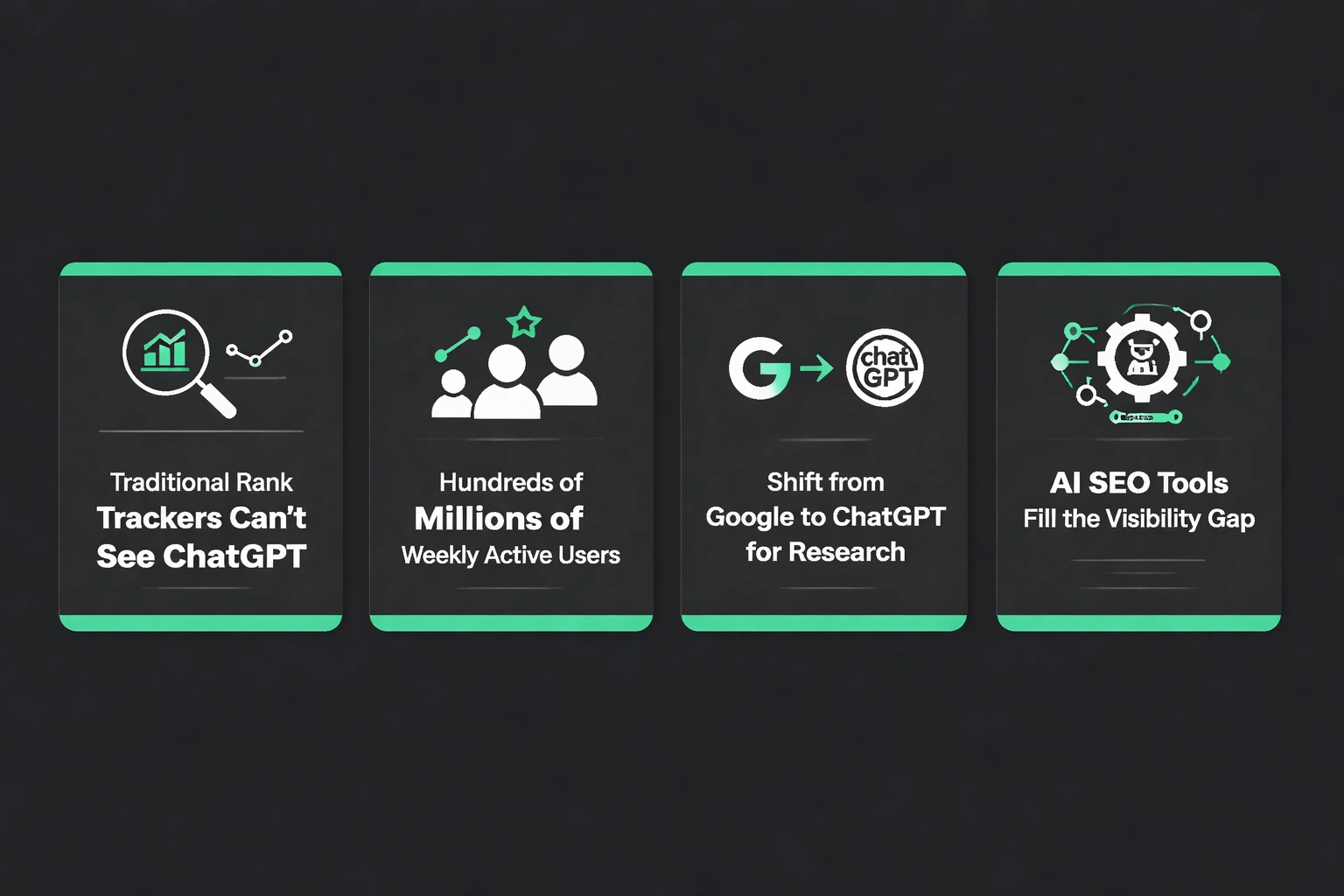
This matters because traditional rank trackers can't see ChatGPT. Millions of people use it every day for product research. If ChatGPT doesn't recommend your tool, you're missing out on a massive buying audience.
It's not a small niche thing anymore. By mid-2026, ChatGPT hit hundreds of millions of weekly active users, and a huge chunk of those are research-style queries. People ask "what's the best project management tool" instead of Googling it.
The catch? ChatGPT doesn't have a public API for checking your visibility like Google Search Console does. That gap is exactly why a whole new category of ai seo automation tools popped up. See AI visibility tools compared for those tools, and AI citation tracking explained for how the tracking works.
What good ChatGPT SEO checking tools actually do
A decent ChatGPT SEO checking tool runs prompt tests at scale, tracks if your brand gets cited, and shows changes over time. It stops you from manually copy-pasting prompts and guessing what real users are asking.
What actually separates a serious tool from a gimmick comes down to a few core features. You need prompt library management to store and group the exact prompts your customers actually type. You need automatic citation detection that flags when your domain or brand name pops up in a response. It also has to do competitor comparisons so you can see who gets cited when you don't. And crucially, you need historical tracking for week-over-week trends, plus source attribution so you know exactly which page the AI pulled its answer from.
Without those, you're just running manual queries. That doesn't scale past a handful of keywords, and it definitely doesn't work for a content team publishing every week.
The best ChatGPT SEO checking tools in 2026
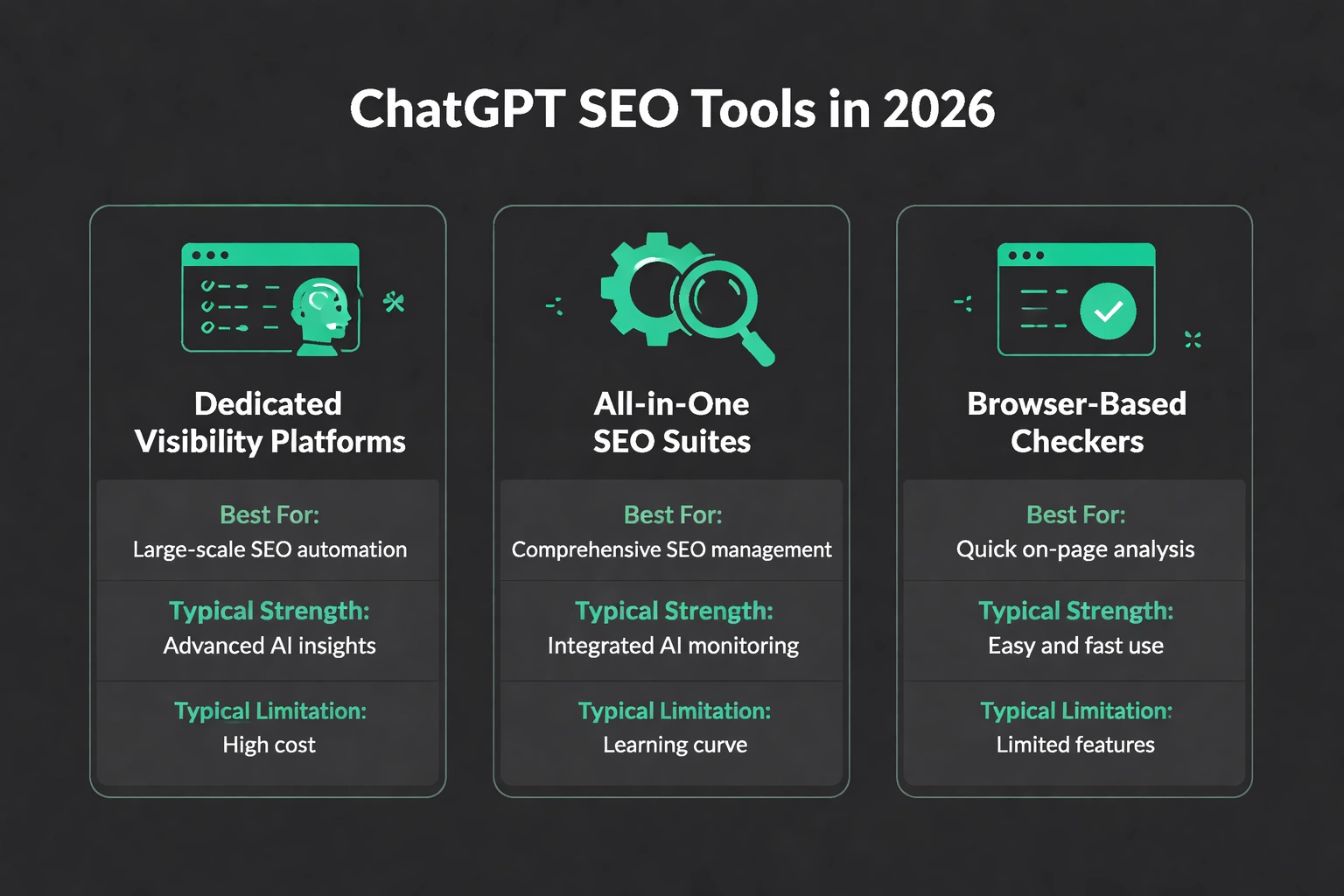
The tools available in 2026 basically fall into three buckets: dedicated AI visibility platforms, all-in-one SEO suites that bolted on AI monitoring, and free browser-based checkers.
Category | Best For | Typical Strength | Typical Limitation |
|---|---|---|---|
Dedicated AI visibility platforms | Teams tracking AI citations as a core KPI | Deep prompt libraries, competitor benchmarking | Often priced separately from existing SEO stack |
All in one SEO suites with AI monitoring | Teams already using a suite for rankings | Combines traditional and AI visibility in one dashboard | AI features are sometimes an afterthought |
Browser based or manual checkers | Solo founders or small teams | Free or cheap, quick spot checks | No automation, no historical trend data |
LeafPad's AI citations tool leans toward the dedicated platform side, but it's built right into the blogging workflow. You can see which published posts are earning citations without switching tabs. That connection between publishing and tracking is the part most standalone checkers completely miss.
If you want to see how automated agents fit into this, LeafPad's guide on the AI content pipeline covers how content creation and citation monitoring can run together.
How to test ChatGPT visibility manually before automating
Before paying for automation, run manual tests. Run five to ten realistic prompts, see if your brand shows up, and repeat it next week. Use real buying questions, not generic keywords. Things like "What's the best tool for [your category] in 2026?", "Compare [your brand] vs [competitor]", or "How do I [problem your product solves]?"
Keep a simple spreadsheet with the prompt, date, whether you got cited, and who showed up instead. In a few weeks, you'll see if your visibility is actually improving.
This manual grind is exactly what ai seo automation tools replace once you hit 30 to 50 prompts across multiple products. That's the point where spreadsheets break.
Why traditional rank trackers miss ChatGPT entirely
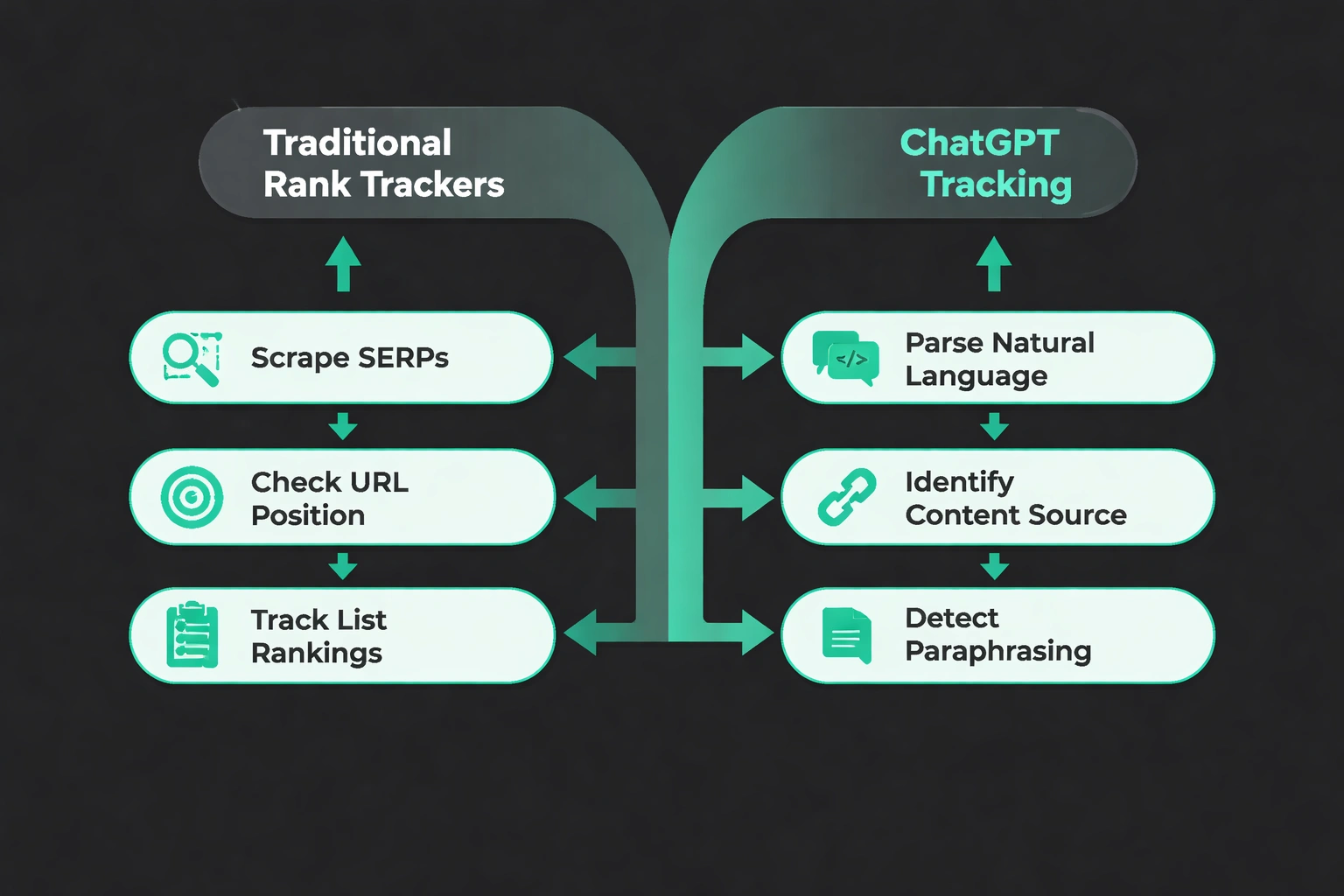
Traditional rank trackers miss ChatGPT because they're built to scrape search engine results pages, not chat outputs. ChatGPT doesn't give you a list of positions one through ten. It gives you one synthesized answer. Tracking that requires a completely different approach.
It's harder than it sounds. Google rank trackers just check a URL's position in a list. ChatGPT checking means parsing natural language and figuring out if your content was actually the source, paraphrased, or completely ignored.
That's a tough engineering problem. It's why so few traditional SEO platforms have nailed it. If you're only using legacy rank trackers, you're flying blind on a huge growth channel. Pairing rank tracking with a dedicated visibility check, like LeafPad's AI SEO tracking and visibility guide, gives you a much fuller picture.
Building a repeatable ChatGPT monitoring workflow
A good monitoring workflow needs three things: scheduled prompts, a citation log, and a feedback loop into your content. If you don't have the feedback loop, you're just hoarding data.
I usually recommend a weekly cadence. Run your prompt library on Monday. Tuesday, look at which pages got cited and which competitors showed up instead. Wednesday, flag the gaps. Thursday, publish or update content to fix them. Friday, log it and compare to last week. It turns citation checking into an active driver of what you publish next. It also pairs perfectly with LeafPad's content refresh workflow, since pages that lose citations often just need updated facts or examples rather than a full rewrite.
Combining web scraping with ChatGPT checking tools
Web scraping tools complement ChatGPT checkers by pulling competitor data so you can figure out why they get cited more. Knowing you have a citation gap is fine, but knowing why is what actually fixes it.
If a competitor keeps getting cited for your target prompt, scraping their content can show you what they're doing differently. Maybe they have clearer headings, more direct answers, or better structured data. LeafPad's Axiom AI guide walks through no-code scraping setups for this exact use case.
Combining scraping insights with citation tracking closes the gap between diagnosis and action. That's the whole point of building an ai seo automation system instead of a pile of disconnected tools.
Getting started without overbuilding your stack
You don't need a massive tool stack on day one. Start with manual prompt testing. Add automated tracking when your prompt library hits 30 queries. Layer in scraping only when you need to explain a visibility gap.
If you already publish through LeafPad, this fits right into what you're doing. You can check LeafPad's features to see how citation tracking connects with publishing, or browse AI SEO tools by task for the complete cluster of guides on automating this. If you're just comparing costs, LeafPad's pricing page breaks down what's included versus what needs an add-on.
ChatGPT visibility isn't a passing trend. It's becoming a permanent line item in how we measure organic reach, right alongside rankings and impressions.
Published with LeafPad