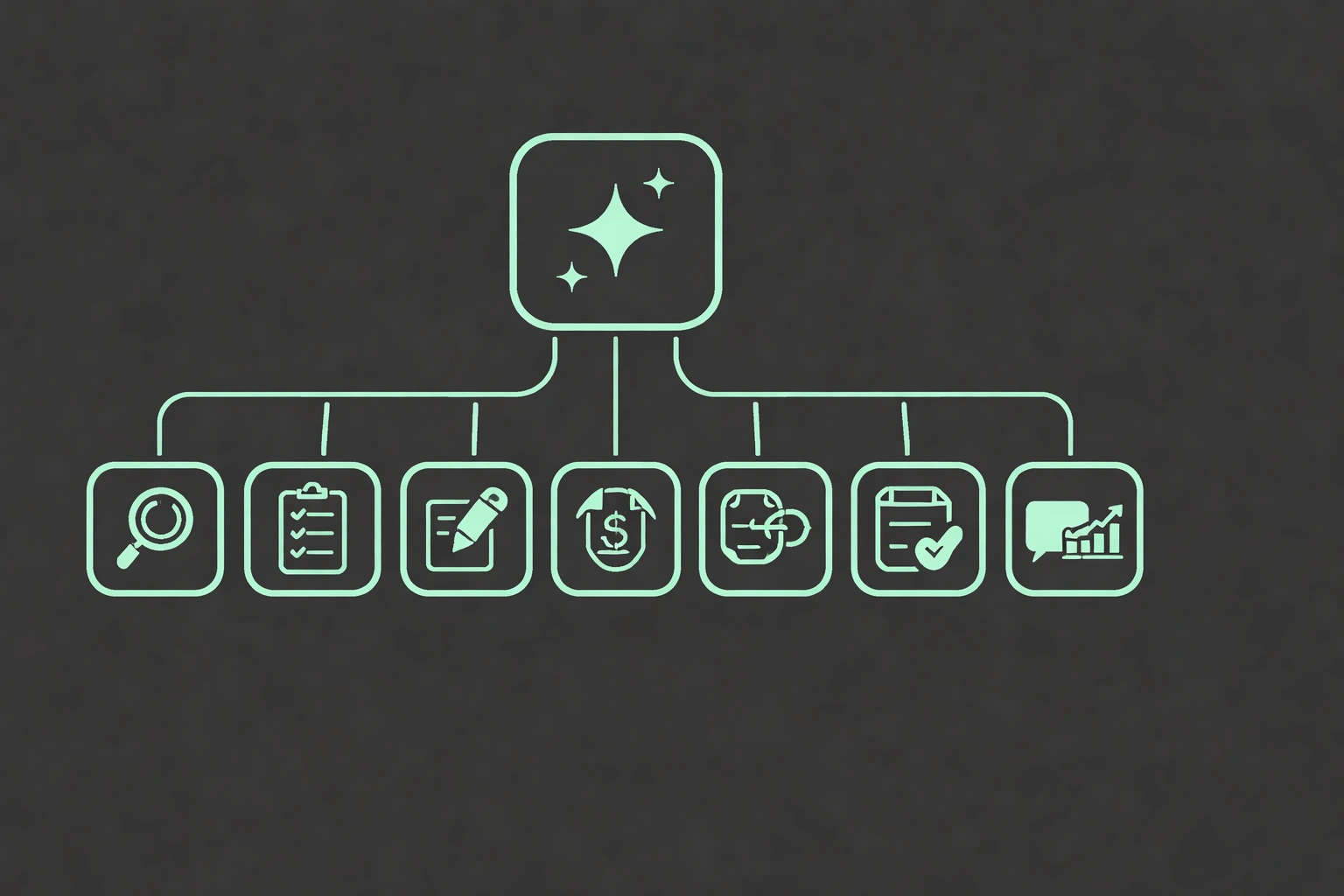
An AI SEO tool is software that uses AI to do part of search engine optimization for a site: finding keywords, briefing and writing content, refreshing old pages, adding internal links, auditing the site, or tracking rankings and AI answers. Each one takes an SEO task off a person's hands, so the work toward more organic traffic gets done without someone running every step. The top lists of the best AI SEO tools rank tools one by one, but the work itself comes in tasks, and AI tools for SEO rarely cover all of them.
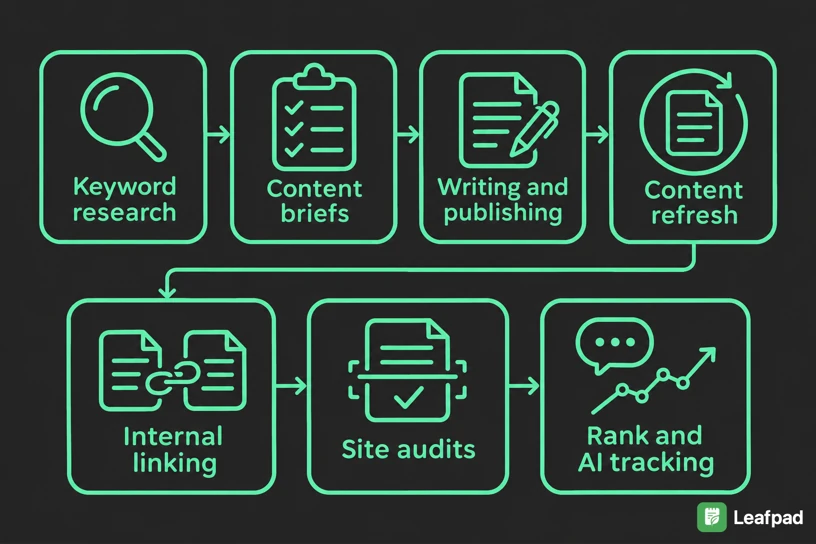
This page sorts AI SEO software by the seven SEO tasks a page goes through, in order: keyword research, content briefs, writing and publishing, content refresh, internal linking, site audits, and rank and AI visibility tracking. Each section names the SEO AI tools that do that task, what each one does for it and what you still do yourself. The tools are the ones named by the three top lists for "AI SEO tools" on Google (surfer.ai, rankability.com and freddiechatt.com) or by Google's AI Overview, read on 11 November 2026, and every fact about a tool comes from its own site, read the same day.
Leafpad, which publishes this page, is one of the tools: an SEO agent that creates and refreshes content from Search Console data. It appears only in the tasks it does today.
SEO task | Tools on this page | What the tool does | Where Leafpad fits |
|---|---|---|---|
Keyword research | Semrush, Ahrefs, Leafpad | Finds searches with their volume and difficulty | Plans topics from Ahrefs data, scored against your domain |
Content briefs and optimization | Surfer, Frase | Scores a draft against the pages that rank | Writes the brief as part of writing each post |
Writing and publishing | Jasper, Scalenut, Leafpad | Drafts articles, and some publish them | Writes a new article for $1 and publishes it to your CMS |
Content refresh | Surfer, RivalFlow AI, Leafpad | Updates pages that are losing traffic | Flags pages that lost over 20 percent of clicks in 90 days and refreshes each for $0.50 |
Internal linking | Ahrefs Site Audit, Surfer, Leafpad | Finds or places links between your pages | Links each new post as it publishes |
Site audits | Semrush, SE Ranking, Frase | Checks a site for SEO issues | Doesn't run technical audits |
Rank and AI visibility tracking | SE Ranking, Profound, Leafpad | Tracks Google positions and mentions in AI answers | Checks which domains AI answers cite, weekly |
One tool rarely covers all seven SEO tasks, so pick by the task that costs you the most time each week.
1. Keyword research: AI SEO tools that find the searches worth targeting
AI SEO tools for keyword research find the searches a site's readers type, how many people type each one a month and how hard each is to rank for. AI tools for SEO keyword research turn a seed topic into a list of queries with a page planned for each, which is the first SEO task of every new page.
Semrush describes itself on its own site as a platform for growing and measuring brand visibility in AI search, SEO, PPC and social. Its keyword research uses AI to surface keywords, beside backlink, ranking, traffic and technical audit data. You still choose which keywords fit the site and which page each one goes on.
Ahrefs presents itself on ahrefs.com as an AI marketing platform built on large search and AI databases, with Keywords Explorer as its keyword research tool. Its MCP server lets ChatGPT and Claude query that data from a chat. You still turn the results into a plan.
Leafpad runs keyword research as the first step of its content plan. It pulls each keyword's monthly search volume, keyword difficulty, search intent and the pages ranking now from Ahrefs, and scores difficulty against your own domain, so a new site gets low competition topics first. It adds the topics your top two competitors rank for and you don't, groups them into a pillar and its cluster posts, and flags queries that show an AI Overview. You approve each topic, with a one line reason it was picked, before any writing starts. The seven steps are on Leafpad's keyword research page.
2. Content briefs and optimization: AI SEO tools that score a draft against the top pages
AI SEO tools for content briefs and optimization read the pages that rank for a query and score a draft against them, by the terms, headings and questions those pages share. They tell a writer what to cover before and while the page is written.
Surfer calls itself an AI visibility platform on its site, built to get a brand mentioned and cited in ChatGPT, Gemini, Perplexity and Google AI Overviews. Its Content Editor gives live guidelines while a page is written or optimized.
Frase describes itself as an SEO and GEO content platform that writes and optimizes content to rank on Google and to be cited by AI, with content optimization and GEO optimization among its products. In both tools you still decide the angle and check the facts.
Leafpad has no separate editor for scoring a draft you write. It generates the brief for each scheduled post as part of writing it, as its content calendar page states.
3. Writing and publishing: AI SEO tools that write articles and publish them
AI SEO tools for writing draft whole articles from a keyword or a brief, and some of them also publish the article to the site's CMS. When you compare the best AI SEO content generator software, ask where its work ends: at a draft for you to finish, or at a published page.
Jasper presents itself as applied AI for enterprise marketing, with AI agents that run marketing workflows end to end. Teams weighing it for blog content can compare it on Leafpad's Jasper alternatives page.
Scalenut's site describes AI SEO with content creation, keyword research and AI visibility tracking, and its plans count the GEO articles created and the existing articles optimized each month. Scalenut alternatives compared sets it beside Leafpad and others.
Leafpad writes a new article for $1 from a prepaid balance and publishes it on the schedule you set to WordPress, Shopify, Ghost, Webflow or Framer, with every SEO field filled in. To see a draft first, its free AI blog writer writes a post from your domain with no signup. Blog publishing also runs from Claude or ChatGPT through Leafpad's MCP connector. With content calendar planning, you set the cadence once and Leafpad fills each slot with a topic, a brief, images and internal links.
4. Content refresh: AI SEO tools that update the pages losing traffic
AI SEO tools for content refresh find the pages that are losing traffic and update them at the same URL, so each page keeps its backlinks and its place in the index. A refresh starts from a page that already has search visibility, so it doesn't wait to be found the way a new page does.
Surfer's site lists a Content Audit, and describes a Re-optimization Loop that flags a page whose mentions in AI answers drop and ships the fix.
RivalFlow AI, from SpyFu, upgrades existing pages: its site says it finds the questions competitors answer better and fills those gaps on your page.
Leafpad connects to Google Search Console and reads the clicks and impressions of every indexed post. It flags any page that lost more than 20 percent of its clicks in 90 days, and puts first the pages with the most traffic to win back and the ones sitting on page two. It then rewrites what fell behind: stale statistics, outdated examples, weak openings, missing FAQs and missing internal links, while the URL, backlinks and indexing stay as they are. Each content refresh costs $0.50, you can review the changes before they publish, and Leafpad refreshes up to 3 pages a day. Afterwards it shows each page's Google clicks before and after the refresh, from your own Search Console data. How it picks and rewrites pages is on its content refresh page.
5. Internal linking: AI SEO tools that link your pages to each other
AI SEO tools for internal linking decide which of a site's pages relate, choose the anchor text and place the link, or suggest where a link should go. The difference between them is how much of that work is still yours.
Ahrefs Site Audit matches each page's top 10 keywords by traffic to mentions on your other pages and reports them as internal link opportunities. You add each link by hand in your CMS.
Surfer offers 1-click internal linking on its Pro plan, which places links in a post. You run it post by post.
Leafpad links each new post from its pillar, its cluster and related posts as it publishes, adds links to it from older posts, varies the anchor type and caps the links to any one page. Nothing is set per post, and it works the same on every CMS it publishes to. Leafpad's internal linking page compares five kinds of linking tool.
6. Site audits: AI SEO tools that check a site for SEO issues
AI SEO tools for site audits crawl a site and list what stops its pages from being found, crawled or understood, ranked by how much each issue matters. An AI tool for SEO analysis also suggests a fix for each issue, as Semrush and Frase do.
Semrush runs technical site audits in its platform, and its free SEO Checker audits a website, lists its SEO issues and suggests fixes.
SE Ranking describes its software as one platform for agencies and in-house teams to research keywords, track rankings, audit sites and report on performance.
Frase audits a site and its search data, then ranks what to fix and what to write, most useful first. Leafpad doesn't run technical audits.
7. Rank and AI visibility tracking: AI SEO tools that track rankings and AI answers
AI SEO tools for tracking record where a site's pages rank in Google and whether AI answers in ChatGPT, Perplexity, Gemini and Google's AI Overviews name or cite the site. The best AI SEO rank tracker for a site depends on which of the two it needs, and some generative AI SEO tools do both.
SE Ranking tracks search rankings, and its AI visibility tracker records brand mentions and links in AI answers beside your competitors'.
Profound describes itself as an AI marketing platform that shows what customers ask AI across ChatGPT, Perplexity, Claude, Gemini, DeepSeek, Google AI Overviews and Google AI Mode, and deploys agents to act on it.
Leafpad runs the same citation check on ChatGPT, Perplexity, Claude, Gemini, Grok and DeepSeek for each target query, weekly by default, and records whether the answer links your domain or names your brand, which competitor domains it cites instead and which queries you are missing. Among AI tools for SEO and AEO, it covers the AI answer side: it doesn't track Google positions, so it sits beside a rank tracker rather than replacing one. What each engine's check covers is on its AI citation tracking page.
How do you choose an AI SEO tool?
An AI SEO tool fits a site when it passes four checks, taken in this order.
The SEO task: start with the task that costs your team the most hours each week, since that is where a tool saves the most.
The data: a tool that reads its own keyword index tells you what people search, while a tool that reads your Search Console data tells you what your pages already get.
Where the work ends: some tools stop at a draft or a report for a person to finish, and others publish to your CMS.
The cost model: most tools on this page sell monthly plans, and some charge for each task done.
Which SEO tasks software can take over from start to finish, and in what order to hand them over, is the subject of SEO automation.
Which AI SEO tools fit a small business?
AI SEO tools for small business are chosen on the cost model and the hours saved, because a monthly plan costs the same in a month when no page is written. A price per task costs nothing in a quiet month.
Leafpad starts with a $20 balance: $10 when you connect Google Search Console and $10 when you connect your blog, enough for 40 content refreshes. After that, each content refresh costs $0.50 and each new article $1, with no subscription, and the balance never expires. The details are on Leafpad's pricing page.
Are there free AI SEO tools?
Yes, several AI SEO tools have free options, though each covers one task or a small allowance. Semrush's pricing page lists a free plan, Surfer offers a free AI visibility audit, and Ahrefs and SE Ranking list free SEO tools on their sites. The best free AI SEO tools are the ones that do one job well, like checking an index status or writing a title tag.
Leafpad's free AI SEO tools each do one task, from an SEO title generator to an index checker and an internal link checker. One of them suggests related terms to cover beside a main keyword, which the tool calls LSI keywords.
Can ChatGPT or Claude work as an AI SEO tool?
Yes, ChatGPT and Claude work as AI SEO tools for writing and analysis: they outline, draft, rewrite and explain on request. Without a connector, though, an assistant can't read keyword data, your Search Console data or your CMS.
An MCP server is that connector. Ahrefs has one that works with ChatGPT and Claude, and Leafpad's MCP connector lets Claude, ChatGPT, Cursor and VS Code publish a post through Leafpad from the conversation. Most Claude AI SEO tools work this way: the assistant does the writing and reasoning, and the MCP server reaches the data.
How do AI SEO tools differ from all-in-one SEO platforms?
All-in-one SEO platforms like Semrush and Ahrefs cover several of the seven tasks from their own data, keyword research, site audits and rank tracking among them, in one subscription. Single task tools like Surfer for briefs or RivalFlow AI for refreshes go deeper on one. An SEO agent works another way: it reads the site's own data, picks the next SEO task and runs it, which Leafpad does today for content creation and content refresh. Map your own stack against the seven tasks above, and the gaps show which tool to add next. For how Leafpad sits beside Ahrefs, Semrush, Moz and Conductor, see SEO platforms compared.
Published with LeafPad