I've been watching Google's AI Mode rollout through 2026, and it completely broke what "ranking number one" even means. You can dominate the classic blue links and still get entirely ignored in the AI summary. Trying to track this across five disconnected dashboards is a nightmare. You need one view, because rankings have split down the middle.
The best AI SEO software tries to solve this by combining classic rank tracking with AI visibility monitoring. It checks your content across Google's AI Overviews, AI Mode, and traditional SERPs all at once. Tracking both surfaces isn't optional anymore. It's the baseline for understanding real visibility.
What makes AI mode rank tracking different
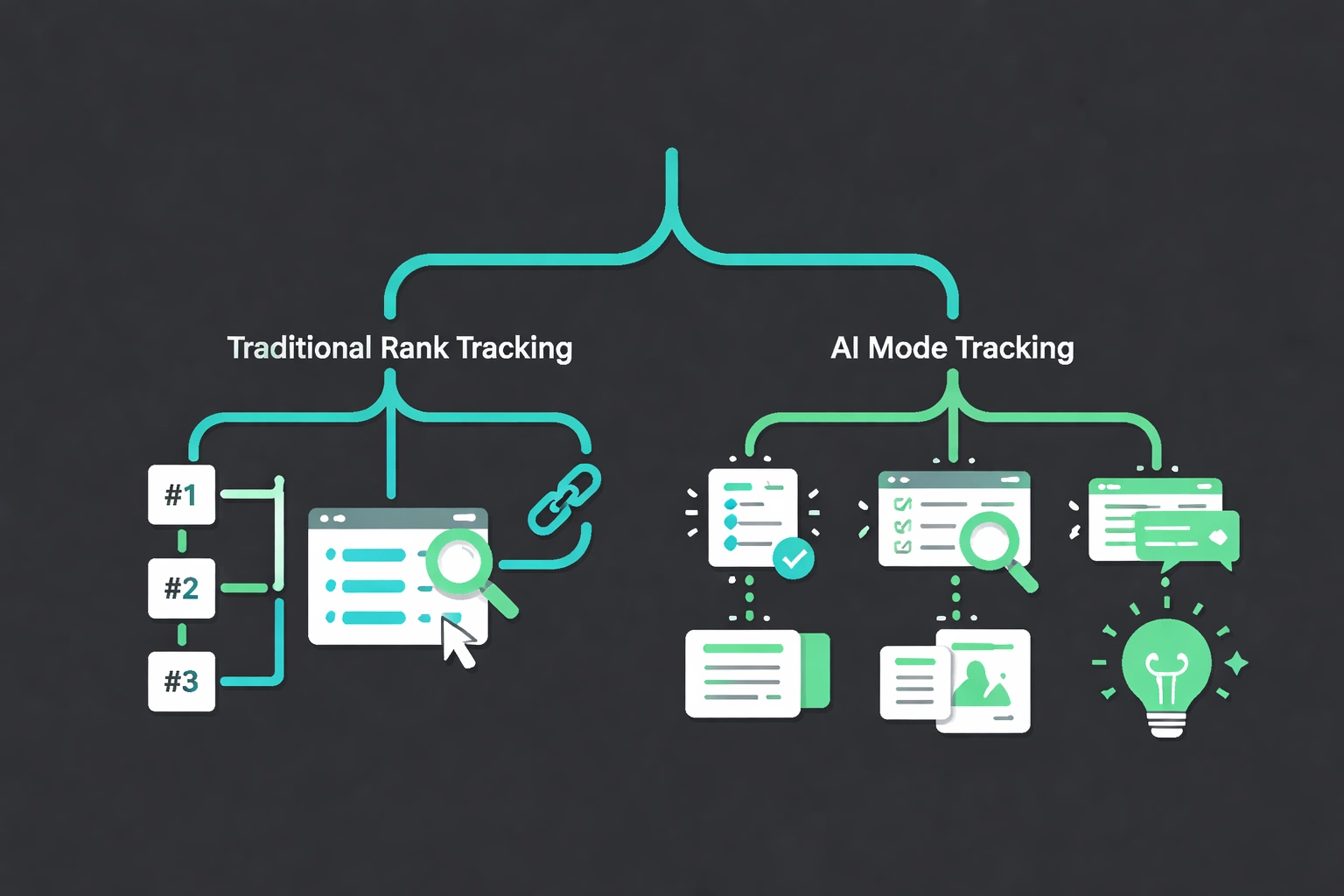
AI mode rank tracking measures whether your content gets cited, summarized, or skipped inside Google's generative answer boxes. Traditional rank trackers just check your position number. AI mode tools look at citation frequency, snippet accuracy, and whether competitors get pulled into the answer instead of you.
We spent two decades building trackers for a web of ten blue links. That worked because position correlated directly with clicks. AI Mode shatters that. A page ranking eighth can be the source Google's AI cites, while the number one result gets left out in the cold.
Here's what actually changes when you track AI Mode:
- Citation tracking replaces pure position tracking as the core metric. You need to know if you're the source.
- Answer synthesis monitoring shows exactly how Google paraphrases or mangles your content.
- Competitor co-citation tells you who else got pulled into the same answer.
- Query fan-out visibility tracks the weird sub-questions Google generates from one search.
- Zero-click impact measures the traffic you lose even when you're cited correctly.
Most legacy platforms just bolted AI tracking onto old infrastructure. It feels like an afterthought. You need a tool that treats AI Mode as its own tracking layer, not a checkbox on a 2018 report.
Core features to look for in AI SEO software
You need four things: AI Overview citation tracking, traditional SERP position monitoring, content gap analysis against AI-cited competitors, and automated alerting when visibility drops. Skip any of these and you're flying blind.
Let's break down what actually matters here.
Citation tracking depth
Citation tracking needs to show the exact phrases Google pulls from your site. A binary "cited or not" flag is useless. You want to know if Google quoted your third paragraph verbatim or just loosely mangled your headline. That detail tells you which content structures actually earn citations.
Cross-surface position monitoring
You have to track the same keyword across AI Mode, AI Overviews, and standard organic results side-by-side. If a tool only reports one surface, you're only getting half the picture. You need to see where the gap is widening or closing.
Competitive gap analysis
This shows which competitors get cited alongside you, and which ones replaced you. This is where automated internal linking and content structure come back into play. Tools like LeafPad's internal linking feature help close these gaps by automatically strengthening topical relevance signals.
Alert systems
You need an alert the moment a high-value keyword loses its AI citation. Waiting for a monthly report means weeks of invisible traffic loss before you even realize something broke.
Comparing approaches: manual vs automated AI tracking
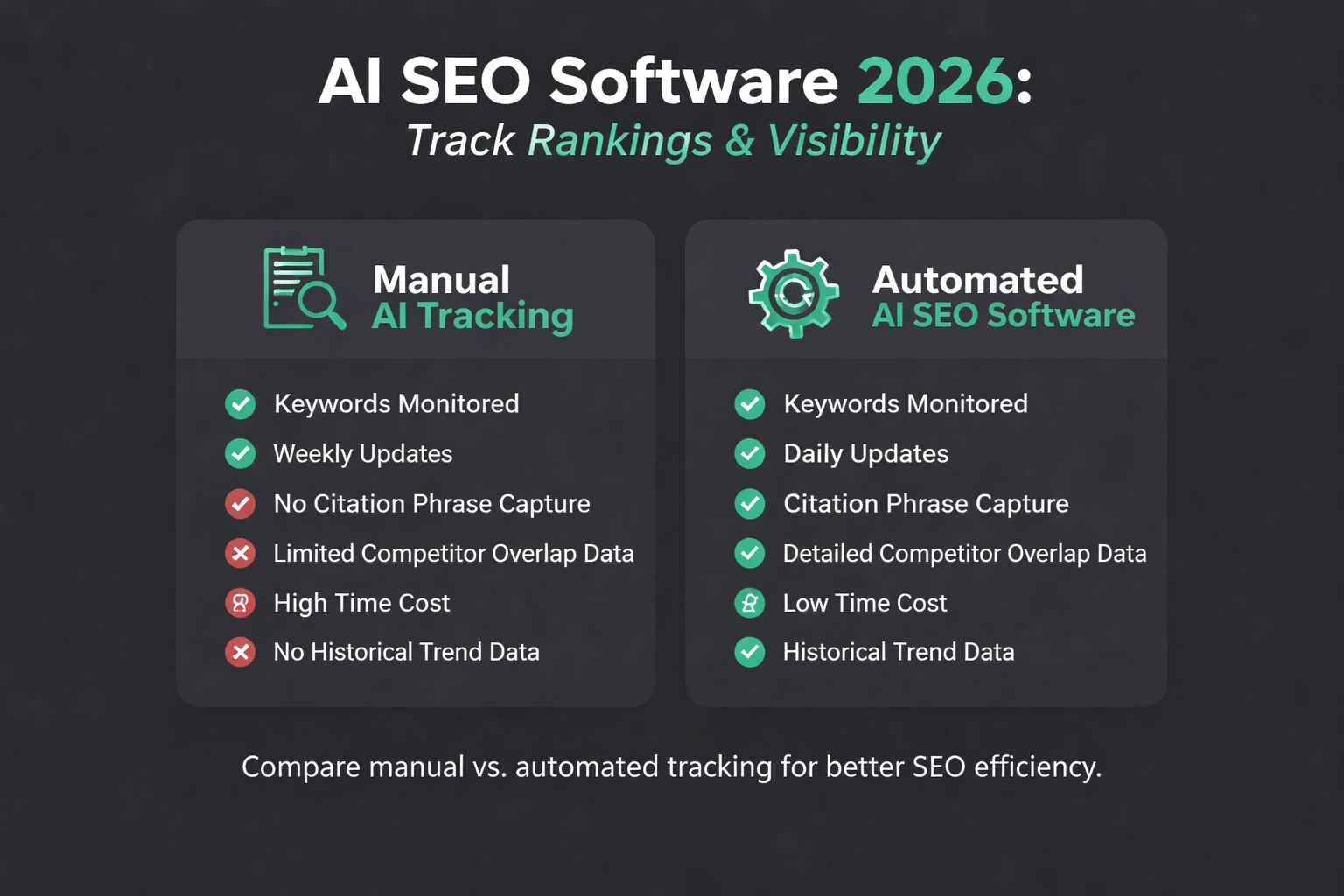
Manual AI tracking means sitting there, searching your target keywords, and checking the results by hand. Automated tracking pulls this data continuously through APIs. Manual doesn't scale past maybe ten keywords before you lose your mind.
| Factor | Manual Tracking | Automated AI SEO Software |
|---|---|---|
| Keywords monitored | 10 to 20 realistically | Hundreds to thousands |
| Update frequency | Weekly at best | Daily or real-time |
| Citation phrase capture | Rarely recorded | Automatically logged |
| Competitor overlap data | Not tracked | Built into reports |
| Time cost per week | 5 to 10 hours | Near zero after setup |
| Historical trend data | Inconsistent | Continuous and searchable |
Manual tracking is fine for a solo founder checking three keywords before a launch. It falls apart the second you're managing a real content calendar with dozens of live articles competing for AI citations.
Teams using content refresh workflows already know this pattern from traditional SEO. Content decays, rankings slip, and you need automated signals to tell you when to act. AI Mode tracking is the exact same thing, just sped up.
How AI SEO software fits into your existing stack
Your tracking software should plug directly into your publishing platform. Standalone tools that don't talk to your CMS just create a gap between what you measure and what you actually do.
If you're already using auto SEO AI tools for research and publishing, AI Mode rank tracking needs to be in that same workflow. Otherwise, you're manually copying data between platforms, which is how mistakes happen.
Think about how this connects to the rest of your stack:
- AI citations tracking shows where your content gets pulled into AI answers.
- Index checker tools confirm pages are actually indexed before you even worry about AI visibility.
- Content calendar integration lets you schedule updates based on alerts.
- Auto publish features push content live the second you find a gap.
Teams already using AI SEO agents have a huge advantage here. The agent can look at tracking data and just refresh underperforming pages automatically. That closed loop, tracking feeding directly into action, is what separates useful software from a dashboard you stare at once a week.
Pricing and evaluation criteria for 2026
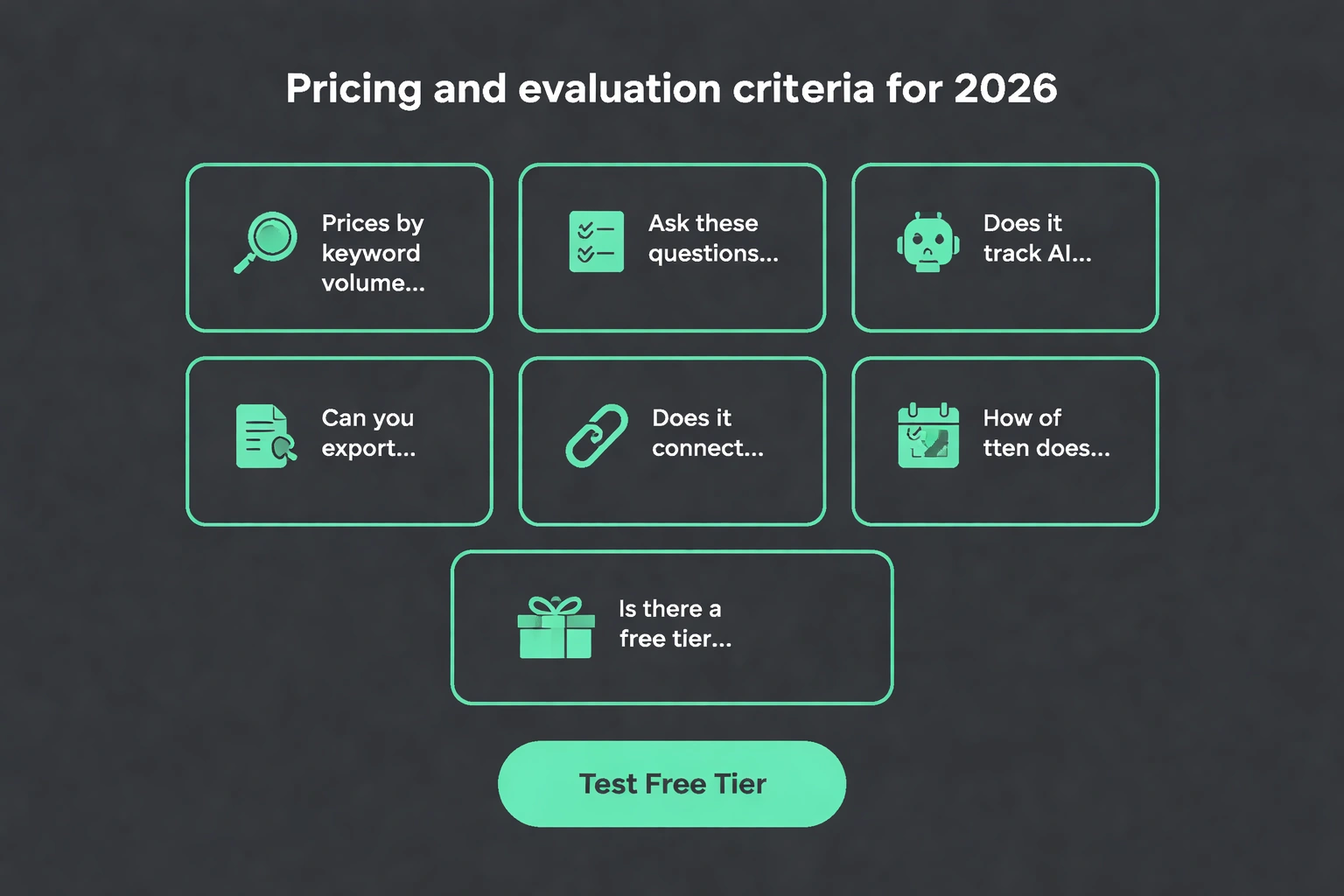
In 2026, AI SEO software usually prices by keyword volume and update frequency. You'll see everything from free tiers to massive enterprise plans. Don't just buy the most expensive one. Match the tool to your actual content volume.
Ask these questions before you commit:
- Does it track AI Overviews and AI Mode as separate metrics, or mash them together?
- Can you export citation phrase data to actually optimize your content?
- Does it connect to your keyword research process, or is it an island?
- How often does the data refresh?
- Is there a free tier you can test before scaling up?
If budget is tight, start with free ai seo tools to get a baseline before paying. Most teams overpay for enterprise features they never touch in year one.
Compare platforms directly. LeafPad's comparison pages break down features against Jasper AI and Scalenut, which helps when you're making a shortlist.
Making the switch to AI-aware tracking
AI mode rank tracking isn't a future thing. If you're publishing content in 2026, you need it right now. Traditional position tracking still matters, but it's only half the story. The gap between blue-link rankings and AI citation visibility is only going to get wider.
Start by auditing your top twenty pages for AI citation status. Then layer in automated tracking. Pair that data with a publishing workflow, like the one in LeafPad's features, so you can act on signals without waiting on a dev sprint.
The teams winning right now aren't the ones publishing the most content. They're the ones tracking the right surfaces and reacting the second citation patterns shift.
Published with LeafPad