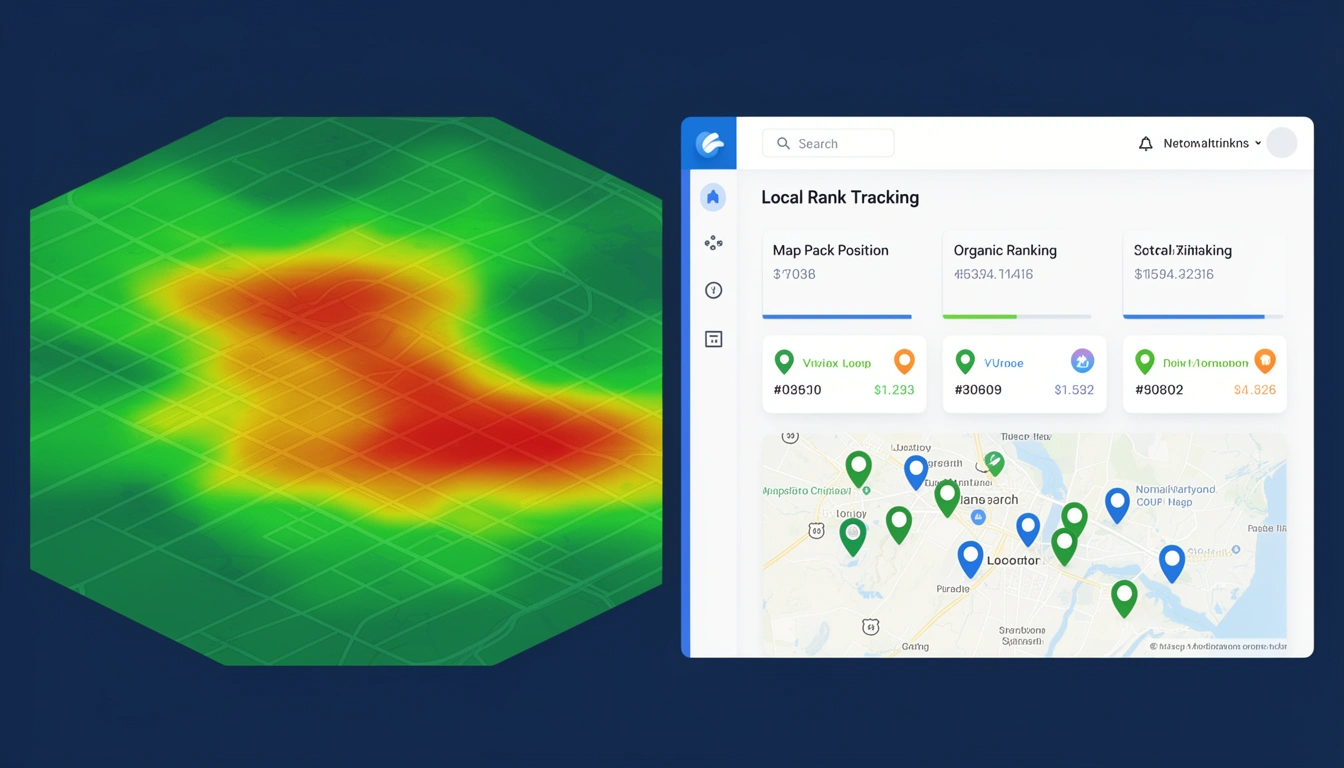
The most accurate local rank tracker for 2026 is the one that matches how you actually check rankings: grid-based tools like LocalFalcon for neighborhood-level precision, BrightLocal for agency reporting, and GeoRanker or SEMrush for tracking hundreds of locations at once. No single tool wins every use case, and the right pick depends on how many locations you manage and how granular your search visibility needs to be.
Tracking local search rankings across multiple locations is one of the hardest parts of local SEO, especially once you're managing dozens or hundreds of location-specific pages. This guide breaks down the tools worth using in 2026, what actually makes a tracker "accurate," and how to track rankings at scale without drowning in spreadsheets.
What Changed in This Guide
This article has been updated for November 2026. We removed specific dollar pricing that changes too often to verify reliably, added a dedicated section on rank-tracking accuracy for dense urban markets like Chicago, explained how trackers simulate a searcher's location, and expanded the guidance on tracking rankings across large, programmatic location sets. The core recommendations for agencies, multi-location brands, and enterprise-scale tracking remain the same.
Why Local Rank Tracking Is Harder Than Standard Rank Tracking
Local rank tracking requires monitoring results tied to specific geography, sometimes down to the neighborhood, which creates problems standard organic tracking never has to solve:
- Location-specific results: A business ranking #1 in downtown Chicago might not appear at all a few miles away in the suburbs.
- Map pack volatility: Google's local 3-pack shifts constantly based on proximity, reviews, and relevance signals, often within the same day.
- Device variation: Mobile and desktop results for the same local query frequently show different businesses in different orders, and most local searches happen on phones.
- Scale complexity: Tracking 50 locations across 20 keywords each means monitoring 1,000+ individual data points every cycle.
If you're implementing automated local SEO strategies, choosing a tracker built to handle this complexity is what makes it possible to prove ROI instead of guessing at it.
How Accurate Is Local Rank Tracking, Really?
Rank tracking accuracy depends almost entirely on how precisely a tool simulates the searcher's actual location, not on the tool's brand name. This matters most in dense, competitive cities like Chicago, where a search from the Loop, from Wicker Park, and from O'Hare can return three different sets of local pack results for the same keyword.
Trackers simulate a place in two ways. The simpler tools route the search through proxies or IP addresses in the target area. The more precise ones set exact coordinates, latitude and longitude, and run the search as if the phone were standing there. Either way, the search has to be clean: a signed-in search with history changes the local pack, so a tracker that doesn't strip personalisation reports a result nobody else sees.
A tracker that only lets you set "Chicago" as the location is averaging across an area that spans dozens of distinct competitive zones. That's why grid-based tools that scan a radius of points around a business, rather than a single city-level check, produce the most accurate picture of where you actually rank. When evaluating any tracker, ask:
- Can you set a location by zip code, neighborhood, or exact coordinates, not just city name?
- Does it scan multiple points around your address, or just one?
- Does it separate map pack position from organic position, since they're driven by different signals?
- How often does it refresh data, given how fast local packs change?
For a business competing in a market the size of Chicago, the difference between city-level tracking and grid-based tracking can mean the difference between thinking you're invisible and correctly identifying the three neighborhoods where you're actually losing ground.
Top Local Rank Trackers for 2026
1. BrightLocal, Best for Agencies
BrightLocal remains a go-to choice for agencies managing multiple clients across locations. It offers granular location targeting by zip code, city, or custom coordinates, local pack tracking alongside organic results, automated white-label reporting, and competitive benchmarking against local rivals.
Best for: SEO agencies and consultants managing 10 or more client accounts. Pricing scales with the number of clients and locations tracked, so agencies should confirm current tiers directly before committing. If BrightLocal doesn't fit your workflow, it's worth reviewing BrightLocal competitors built for the same agency use case.
2. LocalFalcon, Best for Precision Mapping
LocalFalcon scans rankings across a grid of points around your target area, producing heat maps that show exactly where your business appears in local results. This grid-based approach is what makes it the most reliable option for accuracy-sensitive markets, including dense cities where a single city-level check hides real variation between neighborhoods.
Best for: Single or multi-location businesses that need to see their true local visibility footprint, not just an averaged position.
3. GeoRanker, Best for Scale
For businesses running hundreds of location pages, such as those using programmatic local SEO, GeoRanker offers tracking built for volume: unlimited keyword and location tracking on higher tiers, API access for custom integrations, bulk upload for large keyword sets, and SERP feature tracking for local packs, reviews, and Q&A.
Best for: Enterprises and SaaS companies with large location footprints that need programmatic reporting rather than manual checks.
4. SEMrush Position Tracking, Best All-in-One
SEMrush isn't a dedicated local tool, but its position tracking includes location-specific monitoring alongside broader SEO metrics: backlink data, technical audits, cannibalization detection across location pages, and historical competitive analysis.
Best for: Teams that want local tracking bundled inside a full SEO platform rather than run as a standalone tool.
5. GMB Crush, Best for Google Business Profile Focus
GMB Crush specializes in metrics tied directly to Google Business Profiles: daily ranking checks across multiple listings, review monitoring and sentiment tracking, post performance analytics, and citation consistency checks.
Best for: Service businesses whose visibility depends heavily on map pack performance rather than organic local results.
Rank Tracking for Large-Scale and Programmatic Local SEO
Tracking rankings across dozens or hundreds of geo-targeted pages requires a different setup than tracking a single storefront: you need bulk keyword-location pairing, aggregated dashboards, and alerts, not manual spot-checks. This is the exact gap most single-location tools were never built to close. For the basics of local SEO, start with the full guide.
If you're tracking rankings for auto-generated location pages, a few practical steps make large-scale tracking manageable:
- Group locations by market tier. Treat high-volume metros differently from smaller markets so you're not chasing the same alert thresholds everywhere.
- Track a core keyword set per location, not every variant. Ten to fifteen high-intent terms per page is usually enough to gauge health without generating noise.
- Use API access to pipe data into one dashboard. Manually checking hundreds of pages in a tool's UI does not scale past a handful of locations.
- Set movement alerts, not just position snapshots. A location dropping five spots in a week matters more than its absolute position on any given day.
Pairing this with automated keyword research keeps the keyword set behind each location page relevant as search behavior shifts, instead of tracking terms that stopped mattering months ago. For the method, see keyword research, step by step.
Key Features to Look for in a Local Rank Tracker
Accurate geolocation targeting
The tracker should allow precise location specification, not just city-level, but zip codes, neighborhoods, or GPS coordinates. In dense urban markets this single feature is the difference between usable data and a misleading average.
Map pack vs. organic differentiation
Local results appear in two places: the local 3-pack and organic listings. A tracker should monitor both separately, since the signals that move each one are different, review velocity and proximity for the map pack, content and links for organic.
Mobile and desktop tracked apart
Most local searches happen on a phone, and mobile results often differ from desktop for the same query and place. A tracker that reports one blended number hides where most of your customers actually see you.
Scalability for multiple locations
If you manage dozens of location pages, you need bulk uploads, aggregated reporting, and the ability to spot which specific locations are underperforming without scrolling through hundreds of individual reports.
Competitive benchmarking
Knowing where competitors rank in each location surfaces opportunity gaps and helps validate whatever SEO software decisions you've already made. Track three to five named competitors per location, since your position relative to them matters more than the absolute number.
API and export capabilities
For agencies and enterprises, API access lets you feed ranking data into custom dashboards and client reports instead of relying on manual exports.
Best Practices for Local Rank Tracking in 2026
Track what drives revenue, not vanity terms
Focus on longer-tail, high-intent local queries, such as "emergency plumber in [neighborhood]," rather than broad terms like "plumber," which are harder to rank for and convert worse even when you do.
Work positions 4 to 10 first
Keywords where a location already sits just below the top three are the cheapest wins: a citation fix, a profile update or a page refresh often moves them into the pack. Pages on page two still deserve tracking, since their movement shows whether the work is taking.
Watch AI-generated answers, not just the ten blue links
AI overviews now influence how customers find local businesses before they ever scroll to a map pack. Reviewing how your local pages surface in AI-generated responses is becoming part of standard tracking, and it's worth understanding how AI search SEO changes what "ranking well" even means.
Set location-specific baselines
Each location has different competitive dynamics. A #3 position in a major metro can drive more traffic than #1 in a small town. Track performance relative to each location's own ceiling, not against a single company-wide benchmark.
Automate the reporting cadence
Manual rank checking does not scale past a handful of locations. Set automated daily or weekly checks with alert thresholds for meaningful movement, and keep a freshness routine around your data so stale numbers don't quietly drive bad decisions, the same way freshness signals affect content rankings over time. Checking several times a day adds noise, not insight.
Correlate tracking with publishing velocity
If you're publishing location content regularly, compare your content publishing velocity against ranking movement to see what's actually working versus what's just noise.
Building a Complete Local SEO Stack
A rank tracker is one piece of a working local SEO system. Pair it with automated content platforms for scaling location pages without manual overhead, citation management tools for NAP consistency across directories, review monitoring for reputation signals, and analytics that connect rankings back to actual revenue rather than just position numbers.
Which Local Rank Tracker Should You Choose?
The right tracker depends on your scale, not a generic "best overall" pick:
- Single-location businesses: LocalFalcon or GMB Crush for focused, affordable tracking.
- Multi-location brands (5 to 20 locations): BrightLocal for the best balance of features and reporting.
- Agencies: BrightLocal's white-label reporting for seamless client management.
- Enterprise or programmatic SEO (50+ locations): GeoRanker or SEMrush for API access and scale.
Local rank tracking is only valuable when it drives a decision, whether that's fixing an underperforming location, validating a content push, or proving ROI to a client. As AI-driven search reshapes how local results get discovered, accurate, scalable tracking matters more than it ever has.
Frequently Asked Questions
What's the most accurate rank tracker for a city like Chicago?
Grid-based tools such as LocalFalcon tend to be the most accurate for dense cities like Chicago because they scan multiple points across the metro instead of averaging one city-level check. This surfaces neighborhood-level differences that a single city search would hide.
What is geo location rank tracking?
Geo location rank tracking measures search rankings from specific geographic points, such as a zip code or set of coordinates, rather than a generic city-wide search. It shows how visibility changes as you move across a service area, which is critical for multi-location businesses.
How does city-level rank tracking actually work?
City-level tracking simulates a search as if it originated from a chosen city center or, with grid-based tools, from multiple points across the city. Results are pulled the same way a real local search would return them, then compiled to show your position at each point.
What is a local SERP checker?
A local SERP checker is a rank tracker that runs a search from a chosen place, by proxy or by coordinates, and records the whole results page for it: map pack, organic results and the features between them. The term and "local rank tracker" describe the same tools.
What's the best rank tracker for large-scale local SEO?
For tracking rankings across dozens or hundreds of locations, GeoRanker and SEMrush's position tracking are built for scale, offering bulk uploads, API access, and aggregated dashboards that a single-location tool can't handle efficiently.
How is local rank tracking different from regular rank tracking?
Regular rank tracking checks one set of results for a keyword. Local rank tracking checks results tied to specific locations, since the map pack and organic results can differ block by block, device by device, and even hour by hour based on proximity and relevance signals.
Published with LeafPad