Yes, SEO can be automated to a large extent, but not entirely: software can collect Search Console data, track rankings, audit a site and draft fixes, while a person still decides what the business says in public and what goes live.
Automated SEO, also called automatic SEO or SEO automation, is the use of software to run search engine optimization tasks on a schedule or in response to data, instead of a person starting each one by hand. Its main benefit is coverage: software checks every page every week, where a person checks the pages they remember. Google allows it. "Appropriate use of AI or automation is not against our guidelines," says Google Search's guidance on AI-generated content, published on 8 February 2023 and read on 11 November 2026. What Google acts on is purpose: its scaled content abuse policy, added on 5 March 2024, covers many pages made mainly to manipulate rankings, however they were produced.
The top guides give the same answer with the same condition. SEO.com's guide, by Abby Fields, a senior SEO consultant at WebFX, says SEO can be automated but not every task should be, and Google's AI Overview for "can SEO be automated" answers yes, to a large extent, with human oversight. This page defines automated SEO and its other names, sets out the tasks software can run alone and the decisions it can't, then covers whether SEO will ever be fully automated, what Google penalizes, where to start and what it costs.
What is automated SEO?
Automated SEO is software doing the repeatable parts of search engine optimization, monitoring, diagnosis and drafting, on a schedule or when the data changes, so the work happens without a person starting each task.
Automated SEO exists on a spectrum. At one end are point tools that run one task, like a rank tracker or a crawler that audits the site every week. At the other end are platforms that run a chain of tasks, from keyword research to publishing and refreshing posts. The term covers more than writing: much of the useful automation works on pages already published, keeping them accurate and visible. The tools for each task, and how to set up the workflow, are in the guide to SEO automation.
How does automatic SEO differ from SEO automation?
Automatic SEO and SEO automation are two names with one meaning: software running SEO tasks on a schedule or in response to data.
The difference worth checking is control, not the name. Some setups are fully automatic: a change goes live the moment software makes it, with nobody looking. Others are automated with approval: software monitors, diagnoses and drafts, and a person, or a rule that person set, decides what publishes. Both count as SEO automation, and only the second lets a business stand behind every word on its site. The same question of control applies to the content itself.
What counts as automated SEO content?
Automated SEO content is text that software writes or updates for search, like a new article drafted from a keyword, a rewritten title tag or a refreshed section of an older post.
Google judges it like any other content. Its guidance on AI-generated content says its ranking systems reward original, high-quality content that shows expertise, experience, authoritativeness and trustworthiness, E-E-A-T, however it is produced. Its guide to creating helpful content, last updated on 5 October 2026, lists extensive automation used to produce content on many topics among its warning signs, and asks publishers to say who made a page, how and why. Automated content works when a person checks its facts and it adds something a reader can't find elsewhere. Writing is only one of the SEO tasks software can take on.
Which SEO tasks can software run on its own?
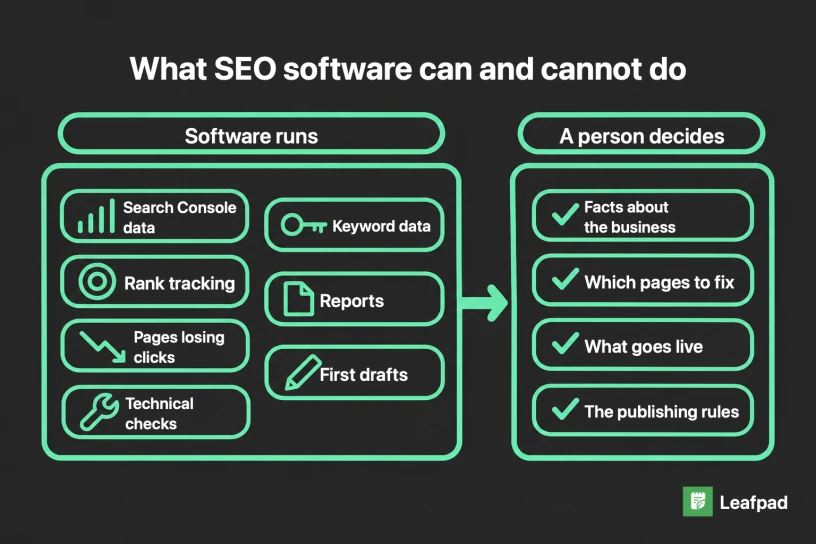
Software can run the SEO tasks that repeat on data: tracking rankings and Search Console numbers, finding pages that lose clicks, technical checks, keyword data, reports and first drafts. A person still checks anything that states a fact.
SEO task | Can software run it alone? | What a person still does |
|---|---|---|
Collecting Search Console data and tracking rankings | Yes | Chooses which numbers matter for the business |
Finding pages that lose clicks or slip in rank | Yes | Decides which ones to fix first |
Technical checks: broken links, missing titles, redirect chains, sitemap gaps | Yes | Approves fixes that change site templates |
Keyword research and clustering | Yes, the data steps | Chooses which topics are worth a page |
SEO reports | Yes | Reads them and acts on them |
Titles, meta descriptions, internal links and first drafts | Yes, as drafts | Checks every claim against what is true today |
Publishing changes | Only inside rules a person set | Sets the rules and reviews what falls outside them |
The top guides agree on the core of that table. SEO.com's guide, updated on 13 October 2026, names five tasks to automate: brainstorming content ideas, keyword research, SEO reports, monitoring SEO issues and tracking rankings, with tools like Screaming Frog's SEO Spider, which crawls a site on a schedule and exports its issue reports. Surfer's guide adds content briefs, writing and on-page optimization, and says its own team publishes 10 to 20 posts a month with two people. How those tasks connect inside one system, from metadata to internal links and indexing signals, is laid out in how an automatic SEO system works.
What still needs a person when SEO is automated?
A person still needs to decide what the business says in public, its prices, features, claims and positioning, which pages are worth the effort and which changes go live, since software knows those facts only when a person keeps them current.
Google's guidance points the same way. Its guide to helpful content asks whether a page shows first-hand expertise and a depth of knowledge, and first-hand experience of a business is the one input no software has. Links and mentions from other sites work the same way: they come from relationships between people, not from a schedule.
Changes fall into two groups: the ones a person always reviews and the ones that can run on a rule a person set.
Always reviewed by a person: any fact about the business, like a price, plan, feature, integration or policy; any change to the title or headings of a page that already ranks; and anything in health, finance or legal advice.
Safe to run on rules: fixing broken internal links, adding links to pages that already exist, filling in missing alt text and updating sitemap dates when a page really changes.
That line between drafting and deciding is also why full automation isn't close.
Will SEO ever be fully automated?
SEO will keep getting more automated, but not fully: monitoring, diagnosis and drafting keep improving, while deciding whether a claim is accurate, current and worth publishing depends on facts inside a business, not in a search index.
Google's systems are why that step matters: they reward content for its quality, not for how it was made, and the scaled content abuse policy acts on pages that add no value however they were produced. As long as that holds, the step that adds value stays with whoever knows the business, and what automated SEO covers grows around it. That raises the question every team asks before it automates anything: whether Google will penalize it.
Does Google penalize automated SEO?
No, Google doesn't penalize automation itself; it acts on content produced mainly to manipulate rankings, whether a person, a script or an AI made it.
Google's spam policies, last updated on 28 August 2026, define scaled content abuse as many pages generated mainly to manipulate search rankings rather than to help users, and give using generative AI or similar tools to produce many pages that add no value as one example. The policy came with the March 2024 core update, announced on 5 March 2024, and builds on Google's older policy on automatically generated content. Google's guidance on AI-generated content names sports scores, weather forecasts and transcripts as automated content that has long been helpful. Automation that fixes broken links, updates stale facts or drafts pages a person checks sits on that side of the line, which is why the safest place to start is a task that changes nothing.
Where should you start automating SEO?
Start automating SEO with monitoring, since it changes nothing on the site: a weekly check for pages losing clicks, queries slipping out of the top results, and crawl or indexing errors.
Diagnosis comes next: software flags the pages that are stale or underperforming and proposes a specific fix for each. Publishing comes last, and only for the changes the review rules above allow. Keyword research is a data task too, since its search volumes, difficulty scores and groups come from tools, and how each of its steps works by hand is in keyword research, step by step. Automated blog publishing then sends approved posts to WordPress, Shopify, Ghost, Webflow or Framer, and on WordPress fills in the meta title, meta description, alt text and schema as well.
Leafpad, an SEO agent, starts where monitoring does. It reads Search Console data, flags any page that lost more than 20 percent of its clicks in 90 days, ranks those pages by how much organic traffic they can win back and refreshes them at the same URL, keeping their backlinks. A setting decides whether each refresh waits for approval before it goes live, and the page on content refresh lists the other rules a team can set, like which sections are never touched. What each of those tasks costs depends on the tool.
How much does automated SEO cost?
Automated SEO costs nothing for free tools like Google Search Console, from $129 a month for the entry plan of an SEO suite, or a price per task.
The suites that automate rank tracking, site audits and keyword data start at $129 a month for Ahrefs Lite and $139 a month for Semrush's SEO plan, billed monthly, on their pricing pages read on 11 November 2026. Leafpad charges per task instead of per month: $0.50 for each content refresh and $1 for each new article, from a prepaid balance with no subscription and $20 free to start, enough for 40 refreshes, as its per-task pricing sets out. Whichever model fits, the split stays the one this page started with: software runs the data and the drafts, and a person decides what goes live.
Published with LeafPad