Topical authority is the trust a search engine places in one site as a source for a whole subject, so it ranks that site's pages across the topic's related queries, not only the keyword each page targets. Ahrefs defines it that way in its guide, updated on 1 June 2026, and Semrush calls it a website's expertise and credibility on a particular subject. Ahrefs sums up the shift: Google used to rank individual pages that targeted the right keywords, and now it increasingly features sites that own the right topics. That shift is what topical authority SEO is about: covering a topic's questions and linking the answers, rather than optimizing one page per keyword.
Topical authority in LLMs is the same trust, seen through AI answers. Google says its AI Overviews and AI Mode retrieve their sources from the Search index through its core ranking systems, and split a question into related searches across subtopics, a technique it calls query fan-out (Google Search Central, read on 11 November 2026). Ahrefs draws the consequence: the more subtopics a site covers, the more of those searches it appears in. That is the case this page makes, that coverage decides how many of an answer's searches a site can be cited for.
This page defines topical authority and how Google measures it, then what AI topical authority means for LLMs and why coverage decides each AI citation. After that come the parts of topical authority, how to build it, how to measure it, how it differs from domain authority and how long it takes. Building topical authority is one part of AI SEO.
What is topical authority?
Topical authority is a search engine's recognition that a site is an expert source on a subject, earned by covering the topic completely and linking those pages together, so the site ranks across the topic's related queries.
Ahrefs adds that topical authority is closely tied to E-E-A-T, Google's framework of experience, expertise, authoritativeness and trustworthiness, applied to one topic rather than to the site as a whole.
Google's results for "topical authority" open with an entity panel for Koray Tuğberk GÜBÜR, the SEO practitioner behind the case study Importance of Topical Authority for SEO on holisticseo.digital. He defines topical authority as a semantic SEO methodology: ranking higher by processing connected topics and the queries they entail with accurate, unique and expert information. In his words, a source shows its expertise on a topic by covering more of its entities, attributes and subtopics.
That makes topical authority in SEO a property of a site, held one topic at a time, and SEO topical authority work a matter of whole topics rather than single pages. Ahrefs puts the effect plainly: each page published within a topic cluster benefits from the authority the pages around it have already built. How Google reads that property is the next question.
How does Google measure topical authority?
Google has never published a formal specification for how it measures topical authority, Ahrefs notes, but Google has named one system built on the idea: topic authority, which its Search Central blog introduced on 23 May 2023 to surface expert sources for news queries in areas like health, politics and finance. Google lists three of its most prominent signals.
How notable a source is for a topic or location, like a local paper for its city's high school football.
Influence and original reporting: how other publishers cite a source's original reporting on the topic.
Source reputation: a history of high-quality reporting, and recommendations from expert sources such as professional societies.
For general search, Google's John Mueller, then a Webmaster Trends Analyst, said in a video of 5 February 2021, quoted in Koray's case study, that if Google can recognise a site is good for a broader topic, it can surface that site for broader queries on the topic without focusing on individual pages.
Ahrefs reads two attributes in the 2024 leak of Google's internal API documentation as topical signals: a site focus score, how concentrated a site's content is around a core subject, and a site radius, how far its content strays from it. That is Ahrefs' reading of leaked documentation, not a statement from Google. Google builds its AI answers on the same Search systems, which is where LLMs come in.
What does topical authority mean for LLMs?
Topical authority in LLMs is a site's standing as a source across a topic in AI answers, from ChatGPT, Perplexity and Gemini to Google's AI Overviews and AI Mode: how often their answers to that topic's questions cite the site's pages. A generative engine like ChatGPT writes its own answer and an answer engine like Perplexity answers a question directly, and for the two companies that document how their AI answers pick sources, Google and OpenAI, the citations come from search.
Google's guide to generative AI search, updated on 10 July 2026, says its AI features are rooted in its core Search ranking and quality systems. They use retrieval-augmented generation, also called grounding: Google's ranking systems retrieve relevant, up-to-date pages from the Search index, and the answer links the pages that support it. OpenAI's crawler documentation says the same of ChatGPT in its own terms: its OAI-SearchBot crawler surfaces websites in ChatGPT's search results, and sites that opt out of it are not shown in ChatGPT search answers.
For Google's AI features and ChatGPT search, then, a citation starts with a page the search system retrieved. Ahrefs shows what that looks like for one page of a site with strong topical authority: Healthline's page on magnesium glycinate shows up for 2,500 keywords on Google, 473 queries in AI Overviews, 279 prompts on ChatGPT, 200 on Perplexity, 86 in Copilot and 28 in Gemini.
Neither Google's nor OpenAI's documentation names a topical authority score for AI answers, and both describe retrieval from search. Which pages that retrieval can find depends on what a site covers.
Why does coverage decide which pages AI answers cite?
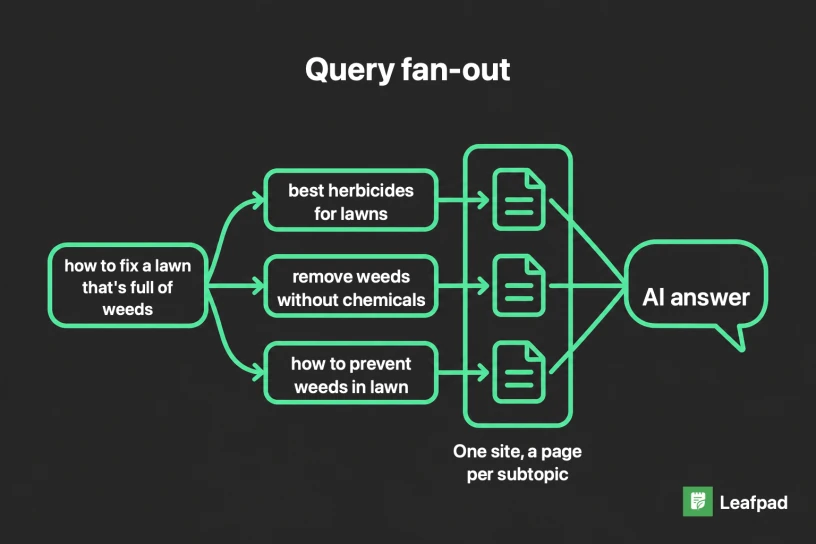
Coverage decides which pages AI answers cite because an AI answer is built from several searches, not one, and a site can only be retrieved for the searches it has a page for. Google calls those searches query fan-out: a set of concurrent, related queries the model generates to fetch more results for the user's question.
Google's own example starts from "how to fix a lawn that's full of weeds" and fans out to "best herbicides for lawns", "remove weeds without chemicals" and "how to prevent weeds in lawn". Its page on AI features, updated on 10 December 2025, says AI Overviews and AI Mode may issue multiple related searches across subtopics and data sources, which lets them show a wider and more diverse set of supporting links than a classic web search.
Ahrefs draws the consequence for topical coverage: the more subtopics a cluster covers, the more of those sub-queries a site appears in. Apply it to Google's example. A lawn care site with a page on herbicides, one on weeding without chemicals and one on preventing weeds has a page for each of the three fan-out searches, while a site with one general page on weeds has one page to offer for all three.
Coverage is not the same as page count, though, and Google draws that line itself.
Does every fan-out query need its own page?
No, a fan-out query doesn't need its own page, and Google warns against making one for each. Its guide says that creating separate content for every variation or fan-out query, primarily to manipulate rankings or AI responses, violates Google's scaled content abuse spam policy, and that a high quantity of pages doesn't make a website higher quality or more relevant. Google adds that its systems understand a page's relevance even when the query and the page don't match exactly.
Ahrefs gives the same advice from the writer's side: when two subtopics are closely related and neither has the depth to stand alone, combine them into one piece rather than publish thin content. Coverage means one page per question, with the question's variations answered inside it. Coverage is also only one of the parts topical authority is made of.
What makes up topical authority?
Topical authority is made up of six parts that the sources read on 11 November 2026 name: coverage, connections, focus, freshness, outside signals and time.
Part | What it means | Example | Named by |
|---|---|---|---|
Coverage | How many of a topic's subtopics, entities and attributes the site answers, and how well | Healthline's magnesium glycinate page shows up for 2,500 keywords on Google | Ahrefs; Koray Tuğberk GÜBÜR |
Connections | Internal links that join pillar and cluster pages, so a search engine reads how they relate | Each cluster page links to its pillar, and the pillar links to each cluster page | Ahrefs; Semrush; Conductor |
Focus | How close the site's content stays to its core subject | An SEO tool writing about project management productivity can confuse Google about what the site is for | Ahrefs, from its reading of the 2024 leak |
Freshness | Pages kept current as the topic changes | A page updated when a study it cites is superseded | Ahrefs |
Outside signals | Links and mentions from sites on the same topic, and E-E-A-T judged for that topic | For a coffee blog, a link from another coffee site counts for more than one from a finance blog | Ahrefs |
Time | The historical data a site builds while it keeps covering and ranking for the topic | Ahrefs expects 6 to 12 months before significant movement | Ahrefs; Koray Tuğberk GÜBÜR |
Google's three news topic authority signals, notability, citations by other publishers and reputation, fall under outside signals and time. Coverage and connections are the two parts a site builds with its own pages, and both start with the pillar and its clusters.
How do pillar pages and cluster pages differ?
A pillar page covers a topic at a high level and links to every cluster page beneath it, while a cluster page goes deeper into one subtopic and links back to the pillar, as Ahrefs describes the topic cluster.
Element | Pillar page | Cluster page |
|---|---|---|
Purpose | A broad overview of the topic, the hub | The detail of one subtopic, a spoke |
Questions it answers | The topic as a whole, at a high level | The specific questions people search about the subtopic |
Internal links | To every cluster page beneath it | Back to the pillar, and across to cluster pages on closely related subtopics |
Format | A guide, a "what is X" or a "how to X" page, chosen from what already ranks | Whatever the subtopic's search intent asks for, like a how-to guide for a "how to" query |
A topic cluster is the pillar page with its cluster pages, and building one for each topic is the work of the next section.
How do you build topical authority for LLMs?
To build topical authority in LLMs, cover one topic's questions completely, one page per question, link those pages into a cluster, and keep them current. A topical authority plan for AI search runs in seven steps, in this order.
Pick one topic your business can credibly own, specific enough to stay focused and broad enough to have subtopics under it, which is the test Ahrefs sets for a seed keyword.
Collect the topic's questions from keyword data, from the gaps against the competitors that get its traffic, and from AI answers; Ahrefs Brand Radar, for one, shows the fan-out queries an AI generates behind a prompt.
Group the questions into a pillar and its clusters by search intent, merging subtopics too thin to stand alone, as Ahrefs advises.
Write answers only your business can give: Google's guide asks for non-commodity content with a unique point of view and first-hand experience, not a summary of what others have said.
Link each cluster page to its pillar and to its closest neighbours, with anchor text that names the target's topic, since Google uses internal links to discover content and understand how pages relate, Ahrefs notes.
Earn links and mentions from sites on the same topic, which Ahrefs counts for more than links from unrelated sites.
Refresh a page when its traffic falls from its peak, a stat it cites is superseded or it drops out of an AI Overview, and run a content gap analysis every few months to close new subtopics, Ahrefs' triggers for both.
Improving topical authority for generative search this way builds the topic itself. Opening the site to AI crawlers, recording which sources AI answers cite today and checking what changed are the other steps of AI SEO, the wider practice this page belongs to. Before the first page is written, though, the plan needs a map.
What does a topical authority map contain?
A topical authority map, usually called a topical map, contains every question a topic raises, grouped into a pillar and its clusters, with the page that answers each question and the links between those pages. Ahrefs calls it the blueprint a team works from: what to create, in what order and how it all connects.
Several tools work as a topical authority map generator. Semrush's Keyword Strategy Builder turns a few seed keywords into suggested pillar pages and subpages, each with its own keyword cluster. Ahrefs' Keywords Explorer groups up to 10,000 keywords into clusters by Parent Topic, and Ahrefs publishes a free topical mapping template beside its guide.
Leafpad builds the map as the first step of its keyword research. It pulls each keyword's monthly search volume, keyword difficulty, search intent and ranking pages from Ahrefs, scores difficulty against your own domain, and adds the topics your top two competitors rank for and you don't. It then groups the topics into a pillar and its cluster posts, flags the queries that trigger AI Overviews, and gives each topic a one-line reason, which you approve or swap before any writing starts. With the map built and the pages live, what remains is to measure the authority they earn.
How do you measure topical authority?
Measure topical authority through three readings: rankings across the topic's queries, branded searches that pair your name with the topic, and how often AI answers mention or cite your site for it. Those are Ahrefs' three ways, and each tool below reads one or more of them.
Four tools read topical authority, each from a different source of data.
Semrush rates a domain's topical authority for a keyword as Low, Moderate, Relevant or High in its Keyword Overview tool, according to its guide of 26 June 2024, which is the Semrush topical authority rating people search for.
Ahrefs reads branded topic searches, like "Ahrefs keyword research", from Search Console or its own keyword data, and tracks AI Share of Voice for chosen topics in Brand Radar.
Google Search Console's Generative AI performance report shows how often a site's pages appeared in AI Overviews and AI Mode, by page, country, device and date. Google announced it on 3 June 2026 and rolled it out to all websites on 31 August 2026.
Leafpad's AI citation tracking runs each target query through ChatGPT, Perplexity, Claude, Gemini, Grok and DeepSeek, weekly by default, and records whether the answer links your domain or names your brand, which competitor domains it cites instead, which queries you are missing and which of your URLs are cited most.
Every topical authority checker or topical authority tool gives an estimate: Google says no third-party tool has access to its internal ranking or AI systems. Read the trend across months rather than one score, and keep it apart from a number it is often confused with, domain authority.
How does topical authority differ from domain authority?
Topical authority is expertise on one subject, while domain authority is a site's overall strength across all subjects, built mostly from backlinks. Semrush describes domain authority as a website's overall trustworthiness and influence across all subjects, and Ahrefs says its own Domain Rating measures backlink strength.
The two can point in opposite directions. In Ahrefs' example, Bicycle Motor Works, a specialist e-bike retailer with a Domain Rating of 15, outranks Amazon, at 96, for competitive e-bike keywords. Conductor makes the reverse point: a site with high domain authority can still lack topical authority on a subject new to it. In the topical authority vs domain authority comparison, Ahrefs says a new site with a precise focus and comprehensive coverage can outrank established generalists, which raises the question of how long that takes.
How long does topical authority take to build?
Topical authority takes 6 to 12 months to show significant movement, by Ahrefs' estimate: the first three months establish coverage, months four to six bring the first ranking gains, and months six to twelve compound them. Ahrefs adds that a specialized niche might need 15 to 20 well-connected pieces and a broader subject 50 or more.
One topical authority case study shows a faster curve. Koray Tuğberk GÜBÜR's case study, which covers four projects, reports its main project growing from 0 to 128,000 organic traffic in 123 days and to 12,000 organic clicks a day in 162 days. Those are his reported results for his own projects, not a forecast for another site, and time builds the record authority rests on without promising a citation.
Does topical authority guarantee AI citations?
No, topical authority doesn't guarantee AI citations. Google's page on AI features says that even a page meeting every requirement and policy isn't guaranteed to be crawled, indexed or served.
What topical authority does is put a site in the running across a whole topic. Google's AI features are rooted in its core ranking systems, an AI Overview or AI Mode answer fans out into searches across subtopics, and a site that covers those subtopics has a page for more of them. Google's guide then names what weighs most once a page is found: content that people find unique, compelling and useful will likely influence a site's presence in generative AI search more than any other suggestion in the guide.
Topical authority makes a site eligible across a topic, coverage decides how many of an answer's searches it can be found for, and among the pages found, Google's guide says a unique point of view is what helps a page stand out from the other sources.
Published with LeafPad