Most blogs are just graveyards. You publish, get a traffic spike, and then the post slowly rots while you move on to the next keyword. Content refresh automation is essentially graveyard maintenance software that finds the stale posts and updates them so you don't have to.
By 2026, this tech is going to decide who survives the AI search shift. We baked this into LeafPad content refresh because the math got unavoidable: AI models and search engines now prioritize freshness. A post that ranked well in 2023 but hasn't been touched since risks becoming invisible.
It's not just editing
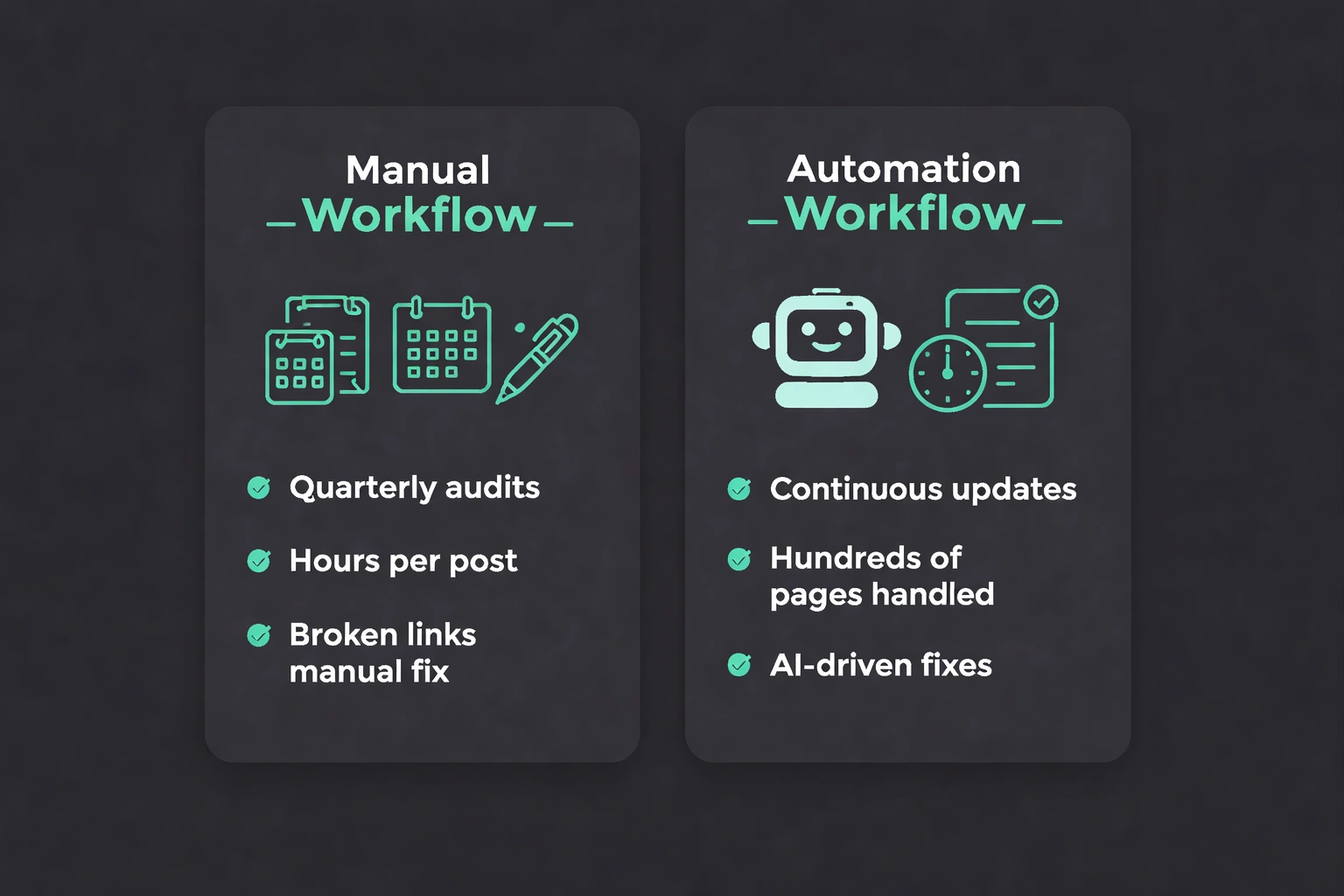
Calling it "automation" makes it sound fancier than it is. The system scans your library for outdated facts, broken links, or shifting keyword intent, then rewrites the weak spots. It runs in the background, which is the whole point. Manual audits happen once a quarter if you're lucky. Automation handles the drudgery continuously.
The old workflow was painful. Spreadsheets, manual rank checks, rewriting paragraph by paragraph. It took hours per post. Now, a script handles hundreds of pages, flagging dead stats and fixing internal links. It’s similar to how we approach automated keyword research and organic internal linking you can't scale this stuff by hand.
The 2026 deadline isn't hype
Static content is becoming a liability. Google’s AI Overviews are picky; they pull from sources that look recently verified. If your last-update timestamp is a year old, you aren't just losing clicks, you’re losing the citation entirely.
Three things are converging:
AI Overviews want recency, not just domain authority.
LLMs like ChatGPT cite sources that look active and consistent.
Google’s crawl budget prioritizes sites that actually publish and update.
Ignoring this is basically opting out of discovery. You can see the impact in the domain freshness signals data dormant domains are getting de-prioritized fast.
How the machine actually works
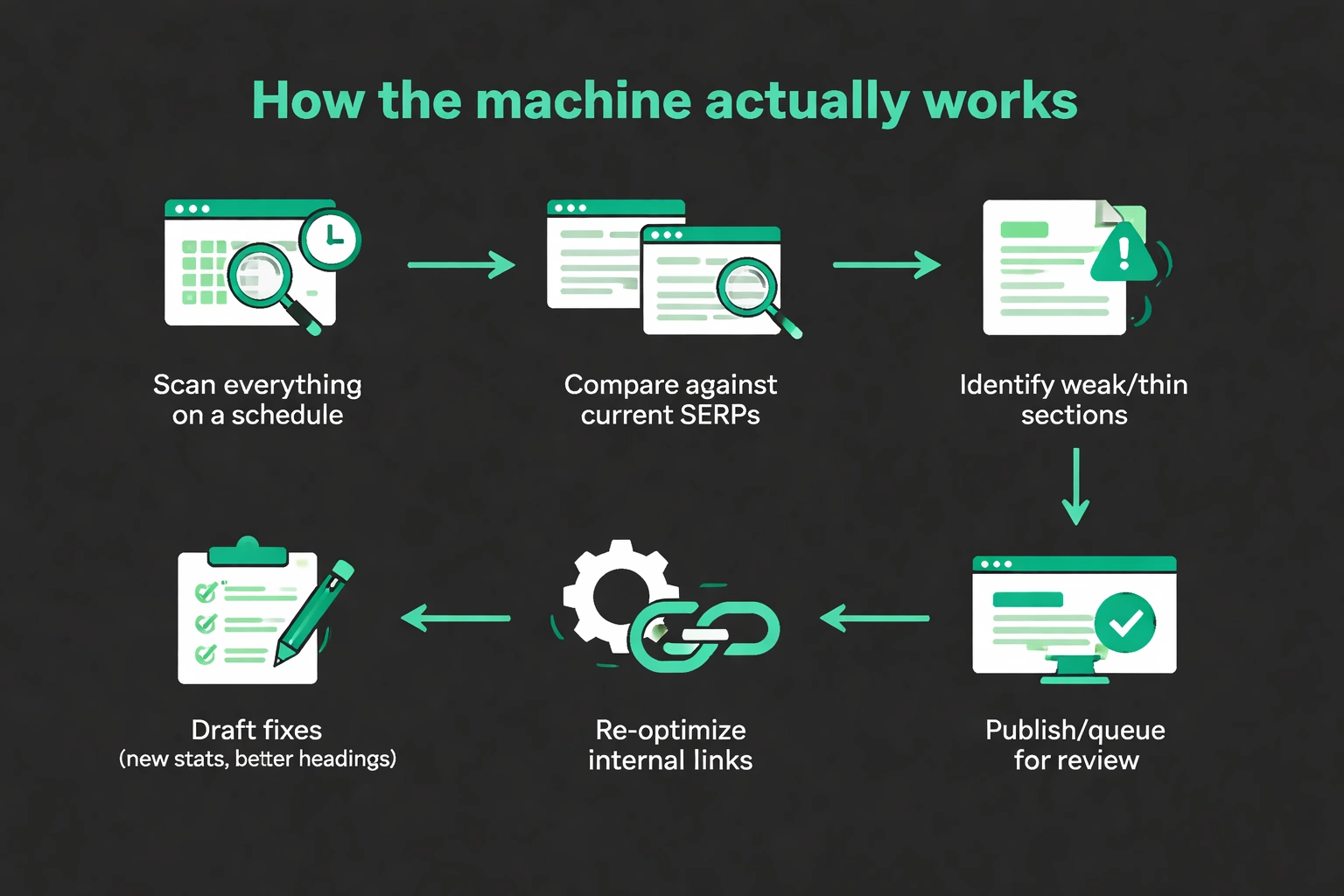
It’s not magic. The system compares your live content against current search results. If a competitor answered the query better, or if your rankings slipped, it flags the page and drafts an update.
The workflow looks like this:
Scan everything on a schedule.
Compare against current SERPs.
Identify weak or thin sections.
Draft fixes new stats, better headings.
Re-optimize internal links.
Publish or queue for review.
A refresh isn't just rewriting text; it's realigning the whole page. That’s why it integrates with the rest of the stack, from the index checker to the content calendar.
The math: New vs. Refresh
Refreshing existing content usually pays off faster. The page already has backlinks. A new post starts at zero and takes months to rank. A refreshed post can move in weeks.
Factor | New Content | Refreshed Content |
|---|---|---|
Time to rank | 3-6 months | 2-6 weeks |
Backlinks | None | Retained |
Authority impact | Slow | Immediate |
Cost | High | Low (automated) |
Teams using the 0 to 100K SEO playbook are shifting 40-60% of their budget here. It’s becoming the default strategy because content velocity means nothing if your archive is full of holes.
What gets fixed first
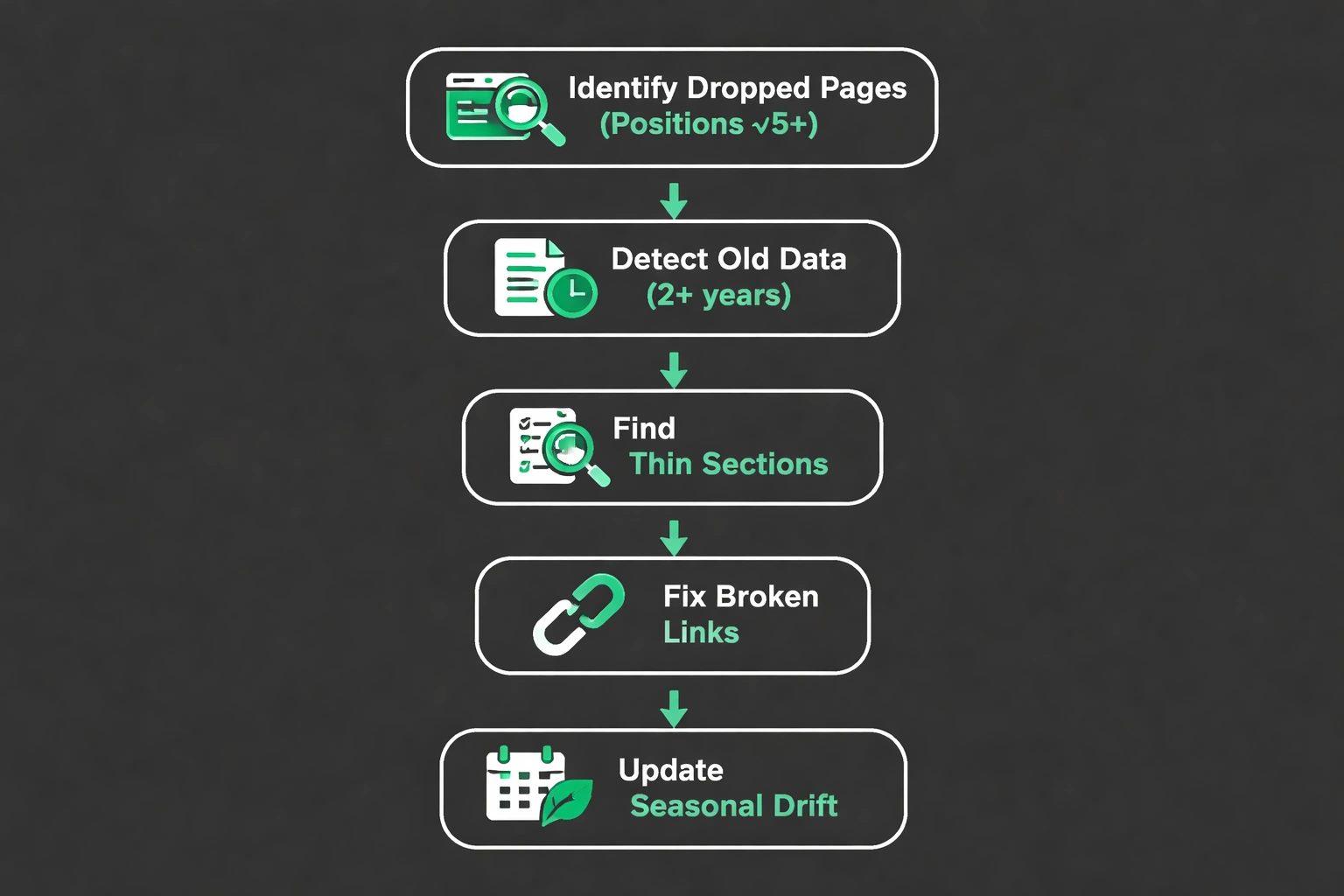
Start with the pages that slipped. If a post dropped from position 2 to 12, that’s the easiest recovery. Then look for "statistical decay" old numbers, deprecated tools.
Look for:
Drops. Anything down 5+ positions in 90 days.
Old data. Pricing or stats from two years ago.
Thin sections. Where competitors cover the topic better.
Broken links. Internal links pointing nowhere.
Seasonal drift. "2025" references when people search "2026."
You can spot this manually, but you can't scale it. Automation is the only way to catch it across a library of hundreds of posts.
The new rules for AI citations
LLMs are snobs about timestamps. They cite sources that look actively maintained. It’s not enough to have good backlinks; you have to look alive.
To get cited:
Show clear "last updated" timestamps.
Structure answers so an AI can grab them.
Use current terminology.
Cite verified stats, not old guesses.
This is why AI citation tracking is now essential. It shows which pages are winning in AI Overviews. Ignore it, and competitors will slide into that citation spot within a quarter.
You don't need a bigger team
You just need better rules. Set the triggers (ranking drops, not arbitrary dates), let the machine draft, and keep a human in the loop for the final check.
A lean setup:
Bi-weekly audits via content calendar.
Auto-trigger on ranking drops.
Use auto-publish for simple fixes (like a stat update).
Push bigger rewrites to a human.
Use ai-blog-generator comparisons to quality-check the output.
When founders compare tools, they usually look at the Outrank alternative or Jasper AI alternative pages because automation quality varies wildly. The pricing breakdown shows which plans actually include full scheduling versus manual-only options.
The takeaway
This isn't a future trend. It's the baseline. The teams winning in 2026 aren't publishing more; they're maintaining smarter. Static libraries are bleeding value every month. The choice is simple: stay current, or fade out. If you're mapping it out, the full features list shows how refresh fits into the rest of the stack.
Published with LeafPad