SEO page structure for individual passage ranking is mostly a writing discipline. Each section works as a standalone answer unit: one question per heading, the answer delivered in the first two to three sentences, and no pronoun that depends on a different section to make sense. Search systems can lift a single section out of a long page and rank it on its own, separate from the rest of the article. A section that only makes sense next to the paragraph before it won't survive that lift. Sounds obvious. Most blogs fail it anyway, because most blogs get written as one continuous argument. The fix is mechanical: isolate the question, answer it immediately, then support it. The rest of this post walks through how to build the pattern across a real page.
If you're running fifty or more posts, this matters more than picking a new topic. Your existing library almost certainly holds sections that could rank on their own if they were structured to stand alone. And a full rewrite is rarely on the table. It almost always comes down to restructuring headings, paragraph order, and where the answer sits.
What passage ranking indexes, and what it ignores
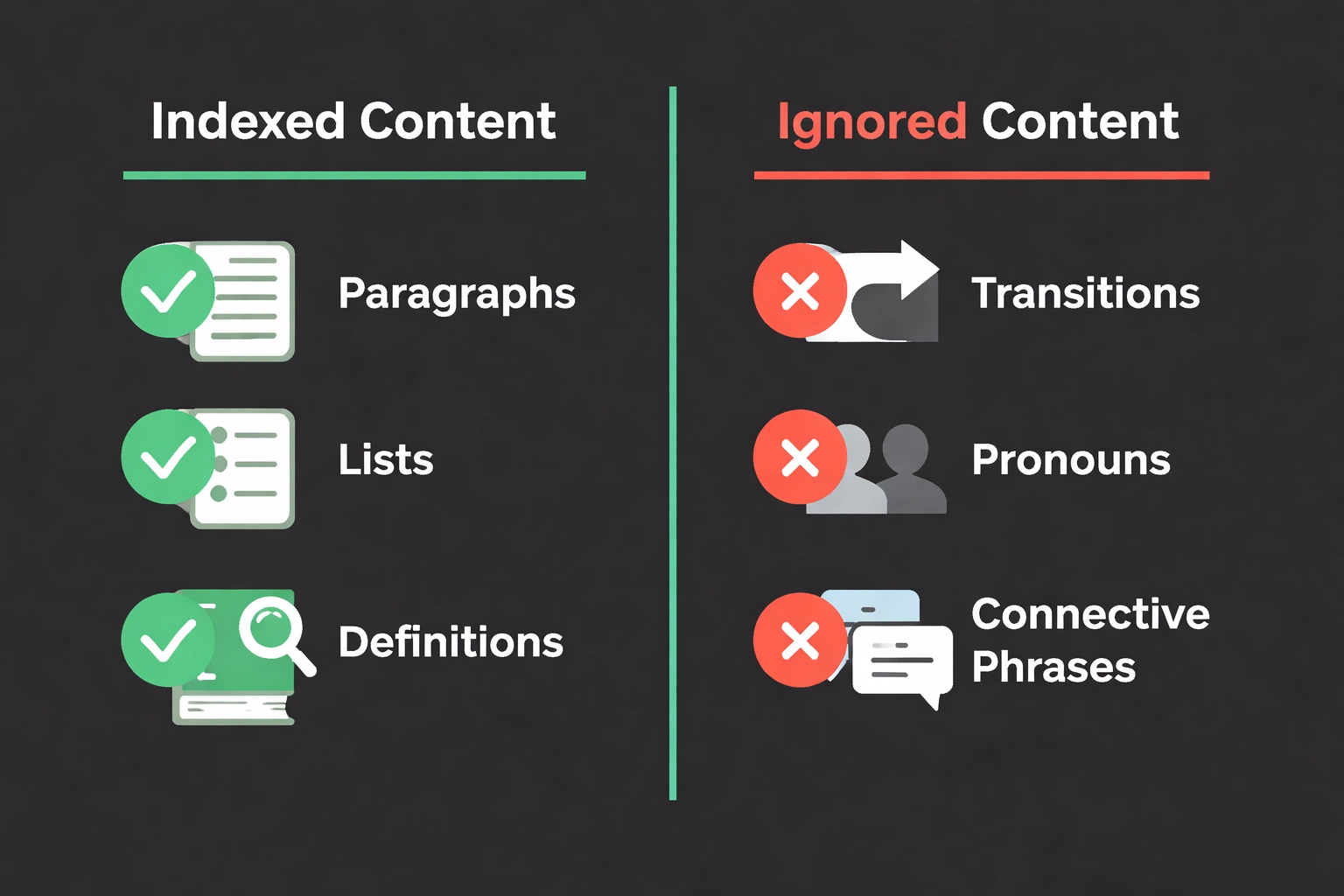
Passage ranking indexes discrete, complete blocks of text: a paragraph, a list, a short definition, anything that reads as finished without outside context. What it ignores matters just as much. Connective sentences get skipped. Transitions get skipped. Any passage that depends on the paragraph before it gets skipped. SEO strategies for passage indexing work when every block can stand alone on the page. They fail when the page reads as one continuous argument with no isolated units.
What gets skipped
Transitional sentences such as "Now that we've covered X, let's look at Y."
Pronouns pointing at earlier sections: "this approach," "the method above," "these factors."
Setup sentences that promise an answer instead of giving one right away.
A quick way to find these in an old post: search for "as mentioned above" and "as we saw earlier." Every hit marks a passage that won't survive on its own.
What gets kept
A paragraph that names its subject and answers a specific question in the same breath survives the lift. A list where each item stands alone, without needing the item before it, survives too. A definition block that repeats the actual term instead of substituting "it" also holds up.
Pattern | Gets indexed as a passage | Gets skipped |
|---|---|---|
Opens with the subject name | Yes | |
Opens with "this" or "it" | Yes | |
Answer sits in the first three sentences | Yes | |
Answer buried after paragraphs of setup | Yes |
None of this is new, by the way. Wire reporters have written this way for a century, because syndicated copy had to survive being trimmed at any paragraph. Passage ranking just puts a machine on the other end of the scissors.
The section pattern that makes a passage self-contained
SEO page structure for individual passage ranking follows one repeatable pattern: question heading, immediate answer, supporting detail, optional example. Apply it to every H2 and H3, not only the sections you expect to rank. The mental model I keep coming back to: each section is a small standalone page, not a chapter in one long book.
One caveat before the mechanics. Not every section wants to be a question. Some stretches of a page are narrative on purpose, and forcing them into Q&A shape makes the prose choppy. When you hit one of those, give it its own H2 and let it be a weak passage deliberately, so the damage stays contained.
The four-step pattern
The heading states the question in plain language.
The first sentence names the subject again instead of relying on the heading to supply it. Retrieval systems often strip headings, so the sentence has to carry the subject by itself.
The second and third sentences deliver the actual answer, not a preview of one.
The remaining sentences add detail, an example, or a short supporting list.
A quick before and after
Before: "As discussed above, this method works because it reduces friction. It's also faster."
After: "The template method reduces friction for the reader because it delivers the answer immediately. It also performs better in retrieval systems that scan for direct, self-contained answers."
The second version names its subject twice and needs nothing from a prior paragraph. That's the entire trick, and once you've fixed a few sections this way, the habit starts leaking into new drafts.
Heading depth, passage length and where to put the answer
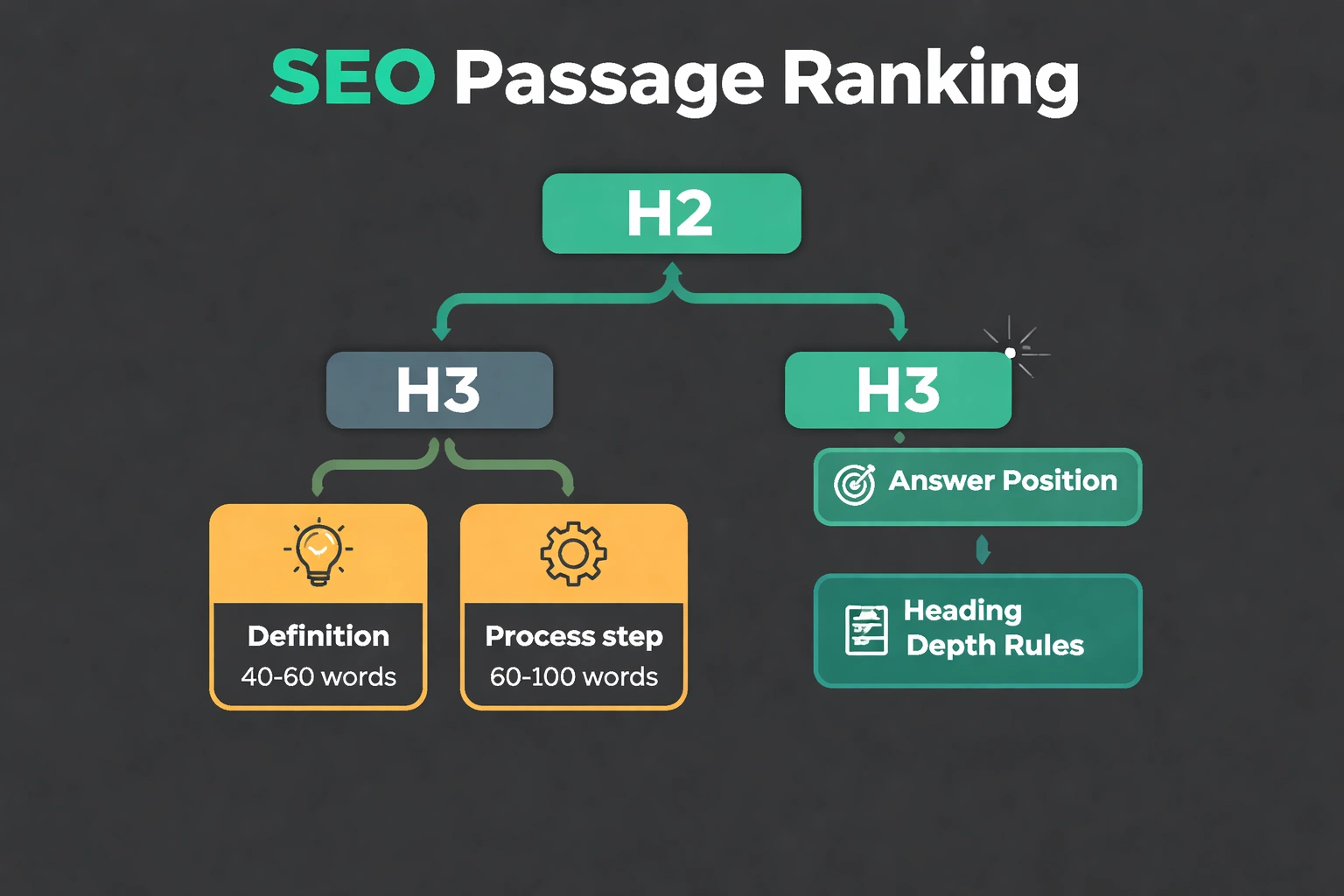
Page structure for ranking individual passages depends on heading depth staying shallow: H2 for the main question, H3 only for a genuine sub-question underneath it. The structure breaks down once writers nest H4s or deeper, because retrieval systems lose track of which heading owns which answer. Length matters too. Individual passages rank best when each passage runs roughly 40 to 120 words: long enough to answer fully, short enough to stay intact when lifted.
Passage length by type
Passage type | Target length | Where the answer sits |
|---|---|---|
Definition | 40 to 60 words | First sentence |
Process step | 60 to 100 words | First two sentences |
Comparison | 80 to 120 words | First three sentences, then a table |
FAQ answer | 30 to 70 words | The entire answer |
Why depth matters more than word count
A shallow heading structure keeps every passage attached to one clear question. Nest three or four heading levels deep and a single passage can end up answering a question that belongs to a heading two levels above it. I see this constantly in long tutorials, where an H4 detail gets credited to an H2 question it never really answered. Flattening back to H2 plus one layer of H3 fixes it without touching the writing itself.
Passage indexing best practices: a section-by-section checklist
Passage indexing best practices only work when applied one section at a time, not as general advice for the whole page. The first test is simple: read the section alone and check whether it still makes sense. From there the work runs through headings, pronouns, and answer placement. A page counts as structured for passage indexing once every item below passes for every section, not just the ones you're fond of.
Work through the list section by section, not once for the whole post:
Cover the heading. Does the first sentence still name the subject? If not, rewrite the opening sentence.
Read only the section, skipping everything above it. Does the answer appear within the first three sentences? Move it up if it doesn't.
Search the paragraph for "this," "it," "these," or "the above." Replace each with the actual noun it refers to.
Count the words. Past 150, there's usually a second question hiding inside the passage. Split it into its own section.
Check the heading itself. Does it ask one question, or two joined by "and"? Split the heading if it asks two.
Look for sentences that only exist to bridge into the next section. Cut them. They cost more than they earn.
Check any list in the section. Does each bullet stand alone, or does the third bullet depend on reading the first? Rewrite the dependent ones.
Item 3 catches about half of all problems on its own, in my experience. The pronoun habit runs deep.
Structuring for retrieval, not just for ranking
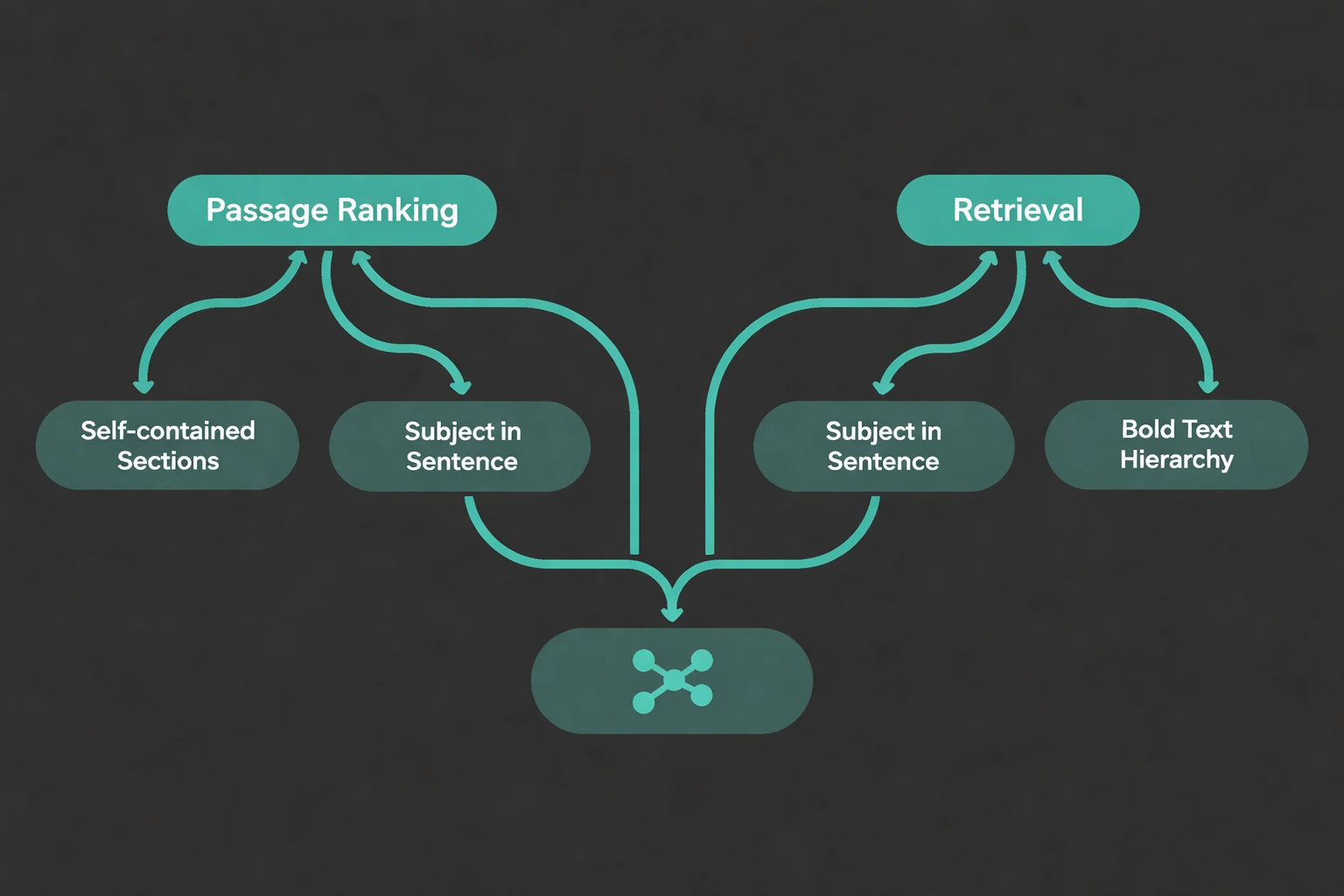
Two related but distinct systems prefer the same page shape. Passage ranking decides whether a section can rank on its own. Retrieval is what answer engines use when they match a question against isolated chunks of text and quote a section directly. The systems aren't the same thing, but a section built for retrieval, carrying its own subject and its own answer with no dependence on the heading tag, tends to do well in both.
Write for the chunk, not the crawl
The subject of a passage should appear in the sentence itself, not only in the heading above it. Bold text and heading hierarchy help a human skim, but they do little for a system that pulls a chunk of text with no formatting attached. Strip the formatting in your head and read the raw sentences. That's closer to what the machine actually sees, and a sentence that reads correctly with no heading in sight is the real test of retrieval readiness.
How this differs from micro-cluster architecture
This post covers structure and formatting inside one page. Micro-cluster architecture is about how multiple pages relate to each other through internal linking and topic grouping. Passage structure is about whether a single section on a single page can be lifted out and understood alone. The two ideas support each other but solve separate problems, and this piece sticks with the second.
Teams with a back catalog of fifty-plus posts often find this restructuring work buried under everything else on the roadmap. Tools such as Leafpad, an AI content refresh agent, can help by monitoring existing posts against Search Console data and surfacing which sections have gone stale. The rewrite and publish decision stays with a person, which is where it belongs.
This walkthrough shows that process on an existing page.
Related reading:
https://leafpad.io/blogs/passage-level-seo-micro-clusters-rank-2026
https://leafpad.io/blogs/on-page-seo-2026-ai-structure-semantic-clarity
https://leafpad.io/blogs/semantic-seo-2026-context-over-keywords
FAQ
What is passage ranking?
Passage ranking happens when a search or retrieval system indexes and ranks a single section of a page rather than the whole page. The system treats that section as if it were its own small document. It ignores the rest of the page when deciding whether that section answers the query.
How long should a passage be for ranking purposes?
Usually somewhere between 40 and 120 words. Shorter passages often leave out enough detail to fully answer the question. Longer passages tend to hide a second question inside the same section, which weakens both answers.
Do I need to rewrite my whole blog to fix this?
No, and that's the good news: a full rewrite is rarely necessary. Most fixes involve moving the answer earlier in the paragraph, removing dependent pronouns, and splitting headings that ask two questions at once. The work happens section by section across older posts, and the rest of the page can stay untouched.
Does heading depth affect passage ranking?
Yes, though indirectly. Heading depth controls how clearly a system can match an answer to its question. H2 for main questions and H3 for genuine sub-questions keeps the mapping clean; go H4 or deeper and it blurs which heading owns which passage.
Is this the same as topic clusters or content architecture?
Not quite. Topic clusters and content architecture describe how multiple pages link together around a subject. Passage structure describes how one section inside one page is written. Both matter, but they're planned separately.
How do I check if a passage is already self-contained?
Cover the heading and read only the paragraph beneath it. If the paragraph still names its subject and delivers an answer without needing anything above it, it passes. If it leans on "this," "it," or any pronoun pointing at an earlier section, it needs a rewrite.