A local SEO audit is a check of everything that decides whether a business shows in Google's local pack and Maps results: its Google Business Profile, its name, address and phone (NAP) citations, its reviews, its website's local pages and links, and its rankings across the area it serves. Google's Business Profile help, read on 11 November 2026, says local results are mainly based on relevance, distance and prominence, and a local SEO audit checks the signals behind each of them. Local SEO audit tools run those checks automatically, for one location or hundreds.
This page sets out what an audit checks, then compares the best local SEO audit tools that run it: BrightLocal, Semrush Local, Whitespark, Local Falcon, LinkGraph and Search Atlas, with free options, including free alternatives to Moz Local, after them. Every price comes from the vendor's own page, read on 11 November 2026. Further down, it covers how agencies automate audits across many clients, what each local SEO audit tool costs at 1, 10 and 50 locations, how AI search changes the audit and how AI helps with local SEO more widely.
Tool | What its audit covers | Entry price, read 11 November 2026 | Fits |
|---|---|---|---|
BrightLocal | Profile deep dive in 300+ checks, citations, rankings, reviews, AI visibility | $41 a month, Track, 1 location | Agencies and multi-location businesses |
Semrush Local | Profile audit and optimization plan, map rank tracking | $30 a month a location, billed yearly | Businesses that want profile work automated |
Whitespark | Citation gaps against competitors, citation tracking | $39 a month; free starter plan | Citation building |
Local Falcon | Geo-grid rank scans, AI visibility | $24.99 a month, 7,500 credits | Service-area businesses |
LinkGraph | Local pack proximity audit, run as a service | Not published | Franchise and multi-location brands |
Search Atlas | Local heatmaps, profile automation, aggregator citations | $199 a month, Growth | Teams that want local and site SEO in one platform |
Moz Local Check Listing | Listing status for one location | Free | A first look |
Local SEO Audit Tool | 310+ website checks in 15 categories | Free; Pro from $4.99 a month | The website side |
No single tool covers every part of an audit, so the checklist below shows which tool covers which part.
What does a local SEO audit check?
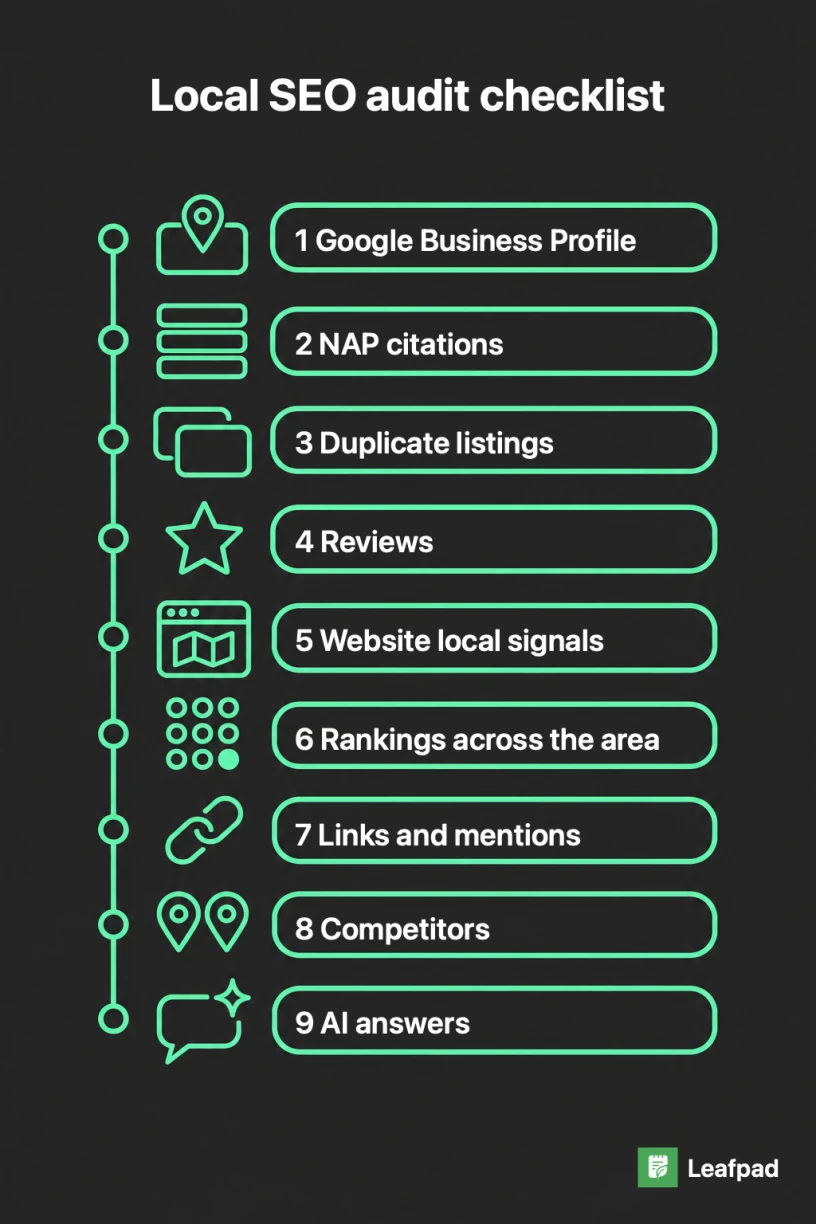
A local SEO audit checks nine areas: the Google Business Profile, NAP citations, duplicate listings, reviews, the website's local pages and markup, rankings across the service area, links and mentions, competitors, and AI answers.
The table lists each area of the checklist with what to look at and which tools on this page automate it.
Area | What to check | Tools that automate it |
|---|---|---|
1. Google Business Profile | Verification, primary and secondary categories, hours, description, attributes, photos, posts | BrightLocal, Semrush Local, Search Atlas |
2. NAP citations | The same name, address and phone on every directory and data aggregator | BrightLocal, Whitespark, Moz's free check |
3. Duplicate listings | A second profile or listing for the same place | A manual search; LinkGraph's audit service |
4. Reviews | Rating, recency, unanswered reviews, recurring complaints, review sites you're missing from | BrightLocal, GatherUp |
5. Website local signals | A page per location, LocalBusiness markup, the place in titles and headings, an embedded map, the mobile view | Local SEO Audit Tool, BrightLocal |
6. Rankings across the area | Map pack and organic positions from several points, not one | Local Falcon, BrightLocal, Semrush Local |
7. Links and mentions | Inbound links, spammy links, unlinked mentions that carry contact details | A backlink tool and a manual search |
8. Competitors | Their citations, reviews and the local pages they have that you don't | Whitespark, BrightLocal |
9. AI answers | Whether AI assistants name the business and state its details correctly | BrightLocal, Local Falcon |
The order follows the two checklists Google ranks for "local seo audit" on 11 November 2026. BrightLocal's guide runs nine steps, from Google penalties and local keyword research through rankings, links, citations, brand mentions, the profile and reviews to social media. Search Engine Journal's 11-point checklist by Jeff Riddall, dated 7 November 2025, adds a Search Console review, an analytics review and AI prompts beside keywords. The diagram shows the nine areas in the order an audit runs them.
Citations are where most audits start, because every listing can be checked against one record.
How do you audit business listings for accuracy, step by step?
Audit business listings for accuracy by writing down one correct record of the business and checking every live listing against it, field by field.
Write down the exact business name, address format, phone number, hours, categories and website URL you want everywhere; "St." against "Street" counts as a mismatch to most citation tools.
Search the business name with its city on Google, Bing, Apple Maps, Yelp and Facebook, then on two or three directories of its industry.
Log every mismatch: an old address, a dead phone number, hours that are wrong.
Look for duplicate profiles, which data aggregators, past staff or a previous business at the same address can create.
Claim any unclaimed listing before editing it, so it can't revert to old data.
Fix the most visited listings first, the Google Business Profile, Yelp and Facebook, then work down to smaller directories.
Set a date to check again, since aggregators can sync old data back onto a listing you fixed.
Steps 2 and 3 grow with every location, and they are the steps audit tools automate.
What are the best local SEO audit tools in 2026?
The best local SEO audit tools in 2026 split by what they audit: BrightLocal audits the whole local presence, Semrush Local the Google Business Profile, Whitespark citations, Local Falcon rankings across a grid, and LinkGraph runs audits as a service.
Each tool below is described from its own site, read on 11 November 2026, with what its audit covers, what it costs and who it fits.
BrightLocal: audit a whole location and report under your brand
BrightLocal audits a location's whole local presence in minutes, with 300+ automated checks and a color-coded roadmap rated Good, OK or Poor, including a deep dive into the Google Business Profile, according to its audit page. Its Track plan, $41 a month for one location or $31 billed yearly, includes comprehensive local SEO audits, a profile audit with competitor benchmarking, citation accuracy monitoring and gap spotting, rank monitoring for 100 keywords and a geo-grid for five.
Its agencies page says every paid plan can remove BrightLocal's branding and add your logo and colors, and each client can get a dashboard of its own. Prices rise by location band up to 100 locations, and the 14-day trial needs no card. BrightLocal reads the whole location; Semrush Local goes deeper on one part of it, the profile.
Semrush Local: plan profile fixes for each location
Semrush Local audits each location's Google Business Profile and turns the result into an optimization plan, on every tier from Base at $30 a month a location to Pro at $60, billed yearly, according to its pricing page.
Base adds an AI agent that manages the profile, AI-written posts, automatic review replies and 375 Map Rank Tracker credits. Pro adds listing management, review requests and 1,225 credits, and the Business tier is quoted. When the profile is the only thing to audit, BrightLocal's profile deep dive and Semrush Local's audit and optimization plan are the two tools here built around it. A profile also depends on the citations that confirm it, which is Whitespark's ground.
Whitespark: compare your citations with your competitors'
Whitespark's Local Citation Finder audits citations by finding every citation of your top ranked competitors and comparing them with yours, sorted by how easy each is to submit, from $39 a month for 5 campaigns to $149 for 100, or $33 to $124 billed yearly.
Paid campaigns rerun weekly to track citation growth, while the free starter plan, 1 campaign and 3 searches a day, reruns monthly. The competitor comparison downloads as PDF or CSV. Whitespark also sells Local Ranking Grids from $10 a month, covering up to 225 points, which leads to the tool built only for grids.
Local Falcon: scan rankings from every point of the service area
Local Falcon audits rankings by scanning the map results from a grid of points around a business, one credit per point, with grids from 3x3 to 21x21 and plans from $24.99 a month for 7,500 credits to $199.99 for 63,150, according to its pricing page.
A 9x9 grid, the example its homepage uses, takes 81 credits, so the Starter plan covers 92 such scans a month. Its pricing page lists scheduled scans, service-area business scans, competitor and trend reports, white-label reports and AI visibility tracking, which its homepage says covers ChatGPT, Gemini, Google AI Overviews, Google AI Mode and Grok. New accounts get 100 free credits. Local Falcon and the tools above are software; LinkGraph sells the audit as a service.
Does LinkGraph run local SEO audits?
Yes, LinkGraph runs local SEO audits as a service rather than software: its local SEO services page offers a "Multi-Location Local Pack Proximity & Governance Audit" by its enterprise local SEO strategists, aimed at franchise and multi-location brands, with no published price.
The page says the work syndicates business data with Data Axle, Neustar Localeze and Foursquare, suppresses duplicate listings and measures each location's "Local 3-Pack Proximity Share". Search Atlas, the software often named beside LinkGraph, lists Local Heatmaps on a 13x13 grid, GBP Galactic for review replies, Q&A, posts and listing updates, and citations sent to 5 major aggregators for 12 months, from $199 a month with a 7-day trial. Its local SEO page names no local audit feature, and neither page mentions the other, so check how they relate before buying. Software and services both raise the question of whether a local tool or a full suite fits better.
Dedicated local audit tool or full SEO suite: which fits your work?
A dedicated local audit tool fits when local search is the main channel, and a full SEO suite fits when local audits are one part of site-wide SEO work, since the two are built for different jobs.
BrightLocal, Whitespark and Local Falcon check local data: profiles, citations and rankings across a grid. Suites add site crawls, keyword research and content tools, and sell local as a module: Semrush prices its Local toolkit per location, from $30, apart from its SEO plans, such as Starter at $165.17 a month billed yearly, and Search Atlas lists a site auditor beside its local tools. A business already paying for a suite should test its local module on one location before adding a second subscription. Either way, an automated audit needs a person to read it.
How reliable are automated local SEO audits?
Automated local SEO audits are reliable for checks with one right answer, like whether a phone number matches or whether a page's LocalBusiness markup carries the business's name and address, the two properties Google requires, and less reliable for judgement calls.
Check five things by hand. A tool's competitor list can rest on keyword overlap rather than the businesses that win your customers. Industry directories, like legal or healthcare platforms, are missing from generic scans. A listing can read correctly in a desktop report and badly on a phone. A score means little without competitors' scores beside it. A single audit shows one day, so only a repeated one proves progress. Repeating audits for many clients is where agencies automate.
How do agencies automate audits with local SEO audit tools?
Agencies automate audits with local SEO audit tools by running one audit template per group of clients on a schedule, with alerts, APIs and branded reports doing the work an account manager used to do by hand.
Group client locations by brand, region or industry, and run one audit template per group, so results stay comparable across clients.
Schedule audits and reports: BrightLocal sends scheduled branded reports, and Local Falcon runs scheduled scans.
Watch for changes between audits: BrightLocal's Active Sync keeps details synced and protected from its Manage plan, and GatherUp's Review Defense sends daily activity notifications.
Connect the data to your own systems: BrightLocal offers APIs and an MCP server, and Local Falcon a data API, a Looker Studio connector, Zapier and n8n on plans above Starter monthly.
Brand the client view: BrightLocal removes its branding on every paid plan and gives each client a dashboard, and Local Falcon offers white-label reports.
Report in five parts: the three to five critical issues, rankings over time, a comparison with the top three competitors, the prioritized actions and the progress since the work began.
Review the flagged exceptions by hand before they reach the client.
Local SEO audit tools for agencies differ most in what they cost at volume, so price them at your own location count.
What do local SEO audit tools cost across 1, 10 and 50 locations?
At 10 locations BrightLocal Track costs $83 a month and Semrush Local Base $300, and at 50 locations they cost $261 and $1,500, according to each vendor's pricing page on 11 November 2026.
The table prices each per-location tool the same way, and counts one Whitespark campaign per location.
Tool and plan | 1 location | 10 locations | 50 locations | Billing |
|---|---|---|---|---|
BrightLocal Track | $41 | $83 | $261 | Monthly |
BrightLocal Grow | $65 | $131 | $494 | Monthly |
Semrush Local Base | $30 | $300 | $1,500 | Per month, billed yearly |
Semrush Local Pro | $60 | $600 | $3,000 | Per month, billed yearly |
Whitespark Local Citation Finder | $39 (5 campaigns) | $49 (10 campaigns) | $149 (100 campaigns) | Monthly |
LinkGraph audit | Quote | Quote | Quote | Service |
Local Falcon charges by grid point, not by location: its $24.99 Starter plan covers 9 scans of a 9x9 grid a month for each of 10 locations, and its $99.99 Pro plan, 31,250 credits, covers 7 a month for each of 50. Agencies that resell audits often package them by cadence, each tier priced per location: a quarterly audit with a summary report, a monthly audit with citation cleanup and review monitoring, and weekly monitoring with competitor tracking and hands-on fixes. The newest thing those packages check is AI search.
How is AI changing local SEO audits in 2026?
AI is adding a new area to local SEO audits in 2026: whether AI assistants and Google's AI features name the business and state its details correctly.
The AI-powered local SEO audit tools on this page measure it. BrightLocal's Track plan includes a Local AI Visibility Tracker that shows how a business appears across ChatGPT and Google's AIs, and Local Falcon tracks local visibility in ChatGPT, Gemini, Google AI Overviews, Google AI Mode and Grok. Search Engine Journal's checklist adds AI prompts to keyword research, warns that some LLMs don't execute JavaScript, so key content belongs in the raw HTML, and ends on readiness for Google's AI Mode. The local SEO guide shows where AI helps with local SEO beyond the audit. Auditing an AI answer starts from the same listings as every other check.
How do you audit client listings for accuracy in AI-powered local search?
Audit client listings for accuracy in AI-powered local search by checking the data AI answers draw on, then asking the assistants the customer's question directly.
Compare the profile's name, hours, categories and service area with the website's, field by field.
Validate the LocalBusiness markup on each location page: Google requires the name and address and recommends geo coordinates, opening hours, telephone and URL.
Reply to reviews that state wrong facts about the business, like old hours or a closed location.
Ask ChatGPT, Gemini and Google's AI Mode what a customer would ask, like best [service] near [city], and record whether the business is named and its details are right.
Track the same questions every month with BrightLocal's or Local Falcon's AI visibility tracking.
Some of these checks cost nothing to run, and so do several of the tools.
Are there free local SEO audit tools?
Yes, free local SEO audit tools cover parts of an audit: Moz's listing check, Whitespark's free Local Citation Finder plan, Local Falcon's 100 free credits, the free tier of Local SEO Audit Tool and the Google Business Profile's own performance report.
Local SEO Audit Tool, the first result for "local seo audit" on 11 November 2026, runs 310+ checks across 15 categories, free for 5 single-page audits a day, with Pro from $4.99 a month. Google's Business Profile help describes the profile's performance report, which counts actions like website clicks and direction requests. BrightLocal offers a 14-day trial with no card and Search Atlas a 7-day trial. Free tools check less often: Whitespark's free campaigns rerun monthly, its paid ones weekly. Moz's free check is the quickest place to start.
Moz Local Check Listing: what does the free check show?
Moz's free listing check, which its help center calls Check Presence, shows how complete a location's listings are as a score, from the business name, address and postcode, and reports their status without fixing them.
Fixing the listings it flags needs a paid Moz Local plan, sold per location as Lite, Preferred or Elite, from $199 a year or $20 a month, according to Moz's pricing page, read on 11 November 2026. For other tools that do Moz Local's job, some of them free, see the free alternatives to Moz Local. A free check shows where things stand today, which raises how often to look again.
How often should you run a local SEO audit?
Run a full local SEO audit at regular intervals and again after any change to the business, since BrightLocal's audit guide says local algorithms change often and sets no fixed interval.
Run one at once after a change of name, address, phone, hours or website, a move, a merger or a new location page, and again a month later to catch directories that synced old data. Between full audits, let the tools watch: Whitespark reruns paid citation campaigns weekly, Local Falcon runs scheduled scans and BrightLocal sends scheduled reports. Each audit tends to turn up the same few problems.
What do local SEO audits usually uncover, and what do you fix first?
Local SEO audits usually uncover NAP mismatches, duplicate profiles, wrong or missing categories, unanswered reviews, incomplete profiles and near-identical location pages; fix first whatever sends a customer to the wrong place or number.
Sort the findings into three tiers as you read them.
Now: wrong phone numbers or addresses, suspended or duplicate profiles, and wrong data at the aggregators, such as Data Axle, Neustar Localeze and Foursquare.
This week: missing profile categories or attributes, the biggest citation mismatches and unanswered negative reviews.
This month: photos, minor citation mismatches and LocalBusiness markup.
Give each finding an owner and a deadline as you sort it, or the next audit finds the same list. Which tool finds them depends on the business.
Which local SEO audit tool suits your business?
The local SEO audit tool that suits a business depends on how many locations it audits and who reads the results.
One location: start free, with Moz's check and Whitespark's free plan, then BrightLocal Track at $41 a month for the full audit.
2 to 10 locations: BrightLocal Track at $62 to $83 a month, or Semrush Local at $30 a location if the profiles are the main job.
More than 10 locations: BrightLocal's bands up to 100 locations, then a quote, or LinkGraph's audit service for franchise brands.
Agencies: BrightLocal for audits and branded reports, with Local Falcon for grid scans, Whitespark for citation gaps and GatherUp for reviews where a client needs them.
Whichever tool you pick, run it against the nine-area checklist at the top of this page, so every part of the audit is covered by a tool or by hand.
Published with LeafPad